Monday, August 22, 2011

August 22: Daily Guru, "Gurucast #86"

CLICK HERE TO LISTEN (will open in new tab)


(Left Click (PC) or Command-Click (Mac) to save it to your desktop...it's about 75MB)

One hour of amazing music and commentary from "The Guru" himself.

Tracklist (all links are to MY review of that artist, song or album):
1. Hüsker Dü, "Celebrated Summer"  New Day Rising
2. Liz Phair, "Girls! Girls! Girls!'  Exile In Guyville
3. Danger Mouse & Daniele Luppi, "Season's Trees"  Rome
4. Wirepony, "High In Your Eyes"  Tour EP One
5. The 101'ers, "Keys To Your Heart"  Keys To Your Heart (single)
6. The Clash, "Clampdown"  London Calling
7. Joe Strummer & The Mescaleros, "Long Shadow"  Streetcore
8.
Johnny Cash, "The Man Who Couldn't Cry"  American Recordings
9. Nine Inch Nails, "Ruiner"  The Downward Spiral
10. T. Rex, "Life's A Gas"  Electric Warrior
11.
Reflection Eternal, "Too Late"  Train Of Thought
12. Ahmad Jamal, "(Put Another Nickel In) Music! Music! Music!"  At The Pershing: If Not For Me
13. Street Dogs, "Tobes Got A Drinking Problem"  Fading American Dream
14. The Supremes, "Where Did Our Love Go"  Where Did Our Love Go
15. Blues Traveler, "Regarding StevenLive From The Fall
16. Jerry Lee Lewis, "Matchbox"  Live At The Star Club, Hamburg
17. Minor Threat, "Straight Edge"  Complete Discography

Sunday, August 21, 2011

August 21: The Everly Brothers, "All I Have To Do Is Dream"

Artist: The Everly Brothers
Song: “All I Have To Do Is Dream”
Album: All I Have To Do Is Dream (single)
Year: 1958


CLICK HERE TO LISTEN (will open in new tab)


While one can easily rattle off a list of large figures in the development of popular music, there are always a handful of performers that are left off.  Though they are in some cases even more important in this development, for whatever reason, they rarely receive the full credit they deserve for their influence, and this becomes more common as one goes back in music history.  Throughout the 1950’s, the “rock and roll” and “pop” sounds were being explored in a number of different directions, and while most are aware of the way in which the musical formula came to be, the way in which the modern pop vocal came to be.  There were a number of performers that aided in its cultivation, but there is simply no other group that had an equal impact of the shape of pop singing and harmonies than one finds in the catalog of The Everly Brothers.  Everyone from The Beatles to Simon & Garfunkel to The Beach Boys owe a great deal of their sound to the work of The Everly Brothers, and there are few singles from the duo that are anything short of spectacular.  Providing the more melodic and mellow alternative to the speedy, louder rock sound that was overtaking the mainstream, The Everly Brothers brought together the sounds of folk, blues, and country in a wonderfully unique manner.  Though each of their songs is unforgettable in its own right, there are few songs in history that can hold their own when compared to the historical significance and musical perfection found on The Everly Brothers’ timeless 1958 single, “All I Have To Do Is Dream.”

Though at first listen,  "All I Have To Do Is Dream" may seem like an exceptionally simple musical arrangement, the fact of the matter is that there is a great deal going on within the song both in terms of composition, as well as the influences one can hear at play throughout the track.  The guitar strum which opens the song, happens to be played by none other than Chet Atkins, and it pulls the best of multiple worlds of music, becoming on many levels the quintessential "rockabilly" tone and sound, and it has been borrowed countless times since.  It is the way that this guitar shifts to a smooth, swaying sound that makes it so intriguing, and this element helps to set the overall mood for "All I Have To Do Is Dream."  The guitar almost shimmers across the track, and the way in which it manages to dance lightly behind the vocals remains one of the most impressive moments in music history.  Combined with the rather unique bassline, which is far more open and widely spaced than nearly any other in history, and one can clearly understand just how much of the fantastic music on "All I Have To Do Is Dream" was completely intentional.  It is also the way in which the percussion plays more lightly than almost any other recording of the time, yet retains a bit of a sting that would become its own sonic blueprint in the years that followed.  The fact that each instrument is working its own rhythm makes the final product all the more impressive, and it is the key that has enabled "All I Have To Do Is Dream" to easily endure the passing decades and musical trends.

However, it almost goes without saying that the most impressive element of any song from The Everly Brothers lives within their shared vocal work.  The way in which Don and Phil Everly combine their voices is rarely anything short of stunning, and one can easily attribute the success of a majority of the great vocal harmony groups to their efforts.  All across "All I Have To Do Is Dream," the duo are nothing short of perfect, as both in terms of the pitch and emotion, they manage to match the music over which they sing.  Truth be told, their singing on "All I Have To Do Is Dream" is so truly perfect that it has almost become cliché as the years have passed, and it is nearly impossible to find any other recording that is up to par in terms of harmonic quality.  One can also easily understand why the song was such a massive hit at the time, topping the pop, r&b, and country charts in the U.S., instantly becoming one of the most accomplished songs in terms of breadth of sales.  Furthermore, "All I Have To Do Is Dream" has become one of the most recognized songs of the entire era, and it has been used in countless films and television shows that depict the point in history.  Yet one can argue that the song also reached such heights due to the perfect lyric, as the words penned by Felice and Boudleaux Bryant may very well be the best of their career, and there is no question that the words stand among the most honest and beautiful ever committed to recorded tape.

As the decades have passed, "All I Have To Do Is Dream" manages to stay relevant, and this is largely due to the fact that within every generation, a significant and well received cover version of the song appears, reminding listeners of the brilliant original recording.  Whether it was Jeff Bridges and Karen Allen singing the song for the film Starman, Kermit The Frog taking a turn on the track for one of the Muppet records, or even the more recent rather strange duet of the song between Elvis Costello and Stephen Colbert, there is no question that the impact of the song remains strong even more than half a century after its initial release.  This in itself is enough to cement the songs' place in history, as there is no other song that seems to have been able to achieve such success, and yet at the same time, the original recording still manages to stand high above every other recorded version.  This is due to the raw and straightforward nature of the performance from The Everly Brothers, along with the fact that the way in which they deployed every element of the song simply "fit" for the time period during which they were recording.  After the song was first released, one can hear traces of its influence in everything from do-wop to soul to country, and there may be no other song that can boast such impact, solidifying the unparalleled magnificence of The Everly Brothers' stellar 1958 single, "All I Have To Do Is Dream."

Saturday, August 20, 2011

August 20: The Psychedelic Furs, "Love My Way"

Artist: The Psychedelic Furs
Song: “Love My Way”
Album: Forever Now
Year: 1982


CLICK HERE TO LISTEN (will open in new tab)


If there is one sure thing that one can see all across the history of music, it is the fact that regardless of the circumstances and current music scene, the art form itself continues to move forward at all times.  Even when one feels that the current sounds cannot evolve into anything of further artistic worth, music itself manages to defy this idea, finding new ways to present itself to new audiences.  This thought process was surely in play during the mid and late 1970’s, as it seemed that music was quickly devolving, with the glam and punk sounds appearing to leave little for up and coming performers to create from.  However, while it certainly did have some rather forgettable offspring, these styles of music also led to the post-punk and “new wave” sounds, and in these subgenres, some of the most memorable music of an era can be found.  Striking a stunning balance in terms of musical approach, sonic mood, and instrumental innovation, there are few groups that embody the early 1980’s as perfectly as The Psychedelic Furs, and even more than two decades after they disbanded, their music sounds just as fresh and exciting.  Going through a number of changes in lineup and musical approach, one can find breathtaking moments scattered across the history of the group, and yet there may be no more impressive or definitive a song in the catalog of The Psychedelic Furs than what one can experience on their superb 1982 single, “Love My Way.”

Though many may not be familiar with the name of the group or this song, there are few who have not heard “Love My Way,” as it is easily one of the most instantly recognizable hooks of the 1980’s, perhaps in the entirely of music history.  Unlike most other songs of the time period, “Love My Way” centers around the brilliant combination of drumming and keyboards, and this interlocking progression is in many way the very definition of the “new wave” sound.   Drummer Vince Ely deploys what is without question the finest performance of his career, as there is a larger presence to his playing than one finds elsewhere, and this tone gives the entire song an almost looming feel.  The keyboards come courtesy of one other than the albums’ producer, Todd Rundgren, and his playing proves to be one of the most important aspects of the overall feeling of the song.  However, the darker, almost tragic mood is largely a product of the bass from Tim Butler, and it is within his performance where one can see the close link to the entire post-punk movement.  The combination of the keyboards and bass stands today as one of the most breathtaking pairings of the decade, and these two instruments truly carry away the listener in the brilliant sonic pattern.  Guitarist John Ashton takes a somewhat lesser role on “Love My Way” when compared to the rest of his work, but it is the balance created by his light, almost surf-like sounds that complete this absolutely fantastic musical landscape.

Along with the unforgettable musical arrangements on “Love My Way,” the vocals from Richard Butler are similarly definitive of both the band and musical time period.  There is a grittiness within his singing that is somewhat similar to that found in punk rock, and yet there is also a more concentrated effort to retain the melody that make his singing something entirely new.  Yet Butler also seems to be channeling the spirit of the glam rock movement as well, and there are moments where his voices are rather “Bowie-esque.”  At every turn, Butler’s singing is nothing short of outstanding, and it is the detached, almost pained way with which he delivers every line that makes him stand out so far from his peers.  It is also the way that the backing vocals from “Flo & Eddie” (Mark Volman and Howard Kaylan) blend so perfectly that makes “Love My Way” such an amazing vocal achievement.  Yet the words that Butler sings are just as essential as the way in which he sings, and there are few lyrics in history that are as brilliantly poetic as what one can experience on “Love My Way.”  These words somehow manage to completely encompass the listener, as Butler is almost avant in the way that he spins the somewhat mysterious ode.  While they may seem a bit cryptic at times, the intent of the words is never in question, and “Love My Way” stands as one of the most uniquely intimate, almost sensual songs ever recorded.

As the decades have passed, a majority of the music from all across the 1980’s has faded into relative obscurity due to it sounding very dated.  However, The Psychedelic Furs have managed to completely avoid this pitfall, as their songs remain just as intriguing and energetic today as they did upon first release.  The fact that “Love My Way” falls into this category whilst simultaneously being as definitive an “80’s tune” as one can find anywhere is a testament to the extraordinary level of musicianship and quality one can experience on the song.  Each of the four band members are in top form throughout the entire song, and yet it is the way that they each give ample space to the others, moving as a single unit, that pushes “Love My Way” to such great heights.  The fact that the band were also able to deploy unforgettable hooks both musically and vocally further set them apart from their peers, and one can find influence of the band and this song in particular all across the next two decades of recorded music.  Even when the song was first unleashed onto the world, “Love My Way” found moderate chart success all across the globe, and yet it has remained a bit of a “cult classic” in the time since.  It is due to this nature that the song falls into the category of one that nearly everyone knows, but few are aware of its name or performers.  However, the fact remains that there is not another song in history that has a similar sonic appeal and impact than what one finds on The Psychedelic Furs’ masterful 1982 single, “Love My Way.”

Friday, August 19, 2011

August 19: George Jones, "He Stopped Loving Her Today"

Artist: George Jones
Song: "He Stopped Loving Her Today"
Album: I Am What I Am
Year: 1980


CLICK HERE TO LISTEN (will open in new tab)


While it goes without saying that any artist from any genre can write about any subject matter they wish, the fact remains that there are certain themes which work better within specific musical confines.  To be more exact, though musicians from every musical style try their best, there is no question that when it comes to songs of heartbreak, country music has the perfect formula.  There is something within the nuances of the genre that make it the ideal fit for such tales, and across the generations, lyrics that reach deep into the heart of listeners have become one of the trademarks of every great country performer.  Among the artists who have perfected this style and theme over the years, there is one who stands above the rest, and one can easily make the case that there has never been a better country vocalist than one finds all across the catalog of George Jones.  As a stalwart of the country music scene for nearly six decades, few artists of any genre have as massive a back catalog as Jones, and he is responsible for a number of the songs considered to be "standards" within country music.  Due to this reality, it is almost impossible to name a single song that defines him as an artist, as there were a few different "phases" that one can see throughout his career.  However, there is a track that is held in such reverence that it cannot be overlooked, and one can quickly understand why George Jones remains such an icon by experiencing his stunning 1980 single, "He Stopped Loving Her Today."

On every level, "He Stopped Loving Her Today" is true musical perfection, and it begins with the absolutely fantastic musical arrangement that works behind Jones' voice.  The song is led by a handful of guitar tracks, with the classic country "twang" provided by a lonesome acoustic progression, and it is in this sound that the songs' soul resides.  Even as more instruments are added to the track, it is this single guitar which remains constant, and it blends beautifully with the slightly distorted slide guitar.  The slide track has an almost ghostly feel to it, and it presents a brilliant sonic contrast to the rest of the track, giving "He Stopped Loving Her Today" far more depth than nearly any other country song.  The slight wavering in the slide guitar is nothing short of perfect, and it pushes the overall mood to unmatched levels.  Yet the "roots" sound is reinforced by the harmonica performance, and this is where the "cowboy" style also comes into play.  It is the fact that even with such an "old" instrumentation, the song fits perfectly into any time period which makes "He Stopped Loving Her Today" such a unique musical achievement, and this amazing overall tone also enables the track to easily appeal to an audience far beyond the "standard" country music fan.  Adding in a bit of percussion and a small string section, there is a fullness to the arrangement on "He Stopped Loving Her Today," and this combined sound creates one of the most completely mesmerizing musical experiences in all of music history.

Yet even as ideal as the instrumentation is on "He Stopped Loving Her Today," it is the unmistakable voice of George Jones that truly makes the song something unforgettable.  One can easily make the case that Jones possesses the strongest and most "pure" voice in country music history, as his vocals never seem forced, and he always finds the perfect way to capture the sentiment of every song he sings.  The level of honest and proximity to the words he is able to deploy is often breathtaking, and it is this subtle showmanship that sets him so far apart from any other singer from any genre in music history.  On "He Stopped Loving Her Today," Jones found a completely new level of heartbreak and despair within his singing, as the song turns into one of the most devastating tales of lost love that has ever been recorded.  Throughout the verses, Jones describes a love to which all can relate, and this simple, unembellished presentation reinforces the honesty and raw nature of the song.  Within these lyrics penned by Bobby Braddock and Curly Putman, one can easily see themselves or someone they know, and one cannot help but get caught up in the seemingly unending devotion the protagonist has for his lost love.  It is due to the fact that Jones draws the listener so far into the song that the chorus is able to be so crushing, and the impact of "He Stopped Loving Her Today" is one which can be felt well after the song has ended.

On every level, George Jones deployed every element of country music with absolute perfection on "He Stopped Loving Her Today," and to this day, it is often cited as the "greatest" song in the history of country music.  In fact, such accolades did not take long to begin, as soon after the release of I Am What I Am, the song found its way to the top of the charts, garnering the Grammy Award for "Best Male Country Vocal Performance" in 1980.  However, in an absolutely unprecedented occurrence, the song was forever vaulted far beyond others when it was awarded "Song Of The Year" by the Country Music Association in BOTH 1980 and 1981.  This in itself should have been enough proof as to the songs' massive impact, and yet even more than three decades after "He Stopped Loving Her Today" was first released, it retains all of its power and relevance within modern music.  In fact, even if one has heard the song countless times, the level of emotion from George Jones continues to hit as hard as ever, and "He Stopped Loving Her Today" remains the standard by which all other songs of heartbreak and loss are judged.  Due to the fact that it is such a powerful recording, as well as the exceptional level of musicianship throughout the track, "He Stopped Loving Her Today" has managed to transcend musical boundaries, and there are few songs from any genre that can compare to the beauty and impact that one can find within George Jones' astounding 1980 single.

Thursday, August 18, 2011

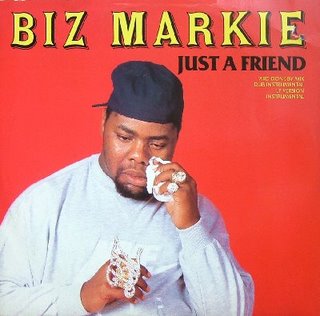
August 18: Biz Markie, "Just A Friend"

Artist: Biz Markie
Song: "Just A Friend"
Album: The Biz Never Sleeps
Year: 1989


CLICK HERE TO LISTEN (will open in new tab)


There are certain moments throughout the history of music that simply cannot be forgotten, and even as the generations and musical trends come and go, these few songs remain relevant and present within the mainstream music scene.  This rather unique group of songs come from all across the musical spectrum as well as that of time, and it is almost impossible to "know" that a song will achieve such success upon its first release.  Furthermore, when such a song seems to defy so many musical norms, the idea of it becoming such an iconic moment may be even more difficult to foresee.  However, if there was one performer in music history that seemed destined for success in one way or another, it was the man who has earned the title of "Clown Prince of Hip-Hop," the one and only Biz Markie.  Though his persona and image are impossible to forget, one cannot overlook the fact that at his core, Biz Markie stands as one of the most creative and outright talented emcees in history, and one can easily make the case that had it not been for his efforts, hip-hop itself would have never achieved the mainstream success that it enjoys to this day.  Having already made his name as both a beat-boxer and an emcee, as well as releasing a fantastic debut album, Biz Markie completely shifted his approach, and it was due to this change that he created what is without question one of the most enduring and endearing songs in all of music history, 1989's, "Just A Friend."

On many levels, the opening moments of "Just A Friend" are as legendary as any musical work from the 1980's, as the almost toy-toned piano springs out, instantly grabbing the listeners' attention.  Though it is slightly altered in terms of speed and rhythm, the iconic core riff upon which the song is built is lifted in its entirely from Freddie Scott's 1968 song, "You Got What I Need," and yet the way that Biz Markie re-works the sound gives it a wonderfully modern feel.  Furthermore, the heavier bass beat that he lays underneath the song make it hit hard time after time, and it is easy to understand how this sound became one of the true standards of the "golden age" of hip-hop music.  Yet even within this sampling, Biz Markie separates himself quite far from his peers, as there is a clear understanding of music itself that goes far beyond scratching and altering the sample itself.  There are a number of "open" spaces throughout "Just A Friend" that suggest a knowledge of blues music, and this leaning is further enforced by the lyrical content.  When Biz Markie lets the drums drop, there is a rather tongue-in-cheek, soulful feel to the song, and though one cannot overlook the humorous nature of the song itself, it is often this lighter mood that makes listeners miss the fact that the composition itself is exceptionally deployed, moving far beyond the "standard" approach within the musical arrangements on hip-hop songs.

Yet while the re-worked riff is without question one of the most unforgettable to ever be recorded, one cannot deny that the true impact and timeless appeal of "Just A Friend" lives within the extraordinary vocals and lyrics that Biz Markie brings to the track.  There has rarely been as perfect a balance between character and content as one can experience all across the song, and yet much like the tone of the music, the light-hearted, almost vulnerable nature of the vocal delivery tends to overshadow the fantastic lyrics that he brings to every line.  Truth be told, during this era of hip-hop music, the idea of a sensitive or "down and out" male is almost impossible to imagine, as the genre was filled with overly-machismo'd rappers largely reminding the world just how amazing they themselves were.  However, as Biz Markie unravels his tale of the girl who had his heart lying to him about her relationship with other men, there is something far more powerful than what his peers could deliver.  It is the honest, unguarded, and absolutely brutal words he spins that enabled "Just A Friend" to rise so far above other hip-hop singles, and there are few lines from the song that are anything less than "classic."  Though for many, the highlight of the song is the chorus, every line Biz Markie delivers is nothing short of perfect, and there are few tracks in history that can boast as potent a perfection in rhyming as one can experience on "Just A Friend."

Even as the decades have passed, the significance and appeal of "Just A Friend" has managed to remain just as strong, constantly reminding emcees that there is just as much success to be had within a lighter delivery style and completely honest lyrics.  Furthermore, it is almost impossible to cite all of the times that "Just A Friend" has been sampled in some form, and this tribute runs all across the musical spectrum.  Whether it was Pharrell Williams from The Neptunes or 50 Cent quoting the song or complete covers by the likes of Umphrey's McGee among many others, "Just A Friend" has achieved a status that one can argue is completely unmatched by any other song in the entire history of recorded music.  Furthermore, one can hear the song played at nearly any large gathering, and it has even been used as "entrance music" by a number of professional athletes, as well as being featured in countless films and television shows.  The fact that the song has managed to ingrain itself into so many different aspects of society pushes it into a category all its own, and yet many do not give the track all the credit it deserves due to the jovial nature of the vocal performance.  Yet after listening to the song with "fresh ears," one cannot deny the sheer perfection that is at play in every aspect of the song, and it is this reality that makes Biz Markie's 1989 single, "Just A Friend," one of the most truly extraordinary moments in all of music history.

Wednesday, August 17, 2011

August 17: The Hollies, "I Can't Let Go"

Artist: The Hollies
Song: “I Can’t Let Go”
Album: I Can’t Let Go (single)
Year: 1966


CLICK HERE TO LISTEN (will open in new tab)


Though the scene was heavily dominated by a handful of bands, the fact of the matter is, the mid-1960’s remains one of the most exciting and progressive periods in all of music history.  As the new face of rock and roll was developing, it was the bands that fused together different sounds who made some of the finest recordings of the era, and it is also these bands that continue to shape and influence the modern music scene.  While there were certainly a number of U.S. groups and performers that remain icons of the era, it was the rock-style bands from the U.K. that were pushing the envelope further for a time, and few groups blended sounds as beautifully as one finds within the music of The Hollies.  Like most bands at the time, the group began by performing a range of r&b and rockabilly covers, but they quickly developed a distinctive sound, and soon started to release a seemingly endless string of hit songs.  The way in which The Hollies fused together the psychedelic landscape, yet kept a foot firmly rooted in folk, is what separated them from a majority of their peers, and this blend would be further explored by the later musical projects of some of the band members.  Deploying stunning harmonies over ringing guitars and some of the catchiest, and most uplifting musical and lyrical hooks in history, there are few songs that can compare to the musical mastery found on The Hollies’ classic 1966 single, “I Can’t Let Go.”

As “I Can’t Let Go” begins, it presents an edge and aggression that are rather similar to the tone found within modern hard rock songs, and this can surely throw the listener for a bit of a curve, though the group quickly moves away from this sound.  While the energy of the guitars of Tony Hicks and Graham Nash retain their presence throughout the song, they shift to a far more stereotypical progression and swing.  Both guitars stay in the upper octaves, making them impossible to mistake for any other group, and it is the way that they create such a fantastic sonic contrast with the bass from Eric Haydock that pushes the song to even greater heights.  Truth be told, “I Can’t Let Go” would be Haydock’s final studio recording with the band, and yet he could not have left on a better note, as his performance is what gives the song its vertical depth.  This incarnation of The Hollies were rounded out by drummer Bobby Elliot, and his cadence keeps “I Can’t Let Go” bounding forward with a tension and energy that is completely unique.  It is the way in which the entire band leaves open spaces at certain points that lends a certain sense of drama to “I Can’t Let Go,” and one can easily picture the song setting off house parties all across the world.  The distinctively “free” feeling that one gets from the musicians is in many ways the key to the appeal of “I Can’t Let Go,” and it remains one of the few songs that can never be forgotten once heard.

Perhaps moreso than their superb musical arrangements, it is the vocal stylings of The Hollies that remain their most distinctive element.  This becomes less surprising when one takes into account the entire career of Graham Nash, and yet it was often Allen Clarke handling the lead vocal duties within the group.  The way in which their voices blend all throughout “I Can’t Let Go” is absolutely spectacular, and in many ways, they achieve the harmonies that most other groups attempted, yet could not achieve.  In terms of both the octaves, as well as the spirit behind the singing, one cannot deny the proximity in sound to some of the finest harmonies in history, and yet it is the fact that the song is still clearly “rock” that sets them so far apart from their peers.  Along with their fantastic vocal work, the lyrics that they sing are as universal and straightforward as one will find anywhere, and it is this simplistic approach that surely made the song even more popular.  There does seem to be a bit of a questionable situation occurring within the lyrics, as one must wonder exactly what the moral purity of the woman in question may be, but the love expressed by the protagonist is clear.  When Clarke sings, “…though I'm just one of your lovers, and I know there are so many others, you do something strange to me…,” one can see just how far from most other lyrics of the era the song was, and yet it is likely that the “true” meaning of the song went rather unnoticed, allowing it far greater airplay.

As the decades have passed, “I Can’t Let Go” has been re-recorded on a number of occasions, including a rather successful version by Linda Ronstadt in 1980.  However, the key element that came from the song was surely the way that The Hollies were able to perfectly balance the musical and vocal beauty of folk with the rising edge of the new sound of rock and roll.  While there were certainly a number of bands exploring this same approach at the time, the method and sound found on “I Can’t Let Go” is unquestionably unique, and it remains perhaps the finest moment in the entire recorded catalog of the group.  It is difficult to pick out a single aspect of “I Can’t Let Go” that stands apart from the rest, but one can hear the impact of Tony Hicks’ magnificent twelve-string performance here all across guitarists that followed, as he seems to simultaneously channel the early sound of The Beatles and the tone of The Byrds.  Yet the vocal harmonies are just as astounding, and the building blocks for the later groups of Graham Nash are clearly on display throughout this song.  The way that Nash, Clarke, and Hicks all combine their voices to create brilliant poly-rhythms, and there has rarely been a performance of equal merit from any point in history.  Combining these two crucial elements with the upbeat mood and swinging rhythm section, and there is simply no denying the musical mastery found on The Hollies’ unforgettable 1966 single, “I Can’t Let Go.”

Tuesday, August 16, 2011

August 16: Medeski, Martin & Wood, "Sugar Craft"

Artist: Medeski, Martin and Wood
Song: "Sugar Craft"
Album: Combustication
Year: 1998


CLICK HERE TO LISTEN (will open in new tab)


While it is certainly not in the spotlight that it was half a century ago, the current world of jazz music remains just as exciting and inventive as ever, yielding some of the most intriguing and creative approaches to the genre that the style has ever heard.  Though some modern jazz musicians have done an amazing job of proving that the "classic" sounds can still be just as powerful today, it is the groups that push the boundaries on the genre that have given the world some of the most exciting and unique music of the past few decades.  Mixing together nearly every genre one can think of, there is simply no other group on the planet that makes music quite like the avant-jazz of Medeski, Martin and Wood.  For more than two decades, the group has been pushing deeper into what is possible within a jazz setting, and there is no question that it is their collective efforts that are one of the main factors in the progression of modern music.  Taking everything from electronica and hip-hop to blues and psychedelic and mixing it all into their distinctive jazz format, there are truly no limits to the appeal of Medeski, Martin and Wood.  Having honed their sound in the New York City underground throughout the early 1990's, it was during the latter half of that decade when the trio finally realized their full musical potential within a studio environmental, and there are few works from any genre within modern music that can boast the sheer brilliance found on Medeski, Martin and Wood's 1998 track, "Sugar Craft."

Serving as the opening track to the trio's amazing Combustication album, they leave little to question as to the extent of their ambition, as the odd sound effect is quickly followed by turntable scratching and a lightning fast, sampled keyboard loop.  This comes courtesy of DJ Logic, who joins the group for a handful of songs across the record, and his presence alone instantly places the band into a category all their own.  Throughout "Sugar Craft," it is the unique sounds and moods from DJ Logic that make the song so unique, and it manages to perfectly straddle the line between a number of genres.  One cannot completely place the song in jazz or hip-hop or electronic, as each are represented equally on the song, proving the groups' unparalleled focus and talents.  It is also the way in which the DJ techniques blend perfectly with the keyboards from John Medeski that become so captivating.  The slinky, descending progression that serves as the central theme to "Sugar Craft" is absolutely fantastic, and yet there is a simplicity to it that makes it even more accessible outside of "jazz circles."  Medeski switches seamlessly from lead to the background, and wherever he is playing within the configuration of the group, he never looses the groove, and the solo he takes is without question one of the finest of his entire career.

However, along with this superb performance, Medeski, Martin and Wood have the benefit of one of the finest rhythm sections in all of music history.  Bassist Chris Wood is easily one of the most talented and creative of his entire generation, and the sway and slide he is able to give "Sugar Craft" quickly becomes one of the most hypnotizing elements of the entire song.  There are also moments within his performance that take on a slightly darker, almost intimidating tone, and it is within these parts of the song where it gains an exceptional amount of depth.  The various fills and progressions that Wood deploys throughout "Sugar Craft" also serve as a clear second rhythm, as he often seems to be "dueling" with drummer Billy Martin.  Yet Martin himself is in rare form, as he seems to fly all over his drum kit, pushing each member of the band in different directions.  Though for the most part his playing sounds rather reserved, it is the manner with which he plays off the other three musicians that is so fantastic.  Whether he is coming in on an "off beat" or creating a truly amazing level of tension through his playing, there are few better examples of the "less is more" principle within drumming.  Furthermore, the complexity that arises from these two players, along with DJ Logic all working different tempos is perhaps the key that makes "Sugar Craft" such a uniquely extraordinary musical experience.

Though many try and "write off" the world of modern jazz as a "watered down" version of the classic sounds, once one gets past the surface of the genre, some of the most creative and original music of the past twenty years lives within the style.  In reality, few groups have constantly pushed the envelope on what could be achieved through music as much as Medeski, Martin and Wood, and whether they are experimenting with equally impressive guitarists or infusing the sounds and styles of a DJ into their compositions, one can easily argue the trio as one of the most important forces of the past two decades of music.  On Combustication, the group completely rewrote everything that was thought to be possible within music, as they perfectly fused together the modern sounds of hip-hop and electronic music with the classic jazz formula.  This is in many ways the most true approach there has ever been to the spirit of jazz, as the foundations of the genre were in the idea of finding complete musical freedom and refusing to conform to the norms and trends previously set.  Furthermore, the fact that Medeski, Martin and Wood achieve this feat with the stunning, sonically pleasing nature that they do is a testament to the exceptional level of talent that the trio have as both musicians as well as "students" of music itself.  Reigniting the flame of jazz music, and turning an entirely new generation on to its full possibilities, there are few moments in music history as pivotal as Medeski, Martin, and Wood's 1998 composition, "Sugar Craft."