Monday, February 7, 2011

February 7: Daily Guru, "Gurucast #58"

CLICK HERE TO LISTEN (will open in new tab)


(Left Click (PC) or Command-Click (Mac) to save it to your desktop...it's about 75MB)

One hour of amazing music and commentary from "The Guru" himself.

Tracklist (all links are to my review of that artist, song, or album) :
1. Country Joe & The Fish, "I Feel Like I'm Fixin' To Die Rag"  Woodstock
2. Mamdouh El Gbaly, "Bint Al-Balad"  The Music Of Islam, Volume 1
3. Babes In Toyland, "He's My Thing"  Spaking Machine
4. Bobby Darin, "Dream Lover"  The Ultimate Bobby Darin
5. The Clash, "Tommy Gun"  Live At Shea Stadium (October 1982)
6. Mr. Jotz, "Chunky Monkey"  Animals
7. Eddie Hazel, "Physical Love"  Game, Dames, And Guitar Thangs
8. The Pretenders, "Middle Of The Road"  Learning To Crawl
9. John Scofield, "Jeep On 35"  A Go Go
10. Ice Cube, "When Will They Shoot?"  The Predator
11. Throwing Muses, "Hate My Way"  Throwing Muses
12. Tony Allen, "Get Together"  Black Voices
13. Jennifer Trynin, "Better Than Nothing"  CMJ, July 1995
14. Nirvana, "Tourette's"  In Utero

Sunday, February 6, 2011

February 6: Eric Dolphy, "Hat And Beard"

Artist: Eric Dolphy
Song: "Hat And Beard"
Album: Out To Lunch
Year: 1964


CLICK HERE TO LISTEN (will open in new tab)


Though it may seem a cliché thought, the reality is that the finest artists in history truly do many the most of the time they have to perform.  While many artists waste decades on making sub-par music, there are an elite handful of musicians who have made some of the largest impact in music history over just a few short years.  The list of jazz players who had their time come far too early is almost disturbingly long, and there are few musicians on such a list that have had as massive and long-lasting a mark on the world of jazz than the late, great Eric Dolphy.  In just over four years, Dolphy completely rewrote what was possible through the jazz style, and he remains one of the most talented and diverse musicians in history, playing a number of different instruments over his brief career.  When one looks at the amount of music that Dolphy recorded in this short time, it is almost unfathomable that a single human could have that much creative genius inside, and it is impossible to list all of the musicians who his innovations impacted.  Though many place his music into the "avant guarde" style of jazz, when one looks at the structure of his recordings, he never abandons chordal improvisation as many other avant artists did, and it is this factor that sets his playing far apart from his peers.  While there is not a "bad" moment anywhere to be found in his recorded catalog, few songs are more moving and definitive of Eric Dolphy than his classic 1964 composition, "Hat And Beard."

Serving as the first track on his final studio session, which was also his first for Blue Note Records, the brilliant Out To Lunch record.   From the moment the song begins, the greatness that Dolphy possesses is clear, but it is also quickly obvious that he has managed to surround himself with musicians that are certainly up to par musically.  In fact, the grouping for this album stands as one of the most impressive musical lineups to ever formally record together.  Standing out from the pack is the equally legendary Bobby Hutcherson on vibraphone, and his performance here is without question one of his finest moments.  The way in which he almost duets with Dolphy throughout the song is absolute jazz perfection, and his fills and solos are equally fantastic.  Working slightly behind Hutcherson is bassist Richard Davis, and it is his playing that gives "Hat And Beard" a unique bounce, as well as an ebb and flow that is rarely heard elsewhere in jazz.  Tony Williams is on drums for the track, and in both the shifts he creates, as well as the creative way in which he works the cymbals into the arrangement stands today as one of the finest pieces of drumming ever recorded.  The backing band is rounded out by trumpet icon Freddie Hubbard, and the bright, yet reflective tone that he produces sits perfectly alongside Dolphy's sound.  Though there is no question that by their names alone, this entire album would be hard pressed to not reach iconic status, each of these jazz giants understands their own place, and the combined effort is far greater than the sum of the parts in question.

While his backing band cannot go without notice, it is "Hat And Beard" that shows Eric Dolphy at his finest, and there are few performances from any genre that can even remotely measure up to the playing found here.  Expressive and creative in a way unlike any other jazz master, Dolphy shows here how he clearly understands musical arrangements in a completely different level.  Bringing an almost vocal-like quality to his solos, even for those not well versed in jazz, one cannot help but be awed by the sheer beauty of his playing.  The way in which Dolphy leads the band with his sharp, often jarring movements can be seen as the culmination of all of his previous musical exploration.  Having gone as "far out" as one can imagine on previous work, it is here where one can experience his adventurous style fused together with a clear form, thus setting him apart from being simply "avant" or "free" in terms of jazz style.  Within Dolphy's performance on "Hat And Beard," one can easily hear the influence of the hard-bop sound as well as the more experimental side of jazz, and rarely has it come together so perfectly, as the pulls the band along with him, taking some of the most daring musical paths ever captured on tape.  The way in which he fearlessly blazes deep into the most delicate nuances of the song gives a perfect picture as to why Dolphy is held in such high regard, and "Hat And Beard" remains one of the most compelling compositions in music history.

Truth be told, "Hat And Beard" is actually a work of tribute, as Dolphy composed it in honor of the great Thelonious Monk.  Strangely enough, for a song dedicated to that jazz giant, "Hat And Beard" is a piano-less composition, but it is nonetheless a moving salute.  As the decades have passed, the song has remained a high-water mark for jazz, and though a handful of cover versions have been made, none come even remotely close to the overall power of the original.  Tragically, Dolphy himself passed away nearly four months to the day of the release of Out To Lunch, so he was never able to fully recieve the accolades for the brilliance within what became his final work.  Yet looking at his entire catalog, one cannot help but be amazed by the sheer volume of seminal jazz pieces that he recorded in such a short period of time.  It is this fact that puts the decades-long progress of other musicians into perspective, and few musicians carry as much of a "what could have been" sentiment as one can attribute to Eric Dolphy.  Furthermore, if one takes a wide look at the progression of jazz, one can mark the passing of Dolphy as the end of the largest period of exploratory jazz, and it is somehow fitting that it would be this record which would stand as one of the finest pieces of such work.  Surrounded by some of the most legendary musicians in all of jazz history, Eric Dolphy can be heard at his artistic apex on his absolutely phenomenal 1964 recording, "Hat And Beard."

Saturday, February 5, 2011

February 5: Noisettes, "Don't Give Up"

Artist: Noisettes
Song; "Don't Give Up"
Album: What's The Time Mr. Wolf?
Year: 2007


CLICK HERE TO LISTEN (will open in new tab)


In an era of music that has become increasingly predictable and artificial, fans of "real music" must cling tightly to those few bands that insist on ignoring trends and staying true to themselves.  However, in many cases, once one of these bands gets exposure, they sadly cave to the will of labels and producers, compromising their sound and losing many of the fans that got them to that place.  Unfortunately, this was the case with UK rockers, Noisettes, but thankfully, their 2007 debut will always be available to remember one of the finest bands of the decade.  Combining a raw, stripped down, almost garage-rock sound with some of the most intense rhythms and breathtaking vocals in recent history, it is no surprise that the group quickly gained a large following across the globe.  Their 2007 debut, What's The Time Mr. Wolf? remains one of the most potent recordings of the decade, as there is not a moment of filler anywhere on the record.  Showing their entire musical range, the group proved that even on slower, more reflective songs, they were capable of executing a mood and energy and instantly captured the listener, and this is why the record remains such a fantastic document.  Yet this also makes it difficult to single out one song as their finest, but one can easily argue that everything that makes Noisettes so superb can be summed up on the albums' lead track, 2007's, "Don't Give Up."

The opening guitar scratch from Dan Smith instantly sets the tone not only for the song, but the entire album, as the quick, distorted sound may seem insignificant, but in the overall work of the song, it is perhaps the most important part.  Smith is able to build a fantastic amount of tension in this opening musical phrase, and as it builds, one can feel the "Don't Give Up" beginning to teeter on the edge of chaos.  The other two-thirds of the band quickly drop in, with bassist Shingai Shoniwa bringing a winding, almost intimidating sound to the song, and drummer Jamie Morrison adding an ideal musical sting.  Throughout the song, Shoniwa manages to keep a hard groove in place, and while it is not quite funk, it enables "Don't Give Up" to swing and sway in a manner rarely found in songs with such an energy level.  It is perhaps the level of energy on "Don't Give Up" that makes it stand out so much in comparison to the other music of the time, and yet it is also due to the way in which the group stays so tight, whilst bordering the musical chaos that makes it so exciting.  Furthermore, there is a clear aggression within their playing, and yet Noisettes somehow manage to keep a unique appeal witihn the song that is rarely found in any song with such a personality.  It is this distinctive blend of sound and energy that defines Noisettes, and it only takes a few moments of hearing a song like "Don't Give Up" to understand why they stand as one of the finest bands of the late 2000's.

Along with her work on bass, Shingai Shoniwa possesses what is without question one of the most powerfully unique voices in all of music history.  Showing a range and spirit that both seem completely without limit, her voice and delivery is a reminder of the pure joy that can (and should) come from any and all musical performance.  One can easily feel her presence on nearly every song, but the nearly off-kilter sound she brings to "Don't Give Up" helps to show off all her talents, and it pushes the song to even greater heights.  Along with her diverse approach in terms of her energy, Shoniwa also uses her vast vocal range to enhance the various moods on the song.  Whether it is the softer, deeper, almost growled and strangely alluring vocals on the verses or the unrestrained shouting on the bridge sections, Shoniwa leaves no question as to her lack of limits, and her overall performance is truly stunning.  This sense of musical freedom is perfectly echoed by the lyrics, which have a similar theme throughout the song.  Speaking of persistence on both a small and large scale, the song also speaks directly to the idea of grabbing opportunities such as when she sings, "...she's got a talented face and a suitcase, ain't got no desire to go no place..."  It is lyrics like this that finish off the overall sense of urgency on the song, and the almost breathless way in which Shoniwa delivers the lyrics makes "Don't Give Up" know very few, if any, musical peers.

Capturing everything that makes "real" rock music so fantastic, Noisettes managed to perfectly fuse together punk, hardcore, and the "garage rock" sound throughout their sensational 2007 debut record, What's The Time Mr. Wolf?  The album overflows with energy and amazingly original and captivating musical arrangements, and few albums in recent history "rock" as hard and in as straightforward and honest a manner as one finds here.  The fact that there are songs on the record that have an almost jazz-like feel to them further shows just how talented Noisettes were, and their unique ability to blend together genres that seemingly have no relation.  Capped off by the unmistakably brilliant vocals of Shoniwa, and there is simply no other band in history that can boast a similar sound, and it is this uniqueness that helps the album sound fresh and exciting even after repeated listenings.  Due to their diverse and original sounds, the entire record is a magnificent display of talent and a reminder that "real" music is still alive and can still easily outshine the over-produced, corporate garbage that continues to dominate the musical landscape.  Sadly, the follow-up record from Noisettes would take a sharp turn and much of the edge and energy that defined their debut record was nowhere to be seen.  However, even with this reality, there is simply no denying the magnificent musical and vocal performance found on Noisettes' phenomenal 2007 single, "Don't Give Up."

Friday, February 4, 2011

February 4: Beasts Of Bourbon, "Hard Work Drivin' Man"

Artist: Beasts Of Bourbon
Song: "Hard Work Drivin' Man"
Album: Sour Mash
Year: 1988


CLICK HERE TO LISTEN (will open in new tab)


While in many cases, a band comes together and runs a full course, there are other situations where outside factors prevent such from occurring.  In these situations, unless the timing is perfect, some of the greatest possible often never come into existence; but every once in awhile, the timing works perfectly.  Though they had been experimenting with different lineups and sounds for nearly a decade, in the late 1980's, due to the break-up of The Scientists and The Johnny's both closing out their careers, if provided a perfect moment for what would become the definitive record from the Australian super-group known as Beasts Of Bourbon.  It is perhaps due to the fact that the band began as a side project, playing "bar style" rock, that the music is far more loose, yet aggressive than work of their other bands, and one can feel the enjoyment that each member is having throughout their stunning 1988 release, Sour Mash.  Blending together blues, country, punk, and outright experimental sounds, Sour Mash truly knows no peers, and one can trace both its roots and influence across the entire Australian music landscape.  Though each song on the record has it's own distinctive feel, there is no question that all the power and sleaze that defines Beasts Of Bourbon is on full display in their 1988 song, "Hard Work Drivin' Man."

The moment that "Hard Work Drivin' Man" begins, the entire intent and personality of the song and band are instantly clear, as there is a hard, dark groove and sway immediately set into place.  The tone from drummer James Baker is almost unsettling, and one can hear a close sonic kinship to the almost chaotic sounds of fellow Australians, The Birthday Party.  The way in which bassist Boris Sujdovic emphasizes this looming, intimidating mood completely captivates the listener, and there is an aggression and power within this rhythm section that has rarely been matched elsewhere in recorded history.  The blues-based swing that the duo put forth absolutely reeks of a smoky, dirty bar in "the bad part of town," and yet it is this very tone that makes "Hard Work Drivin' Man" such a fantastic song.  The addition of the dual guitars of Spencer Jones and the great Kim Salmon only add to this already phenomenal mood, and they also present a fantastic sonic contrast.  As the song progresses, the guitars begin to ring out, adding more to the bluesy undertones, as they cross in and out of a slide-guitar sound, seeming to shoot through the rhythm at random angles.  The combined sound also leans heavily on the post-punk sound, and this is where much of the dark mood comes into play, and the overall raw, unrestrained feel is what sets "Hard Work Drivin' Man" so far apart from everything else being created musically at the time.

Though there are have been many great pairings of vocalists with bands, few present as perfect a match in sound and style as the combination of this musical lineup of Beasts Of Bourbon and legendary vocalist, Tex Perkins.  Bringing a rough, gritty growl that is far beyond that of others who attempt such a sound, Perkins' voice adds even more to the overall mood, as there is simply no other vocal sound that would have sounded proper on "Hard Work Drivin' Man."  Furthermore, his raw, gruff sound lends even more of an "everyman" quality to the music, and it is very much his voice that helped make "Hard Work Drivin' Man" and underground classic.  It is also the fact that the lyrics which Perkins sings are equally appealing to the "working man" which push the song to such a status, and few bands have ever been as unrelenting and honest about the frustrations of "getting through the nine to five" as one finds here.  The sound and swagger with which Perkins sings the lines, "...boss man needs a kick in the pants, I'm gonna give it to him..." quickly brings a grin to the face of nearly everyone, as this is one of the most universal sentiments one can imagine.  As Perkins sings other thoughts of the difficult of getting through the day, only to be left exhausted in the evening, it is clear that there is a proximity to the words, and this reality, combined with the unapologetic lyrics are the key to making "Hard Work Drivin' Man" such a special moment in music history.

Though the band ha gone through a number of lineup changes and hiatuses over the decades, it is difficult to argue that Beasts Of Bourbon sounded any better than one finds them on their 1988 release, Sour Mash.  Clearly hitting their artistic stride as a group, much of the overall greatness of the band is due to the fact that even though many of the members had already made a name for themselves with other projects, there are no egos at play here.  The result of this collectively unselfish approach is one of the most powerful and dirty rock records ever recorded, though it also remains one of the most overlooked outside of Australia.  Yet if one compares Sour Mash to music from any other place on the planet from that time, it easily buries nearly everything else being recorded.  The sheer sonic force of which Beasts Of Bourbon are capable is at its high-point on "Hard Work Drivin' Man," and it is also this song that largely defines their overall mission as a group.  The rhythm section is nothing short of intimidating, and yet there is a dark, bluesy edge to the music that makes it brilliantly unique.  The addition of the dual guitar sound only makes "Hard Work Drivin' Man" more musically robust, and one can picture the song being played in a run-down bar as easily as on an arena stage.  Quite simply, Beasts Of Bourbon manage to pull off sleazy hard rock in a way that no other band has achieved, and one can experience this unique musical greatness within their 1988 song, "Hard Work Drivin' Man>"

Thursday, February 3, 2011

February 3: Megadeth, "Peace Sells"

Artist: Megadeth
Song: "Peace Sells"
Album: Peace Sells...But Who's Buying?
Year: 1986


CLICK HERE TO LISTEN (will open in new tab)


Whenever a band pushes to any extreme point across the musical spectrum, the chances of success are at their smallest, as history has shown that taking such a musical approach is almost always forced to compromise in some way.  This can be seen in the most mellow and melodic styles, as far too often, there is some element of the music that gets in the way of its own perfection.  Such instances are just as common in the most aggressive music one can find, yet in either case, when a band is able to overcome this trend, they are almost instantly vaulted to legendary status.  This is exactly the case that one finds within the music of thrash-metal icons, Megadeth.  Formed in the wake of Dave Mustaine's brief stint with Metallica, the group quickly distanced themselves from the rest of the heavy metal scene, and to this day, few groups have even come close to the energy and sound they produce.  Making a conscious effort to be a bit darker, a bit faster, and taking plenty of time to show off their superb talents via instrumental passages on nearly every song, Megadeth formed the blueprint for thrash-metal, and nearly thirty years after their first records, they sound just as fresh and fierce.  Boasting a massive catalog of heavy metal classics, there are few songs from any point in music history that can compare to the power, mood, and impact found on Megadeth's 1986 anthem, "Peace Sells."

As "Peace Sells" begins, it sounds about as far from heavy metal as one could imagine, with the bassline from Dave Ellefson standing in retrospect as the first clear link between funk and metal.  The fact that Megadeth is able to fuse these two styles together is one of the clearest examples as to why their music is "more" than metal, and countless bands have copied this hybrid over the decades.  Yet even with this groove being set into place from the onset, it is the drumming underneath by Gar Samuelson that injects the nervous energy into the song.  It is this strict, quick pace that gives "Peace Sells" much of its mood, and as the song progresses, the power displayed by Samuelson grows with every minute.  While the rhythm section here is certainly in top form, there is simply no way to discuss the sound of Megadeth without mentioning the core of their sound: the guitar tandem of Dave Mustaine and Chris Poland.  Whether they are pounding out the songs' rhythm or playing brilliant, speedy fills and solos, in many ways, this is as good as heavy metal gets.  The energy and emotion that one can feel within their playing is captivating from beginning to end, and one can hear influences form bands ranging from The Stooges to Black Sabbath within their sound.  Furthermore, there is a simplistic genius in the combined sound of the band on "Peace Sells" that is nothing short of heavy metal bliss.

Along with the brilliant musical arrangement on "Peace Sells," the song is made better by the somehow perfect vocals from Dave Mustaine.  Though his vocal range is rather limited, they are able easily convey all of the necessary emotion and power, and it is perhaps this limit in range that makes the songs of Megadeth so anthemic in nature.  This is especially evident during the closing section of "Peace Sells," as the entire band joins in on the chorus, and it is this part of the song that has made the song a regular part of the bands' set, and why it remains one of the most treasured songs in their entire catalog.  Yet one can also see the lyrics on "Peace Sells" as the definition of the early years of Megadeth, as they bring a straightforward, critical attack that can be interpreted in a number of different ways.  Though the band has denied it at times over the decades, the most popular interpretation of the song is that it is an attack on the stereotype that all "metalheads" are lazy, anti-everything idiots.  On many levels, this is clearly untrue, and one can even hear the lightning fast guitar solos as a statement to refute this generalization.  Obviously, one can also take the songs' lyrics on a far larger scale, giving it a global social context, and regardless of which way one reads the song, the impact and oddly inspiring vocals from Mustaine help to propel this song to the level of absolute thrash classic.

Strangely enough, though the station rarely made any "real" time for heavy metal over the years, the opening bassline of "Peace Sells" was used for years as the closing music for EmpTV News.  This fact makes it clear that though they preferred to play less aggressive music for their viewers, at least one person in the stations' programming department had a far wider range in musical taste.  The song has also appeared in a number of video games and TV shows over the years, and this is the final piece of evidence that one needs to argue just how important a song "Peace Sells" has been in the development of modern music.  Though there were many metal bands at the time, Megadeth sounded very little like their peers, as in both their town and musical arrangement, they were completely unique.  Throughout all of Peace Sells...But Who's Buying?, the band is in top form, and though they have released a large number of records over the years with many changes in lineup, one can still argue that it is this record that best defines the band and their sound.  Whether it is the unique groove put forth by the rhythm section or the fast-paced, crushing guitars, there is a dark, almost apocalyptic feel to their music, and it is this mood that makes the album stand out among the other metal bands of the era.  The aggressive, grity overall feel is both perfect and unique, and there is no denying the lasting impact that one can hear within Megadeth's 1986 thrash-metal classic, "Peace Sells."

Wednesday, February 2, 2011

February 2: Belly, "Feed The Tree"

Artist: Belly
Song: "Feed The Tree"
Album: Star
Year: 1993


CLICK HERE TO LISTEN (will open in new tab)


Though many musicians would be more than satisfied with a single iconic band, there are a select few who are so talented, that it seems regardless of the group around them, musical greatness simply happens.  It is these elite performers that have helped to shape music over the decades, and it is truly impossible to picture the musical landscape without their presence.  Whether it was her groundbreaking work as part of Throwing Muses, her brief stint with The Breeders, or her later solo work, one cannot deny that Tanya Donelly belongs within such a list, and she rarely sounded as free and creative as her work within her short-lived project, Belly.  Unquestionably one of the most unforgettable bands to come out of the fertile "alternative rock" scene of the early 1990's, the band in many ways encapsulated the free spirited, "dark happiness" that is present across nearly all the music of the time, and it is due to their honest, beautiful sound that Belly were able to rise above their peers.  Blending together soft, soaring moods with an aggression and power that somehow worked perfectly together, the bands' 1993 debut, Star, remains one of the artistic high-points of the entire decade, and the album displays Donelly hitting her artistic stride.  Though every song on Star is nothing short of fantastic, in both content, as well as the way in which it changed the course of music history, there are few songs of the decade that can compare to Belly's magnificent 1993 single, "Feed The Tree."

As the song begins, it is easy to hear all the sides of Donelly's past, as the descending guitar riff has a tone and attitude that reflects her time in Throwing Muses, yet the song quickly shifts to a more sparse, light sound as the verse begins.  The way in which these two sounds play so perfectly with one another is largely due to the fantastic production work of Gil Nortion, whose previous work with bands like The Pixies as well as Throwing Muses made him a perfect fit for this project.  The tension created during the verses by the bass of Fred Abong and drummer Chris Gorman is absolutely fantastic, and it is this soft, almost nervous feeling that gives "Feed The Tree" much of its personality.  Adding in guitars from Donelly and Tom Gorman, and the overall sound of the group becomes an amazing clashing of sounds and moods.  Whether it is the way in which the bass seems to dance across the song or the brilliant fills from the guitars, it is very much the nuances of this song that make it so unforgettable.  The stark shift that "Feed The Tree" takes from the verses to the bridge and chorus sections adds to the overall impact of the song, and it is in this fact that one can clearly see just how much Donelly as grown as a writer.  Furthermore, there is a fantastic sense of movement on the song, and even during the slower sections, it is difficult to not get completely caught up in the mood that the band brings.

However, along with crafting the song so perfectly, one can also see "Feed The Tree" as the ultimate display of Tanya Donelly's superb voice and uncanny talent as a lyricist.  Having displayed in her previous projects an ability to work all over the vocal scale, "Feed The Tree" highlights her diverse sound, as the soft, low, reflective verse present a fantastic contrast to her soaring, powerful delivery during the bridge and chorus.  It is this shifting of styles that makes "Feed The Tree" all the more intriguing, and also provides for a great sense of drama on the song.  There is also a sense of raw, unrestrained emotion throughout "Feed The Tree," and it is moments like this that defined the new movement of music, pushing away from the over-produced, detached feel that represented much of the music of the 1980's.  Along with this straightforward, honest sound, the lyrics that Donelly sings stand as some of her finest work, and they were far deeper and more beautiful than nearly any other band at the time.  Though they can be interpreted in a number of different ways, Donelly claims that the song was about respect and commitment, using the tree as a place under which a family is buried over the generations.  With this knowledge in hand, the chorus of, "...take your hat off boy when you're talking to me, and be there when I feed the tree..." makes a great deal of sense, and it is this simple, yet powerful phrasing, combined with Donelly's amazing voice that make "Feed The Tree" such an unforgettable song.

There is perhaps no better gauge for the overall importance of "Feed The Tree" than when one inspects its performance and impact.  It is also in these elements where one can see the true difference between Belly and the previous projects of Donelly.  Though her previous groups were certainly influential in their own right, within Belly, Donelly was able to hit her stride and properly execute her amazing melodies that had their own unique pop sensibility.  Songs like "Feed The Tree" share very little with the music that was being created previously within the pop scene, yet the song reached the top spot on the "Modern Rock" charts, and remains one of the most definitive songs of the decade.  The fact that a song with such a non-traditional arrangement and dark mood was able to achieve this success is a testament to the sonic beauty and brilliance that one can find within, and there are a number of bands that attempted the same formula in the wake of Belly's success.  Whether it was the sharp, yet stark drumming, the uniquely distorted bass and guitars, or the shifts in tempo, there has never been another song quite like "Feed The Tree," and the way in which Donelly's voice soars across the chorus remains breathtaking even almost twenty years later.  Though every song on Star is outstanding, one can make the case that all of the talents of Belly came together perfectly in the form of their pivotal 1993 single, "Feed The Tree."

Tuesday, February 1, 2011

February 1: Elmore James, "Dust My Broom"

Artist: Elmore James
Song: "Dust My Broom"
Album: Dust My Broom (single)
Year: 1951


CLICK HERE TO LISTEN (will open in new tab)


Though the idea of stating who the best guitar players of all time is certainly a subjective discussion, there are a handful of performers that simply cannot be left off of such a list.  Due to their exceptional level of talent, the time in which they played, or some factor so rare they it cannot be topped, it is these few guitarists that have truly shaped the world of popular music over the past century.  Among these great names, few were as important as the great Elmore James, and even almost five decades after his passing, there remain no other guitarists that have unseated him as the King of slide guitar.  In both his approach and his tone, James was truly a revolutionary player, and across the musical landscape, from blues to rock to punk, one can hear clear echoes of his style.  Yet within his own music, one can also easily hear his own influences, most significantly, the one and only Robert Johnson.  As a clear disciple of Johnson's style, it was very much James that provided the "proper" transition of Johnson's playing into the more modern world, largely being responsible for "electrifying" the blues.  Over his short recording career, James played a truly staggering amount of music, and this makes it virtually impossible to single out any one song as his finest.  Furthermore, with James largely pre-dating the LP era, his recordings are scattered across countless sessions on a number of labels.  However, taking this all into account, there may be no other song more important to the development of music across the decades than one finds in Elmore James' classic 1951 recording, "Dust My Broom."
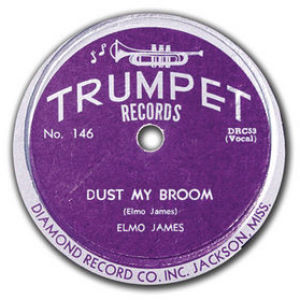
There is no secret that this song is, in both musical and lyrics, almost entirely lifted from the Johnson recording, "I Believe I'll Dust My Broom," and over the decades, there have been a myriad of other adaptations of the song.  In fact, one can easily argue that aside from perhaps Bo Diddley's opening progression on "I'm A Man," there is no more famous a progression that the one fond here.  However, James' take on the song is absolutely mind-blowing, as the gritty, dirty guitar sound, and the aggressive mood is far ahead of its time.  Even more "in your face" than a majority of the rock music of that entire decade, there is a tone on "Dust My Broom" that would have been mesmerizing in the late 1960's, let alone twenty years earlier.  The way in which James seems to fly across the fret-board gives it a uniquely dangerous feel, and it is largely this recording that would be the main source of fuel for the development of the early rock and roll sound.  As James rolls across the track in brilliant fashion, with Frock O'Dell on drums and the now-legendary grooving bassline from Leonard Ware, the song takes on a personality far greater than the sum of its parts, and there is simply no resisting the allure of "Dust My Broom."  The sound of the harmonica from Sonny Boy Williamson III provides an amazing compliment to James' sound, and the full, almost overly-loud sound of the combined group is the reason the song stands as such a pivotal moment in music history.

Yet as fantastic as the overall sound on "Dust My Broom" may be, there is not a moment anywhere on the song where the focus is taken from Elmore James and his phenomenal display of talent.  After hearing his work here, it is understandable why he remains the unchallenged champion of slide guitar, and this honor alone vaults him high atop the list of greatest guitarists of any style.  While to the more modern ear, his performance may not seem that out of the ordinary, there is simply no getting around the fact that the fast, almost distorted style with which he plays was years ahead of its time, and one can trace the origins of rock and roll back to this recording.  James gives "Dust My Broom" a unique swing, and it is this slight shift away from the "classic" blues sound that can be seen as a vital piece of the formation of the "boogie woogie" sound.  However, even though it has its own unique personality, there is no question as to the songs' roots, as the musical progression almost completely matches that of the original composition which has become attributed to Robert Johnson.  Furthermore, the lyrics, both in structure and content have a similar source, as James took the Johnson words, yet used the slightly modified additions from the version of the song recorded by Arthur Crudup a few years prior.  Regardless of these material sources, Elmore James' take on the song stands far above the others, and the sound and sting of his guitar here remains one of the most important moments in all of recorded music.

While many still do not quite see how the blues transitioned into the sound now known as rock and roll, one can easily see the connection within Elmore James' take on the classic arrangement, "Dust My Broom."  In terms of tone, speed, and talent, there was simply no other similar song before his, and one can point to this moment as the "beginning" of rock music in its more modern sense.  Furthermore, it is on this track that James is perhaps at his best, and after hearing his performance, one cannot deny his rightful place among the most elite guitarists in all of music history.  Truth be told, every slide guitar player that followed him owes a great deal of their sound to James, and even later blues legends like Muddy Waters and Howlin' Wolf cited James as a massive influence on their playing style.  On "Dust My Broom," James not only gives a legendary performance on guitar, but his singing also serves as a bridge between the traditional blues sound and the more modern approach to the style.  Mirroring his guitar work, there is a grit within his voice and helps to further express the deep emotions that he pulls from the song.  It is this combination that sets James apart from his peers, as few others were able to perform as brilliantly in both singing and guitar playing simultaneously.  This is yet another reason why he stands as such a massive icon in the overall history of music, and there are simply not enough words to do justice to the sound and impact that one can find within Elmore James' monumental 1951 recording, "Dust My Broom."