Friday, January 21, 2011

January 21: Big Youth, "The Killer"

Artist: Big Youth
Song: "The Killer"
Album: Screaming Target
Year: 1973


CLICK HERE TO LISTEN (will open in new tab)


For true music fans, there is perhaps no more disappointing reality than the way in which nearly every musical genre seems to have lost its way over the past twenty years.  Though many styles still boast the same name as earlier bands, the fact of the matter is, in most cases, the current acts are little more than watered down versions of their claimed influences.  Whether it is the way in which punk rock has turned into nothing but "boy bands" with dye jobs or the overly-artificial, almost cliché sound that is "hard rock," there are few bands even remotely worthy of connecting themselves to the founders of their particular genre.  While this reality is present in every musical style, it is perhaps no more apparent than in that of hip-hop, and if one traces the sound back to its true roots, it is almost embarrassing how far it has fallen.  Though many feel that hip-hop began in the late 1970's, there are far earlier roots of the genre that are undeniable.  However, to find these sources, one must look outside the presumed birthplace of hip-hop and travel to the "island sounds" of the late 1960's and early 1970's.  It is here that one finds a musical style known as "toasting," and there is no question that it is here where hip-hop music began.  Though there were a number of fantastic performers who made their name in the "sound system" parties in Jamaica at the time, few were as captivating as the great Big Youth, and there are few songs in history that can compare to his 1973 single, "The Killer."

The moment that the music kicks in on "The Killer," there are a number of influences that become immediately evident, and it is the way in which producer Gussie Clarke mixes them together so perfectly that makes the song so fantastic.  Bringing a steady, yet strangely dark beat, there is something almost menacing or dangerous about the overall mood of the song, and there are few instances elsewhere in music where this feeling is as authentic as one finds here.  It is also in the rhythm that one can hear the influences of the island sounds, with the guitar sending out a consistent ska sound, yet the overall tone retaining a rock-steady feel.  It is the interplay between the instruments where one can hear and understand the differences between these two styles, and they are both complimented in grand fashion by the piano that repeats a catchy melody in the background.  The way in which the entire band seems to surge back and forth as the song progresses is like nothing else previously recorded, and it is much the reason that "The Killer" stands so far above other singles of the "toasting" era.  It is also through the tight musical arrangement that one can completely feel and understand the entire idea of the "sound system," as the way in which this song would have moved such a gathering cannot be denied.  Furthermore, the fact that the song never loses the mood or becomes overly repetitive is a testament to the true musical perfection one finds on "The Killer."

However, while the musical arrangement is superb on "The Killer," there is simply no getting past the fact that Big Youth is in rare form, and it is this song that forever changed the musical landscape.  Though many have tried over the decades, no artist has come close to the sound and emotion found in Big Youth's voice, and there is also a sense of proximity to that which he sings about that makes his performances all the more impressive.  After hearing just a few moments of the song, the word "raw" comes to mind, and once one hears Big Youth's work here, it is almost impossible to use that term in reference to any other recording.  It is also through the vocal performance on "The Killer" that the live feel of the song is completed, as the opening "welcome" brings the listener into the song and almost transports them to the street party where the song was likely born.  Yet while one can tie the sound found here to the other "island styles," there is simply no denying the fact that "The Killer" can be seen as the final step into what would become rap music, and Big Youth sets the standard for vocal delivery as he flows perfectly along with the music.  There is an excitement and tension in his voice that is not lost on any listener, and it is this aspect that makes one want to hear the song over and over.  In many ways, one can feel Big Youth simply letting the music drive his vocals, and it is this loose, yet potent delivery that serves as a phenomenal finishing touch to "The Killer."

While the entire "toasting" style was largely lost on foreign shores at the time, the fact of the matter is, such artists became massive hits across Jamaica.  Among all of these performers, few were as well known as Big Youth, and "The Killer" would become a huge hit, and remains one of his most beloved recordings.  After hearing the song, its longevity is no surprise, as there is something that remains captivating in the way that his vocals seem to bounce along with the musical backing.  Furthermore, one can feel how this song, in both the music and vocals, would have kept a live crowd dancing and interested, and this represents the true spirit of the "sound system."  While many see the "toasting" style as little more than an aggressive take on reggae, there is no question that it has had a massive influence in ways that cannot be tied to the reggae sound.  The similarity between the "toasting" sound and modern hip-hop is clear, and yet it is almost embarrassing to think that the largely uncreative, uninspiring sounds that dominate the current hip-hop scene have any relation to the raw, emotion-filled sounds of its origin.  Over the decades, Big Youth has been cited as an influence across a number of genres, and it is clear that beyond the style in which he performed, it was the passion and content of his lyrics that inspired many other bands.  Though the entire Screaming Target record is a mind-blowing musical experience, there are few songs in history that remain as enjoyable or as important as one finds in Big Youth's 1973 classic, "The Killer."

Thursday, January 20, 2011

January 20: The Minutemen, "Political Song For Michael Jackson To Sing"

Artist: Minutemen
Song: "Political Song For Michael Jackson To Sing"
Album: Double Nickels On The Dime
Year: 1984


CLICK HERE TO LISTEN (will open in new tab)


Though the entire idea of punk rock is to be completely different and free thinking in the musical approach, the fact of the matter is, there is still a rather clear conformity within an overwhelming majority of punk bands.  Whether it is in their tone or the actual arrangement of their music, there are very few bands that truly represent the idea of punk as a formless, anarchic musical style.  Throughout the entire history of what one can see as the "punk progression," there is perhaps no other band that better represented this idea of being completely original and ignoring all previous musical conventions than one finds in the brilliant music of San Pedro, California's Minutemen.  Bringing together elements of funk, blues, and jazz, all under the overall style of punk, the influence of the group can still be heard in today's music scene, yet in the overall history of music, they are often overlooked.  Yet even if one ignores their musical approach, the truth of the matter is that lyrically, the band new few peers, and there are few records of any genre that are as stunning to experience as their 1984 masterpiece, Double Nickels On The Dime.  With forty-four tracks clocking in at just under seventy-five minutes, the group deploys their brilliance with mind-boggling speed and efficiency, leaving no musical thought unexplored.  Though each song on the album as it's own, unique feel, there are few songs in their catalog that better represent their entire ethos as a band than one finds in The Minutemen's 1984 song,"Political Song For Michael Jackson To Sing."

Though it has been said of many songs, there is quite literally no time wasted at any point on "Political Song For Michael Jackson To Sing," as in many ways, the song "just starts."  There is no musical lead-in or introduction, as the entire band drops in at full speed.  Led by the fantastic guitar of the late, great D. Boon (real name: Dennes Boon), there is instantly a sense of urgency and frustration that can be heard.  The soft grind of his guitar sounds perfect with the overall arrangement, and yet there is a unique looseness in his playing that seems to simultaneously play in contrast to the song.  Mirroring the tone and mood of the guitar, bassist Mike Watt sounds as good here as anywhere else in his career.  The fast-paced, winding progression which he plays helps to highlight the almost nervous tension on the song, and it is this aspect that makes "Political Song For Michael Jackson To Sing" such a unique musical experience.  Rounding out the band is drummer George Hurley, and the strict cadence with which be plays helps to give the song a far more imposing sound than the songs of their peers, as at many points, it almost feels like a military-style march.  The combined sound of the trio is far beyond that of nearly any other band at the time, and the group perfectly represents the punk sound as there is only a brief, almost sarcastic guitar solo that breaks up the ninety-three second song.  The fact that The Minutemen were able to accomplish so much musically in such a short song is a testament to their talents, and much the reason they stand so high above their peers.

Along with his amazing work on guitar, D. Boon also stands as one of the most prolific and influential vocalists in the history of punk, and he rarely sounded better than he does on "Political Song For Michael Jackson To Sing."  Though he is almost always speaking the lyrics, even when he pushes into more traditional signing, there is simply no mistaking the sound or urgency within his voice.  Certainly along the same lines as Ian MacKaye or David Thomas, there is a strange tone to Boon's voice that demands total respect, as it is clear that there is always a deeper message within his music.  Though the title may suggest a humorous, almost silly song, the fact of the matter is, "Political Song For Michael Jackson To Sing" is one of the groups deepest and most philosophical lyrical achievements.  Penned by Mike Watt, the song is almost a train-of-thought approach, and it is one of the few songs in history that needs to be listened to a number of times so that even the slightest nuance of the words can be properly processed.  In many ways, the lyrics are like a Shakespearean poem, as they must be completely dissected to be completely understood; and this in itself shows the amazing writing talent of Watt, and the fact that he was able to work such complex thought into such a stripped down sound proves the high level of genius that was at play within The Minutemen.

Truth be told, one can see the overall idea of "Political Song For Michael Jackson To Sing" as a bit of a ploy to see what radio stations might play the song.  Name-checking what was then the biggest pop star on the planet is a perfect representation of the intelligence and distinctive humor that one finds within the music of The Minutemen, and by all popular accounts, their idea worked, as a number of radio stations gave the song airplay.  This idea perfectly mirrors the overall feel of both the band and album, as there are countless juxtapositions at play throughout Double Nickels On The Dime.  Whether it is the succinct, yet amazingly complex musical arrangements or the unassumingly intellectual lyrics, on nearly every level, there is no better representation of the entire punk ethos than one finds in the music of The Minutemen.  Furthermore, the fact that their music was such a far cry from anything else being recorded, yet it is unquestionably catchy, serves as the final evidence that one needs to understand just why the group remains such an important piece in the overall progression of music.  Though they are often placed as a "second tier" group insofar as influence is concerned, after experiencing their music, it is obvious that they were far more important than many bands that gained a larger amount of hype.  Boasting countless examples of true musical perfection, there are few songs that pack a similar punch and overall level of musical achievement than one can experience within The Minutemen's 1984 classic, "Political Song For Michael Jackson To Sing."

Wednesday, January 19, 2011

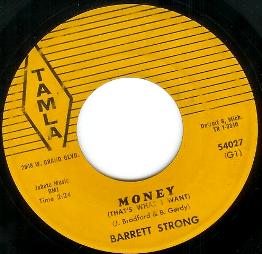
January 19: Barrett Strong, "Money (That's What I Want)"

Artist: Barrett Strong
Song: "Money (That's What I Want)"
Album: "Money (That's What I Want)" (single)
Year: 1959


CLICK HERE TO LISTEN (will open in new tab)


While it may seem at first glance as if there have been a handful of spontaneous musical revolutions across the course of music history, the fact of the matter is, if one looks closer, there is some sort of catalyst for every event.  However, in most of these situations, the songs or bands that came later were so famous that they completely overshadow the true originators, and cause this false sense of "coming out of nowhere" with their particular sound.  Though this has occurred a number of times over the decades, it is perhaps no more obvious then when one considers the seemingly meteoric rise of Motown Records, and yet even in that case, there was a "first."  While anyone can name off a number of the labels most famous artists, there are very few who can name the true first star of Motown, and it was in fact the one and only Barrett Strong.  It was late in 1959 when he released his first single, and it would be the success of this song that would provide the great Berry Gordy with the money he would need to turn the label into the iconic hit producer that it is known as today.  Furthermore, it is on this early single that one can hear the transition of the rhythm and blues sound into the "Motown sound," and there is perhaps no more clear a sign of things to come than one finds in Barrett Strong's aptly titled hit single, "Money (That's What I Want)."

From the moment that "Money (That's What I Want)" begins, it is clear that this song is a transitional tune, as one can easily hear both the old and new sounds.  There is no question that the song is rooted in the rhythm and blues sound, and one can hear the influence of the Sun Records sound in the opening piano progression.  However, as soon as the rest of the band drops in, "Money (That's What I Want)" takes on its own personality, and the way in which all the other instruments blend together is truly where the "Motown sound" began.  Whether it is the tambourine, which is almost oddly forward in the mix, or funky, somewhat surf-rock sound of the guitar, there is so much going on musically on the track that it is almost impossible to catch it all within a single listening.  However, even on this early single, the key to the "Motown sound" can be heard, as the bass progression has a deep groove and provides far more movement on the track than almost anything else heard previously.  The way in which the drums move back and forth on the track also gives an amazing amount of depth to "Money (That's What I Want)," and this is especially clear on the verses, as they seem to echo and bounce behind the vocals.  The fact that so much is going on musically, yet it does not seem overwhelming in many ways defines what Motown Records would become famous for, and in many ways, it rarely sounded better than it does on "Money (That's What I Want)."

Providing the ideal vocals for the funky, yet upbeat music behind him, Barrett Strong in many ways sets the standard for Motown singing on "Money (That's What I Want)."  Clearly able to work the entire vocal spectrum, one can sense that he was truly letting the song dictate where his vocals went, and this feeling provides an authenticity and honesty in his vocals that set them far apart from a majority of his peers.  Fusing together the sounds of soul, blues, and the emerging rock and roll style, as is the case with a majority of Motown singing, there is also an ever-present feeling that he is enjoying the singing that remains one of the signature sounds of the era.  Also on "Money (That's What I Want)," the way in which the backing vocals blend into the piece, as well as the sound itself would become a standard, and one can easily hear how these backing vocals would become the blueprint for the "girl group" sound that would explode over the following years.  Yet it is also the words to "Money (That's What I Want)" that remain iconic, and they are just as relevant today as they were more than fifty years ago.  There are few songs with more memorable an opening line, and the almost sarcastic, frustrated thought of, "...the best things in life are free, but you can keep 'em for the birds and bees..." is perhaps the ultimate "working man's" anthem.  In both what he is saying as well as the way in which it was delivered, the vocals of Barrett Strong on "Money (That's What I Want)" clearly stand as the blueprint for the next generation of pop music.

However, as fantastic as "Money (That's What I Want)" is, one cannot overlook the fact that the source of the lyrics and idea are perhaps the longest standing musical dispute in history.  While the Barrett Strong recording was made in August of 1959, for years preceding it, the great John Lee Hooker had been performing his song, titled "I Need Some Money."  The lyrics are almost an exact copy, and Hooker's trademark sound can be heard as a slightly slower, stripped-down version of the Barrett Strong single.  Though it never went to court, the similarity between the two songs is undeniable, and yet they both manage to retain their own personality.  The way in which Barrett Strong and the Motown team took the overall theme of Hooker's song and spun it into something completely new can be seen as "the" revolutionary moment that spawned the "Motown sound," and the fact of the matter is, it was this song that provided the financial means for Berry Gordy to get his label off the ground.  It is in this fact that one can find the amazing irony of the song, as it was perhaps the most truthful song ever recorded.  Furthermore, few songs have persevered as well as "Money (That's What I Want)" has over the decades, and everyone from The Stooges to Etta James to Smashing Pumpkins have recorded their own version of the song.  Though it is often overlooked for its massive historical significance, there is simply no arguing that the revolution that was the "Motown sound" began with Barrett Strong and his monumental 1959 single, "Money (That's What I Want)."

Tuesday, January 18, 2011

January 18: Elvis Costello, "Radio Radio"

Artist: Elvis Costello
Song: "Radio Radio"
Album: This Year's Model
Year: 1978


CLICK HERE TO LISTEN (will open in new tab)


While there is certainly something to be said for subtlety, there are times when a far more aggressive, in-your-face type approach is more fitting for the situation.  In most cases, a writer or band is good at one or the other, as each takes their own special understanding.  Yet in the latter of the two approaches, one must still temper themselves in some way if there is a hope of getting a message across, and in many ways, this can be seen as the reason many of the early punk songs did not resonate with a larger audience.  Then of course, there was Elvis Costello.  Unquestionably one of the most uniquely talented musicians in history, it was his brand of cynicism and distinctively catchy songs that made him into a true music legend, yet it is also through his music that one can see the beginnings of many new styles.  By the time Costello released his third record, 1978's This Year's Model, he had already established himself as one of the finest writers of his generation, and yet it would be this record that would highlight his connection to punk rock, as well as the venomous attacks that seemed to come so easily with his writing.  Clearly fed up with the machine that is the music industry, Elvis Costello held nothing back, penning one of the most scathing, yet musically brilliant songs ever in the form of his phenomenal 1978 single, "Radio Radio."

From the moment that "Radio Radio" begins, a number of different genres are clearly at play, and one can hear just how closely connected the styles of punk and new wave are through the music found here.  Led by the strangely toned organ of Steve Nieve, the songs' hook is immediately set into play, and it remains one of the most recognizable progressions in all of music history.  The pace at which this hook is played also gives "Radio Radio" a unique sense of urgency, and this mood is highlighted by the drumming of Pete Thomas.  As the song moves into the verse section, the song drops into a sparse arrangement featuring little more than bassist Bruce Thomas and light touches from Costello's guitar.  Yet even with this change in the sound, the mood of the song is never lost, and the drive that lies underneath the music is in many ways the concentrated spirit of the punk movement.  The way in which the band spins back into the bridge and chorus sections is where "Radio Radio" gains its wide range of appeal, as even with the frustration that is evident in the sound, there is something upbeat, almost sweet within the sound that cannot be denied.  It is this juxtaposition of sounds that defines Costello's sound and proves the true genius of his musical arrangements.  On "Radio Radio," Elvis Costello also makes it quite clear that one need not use heavy distortion or excessive volume to make a musical point.

Perfectly aligning with the mood and sound set forth by the music, the vocals of Elvis Costello on "Radio Radio" are his finest in a number of different ways.  Though he had already shown his amazing voice on his previous releases, on this song he displays an angry sneer that was in many ways lying underneath all of his earler work, and when it is unleashed here, the complete picture of Costello as an artist becomes clear.  There is an attitude within his voice that is nothing short of captivating, and it is his ability to make these feelings almost universally understood that serve as further evidence of his skill as a musician.  Yet even with the music and singing in the top notch form which they are, there is simply no getting past the fact that "Radio Radio" boasts what are without question some of the greatest lyrics ever penned.  Taking full aim at the music industry, from the lack of "real" musical understanding and love in those who run it to the unfair practices used in promoting certain music above other, Costello holds nothing back and in the process created an absolute classic.  Speaking to the feeling that he was little more than a number to industry heads, few artists have captured the feeling as perfect as when he sings, "...it's only inches on the reel-to-reel..."  Costello continues his assault when he slams the industry heads with the lines, "...and the radio is in the hands of such a lot of fools, tryin' to anaesthetise the way that you feel..."  Though many have tried to take similar shots over the years, in comparison, nothing even comes close to the powerful, yet catchy approach found on "Radio Radio."

Truth be told, "Radio Radio" does not appear on the original U.K. release of This Year's Model, and it became the albums' thirteenth song when the record was released in the U.S. By the time This Year's Model was released in the U.S., the single had already made waves due to Costello's notorious performance on Saturday Night Live in December of 1977. Serving as a last minute replacement for the Sex Pistols, Columbia Records insisted that Costello play "Less Than Zero" in an effort to promote the release of his first two records in the U.S.  Costello felt the song had little resonance in the U.S., but reluctantly agreed to play it after a lengthy battle with studio executives.  However, a few bars into the song, Costello famously stopped the band and stated, "I'm sorry, ladies and gentlemen, there's no reason to do this song here..." The band then launched into a blistering version of "Radio Radio," instantly becoming one of the most famous moments in music history.  The event lives on in the lore of the show, and on the twenty-fifth anniversary of the event, Costello "interrupted" a performance by the Beastie Boys on SNL, and they all launched into "Radio Radio."  Even without these unforgettable live incidents, the song would have achieved its iconic status, as in every way, it is absolute musical perfection.  Forever altering his image and becoming a legend of the punk spirit, there is simply no other song in history that can compare to the sheer musical genius that one finds in Elvis Costello's 1978 single, "Radio Radio."

Monday, January 17, 2011

January 17: Daily Guru, "Gurucast #55"

CLICK HERE TO LISTEN (will open in new tab)


(Left Click (PC) or Command-Click (Mac) to save it to your desktop...it's about 75MB)

One hour of amazing music and commentary from "The Guru" himself.

Tracklist (all links are to my write-ups of that artist, song, or album):
1. The Ramones, "Rockaway Beach"  1978/01/07, NYC
2. Les Claypool's Fearless Flying Frog Brigade, "Up On The Roof"  Purple Onion
3. Goldfrapp, "Lovely Head"  Felt Mountain
4. John Lee Hooker, "Boogie Chillun"  I'm John Lee Hooker
5. Tenacious D, "Rock Your Socks"  Tenacious D
6. Kraftwerk, "The Robots"  The Man Machine
7. Tom Waits, "Chocolate Jesus"  Mule Variations
8. Dead Meadow, "Beyond The Fields We Know"  Dead Meadow
9. The Clash, "Janie Jones"  The Clash (UK)
10. The Jimi Hendrix Experience, "Little Wing"  Live In Paris
11. Notorious BIG, "Things Done Changed"  Ready To Die
12. The Raconteurs, "Old Enough"  Consolers Of The Lonely
13. Black Eyes, "Day Turns Night"  Black Eyes
14. The Adverts, "Safety In Numbers"  Crossing The Red Sea
15. Jerry Lee Lewis, "Down The Line"  Live At The Star Club, Hamburg

Sunday, January 16, 2011

January 16: Deadboy And The Elephantmen, "Stop, I'm Already Dead"

Artist: Deadboy And The Elephantmen
Song: "Stop, I'm Already Dead"
Album: We Are Night Sky
Year: 2005


CLICK HERE TO LISTEN (will open in new tab)


In an era where a majority of music comes off as embarrassingly disingenuous and annoyingly artificial, it is understandable that many have lost faith in the continued existence of "real" music.  As the major labels and mass media push more and more sub-par music onto the masses, one is forced to dig deeper and rally behind the few groups that prove the presence of truly talented and inspiring musicians.  Thankfully, there are a handful of record labels that consistently produce such acts, and few are better at finding these bands than Mississippi-based Fat Possum Records.  Whether it's The Black Keys, Bob Log III, or a number of other groups, the label is unquestionably one of the finest today, and few acts on that label showed more promise than the short-lived project, Deadboy And The Elephantmen.  Though it is arguably their second full length album, many saw 2005's We Are Night Sky as the groups' debut, yet whichever way one sees it, it is impossible to deny the musical brilliance on display throughout the record.  Combining an overall dark, almost haunting mood with an attack and distortion that is absolutely perfect, the album remains one of the finest and most refreshing musical efforts in recent history, and it served as the introduction of Dax Riggs to many music fans.  Though every track on the album is fantastic, the essence of the group can be heard clearly within Deadboy And The Elephantmen's 2005 song, "Stop, I'm Already Dead."

As the song opens, the mood for both the song and album are immediately set into place, as there is a somber, yet almost nervous energy created by the lone guitar and dual vocals of Dax Riggs and Tessie Brunet.  The guitar seems to be the source of the mood, as it feel as if it is ready to lash out and attack at any moment.  The fact that such mood is able to be conveyed through a simple, unassuming progression is the perfect example of the overall ability of Deadboy And The Elephantmen, and this minimalist approach is where one can see close ties to the punk rock ethos.  However, "Stop, I'm Already Dead" quickly drops into an all-out rock and roll masterpiece, and the heavy drumming becomes just as essential to the feel of the song as the guitar work.  During the latter half of the song, this cadence becomes far more present, and the sharp stutter that the song creates is as heavy metal as it is punk, and it is this combination of sounds that makes both the song and band so uniquely brilliant.  It is also in the simple combination of instrumentation where one can hear the fantastic chemistry between Riggs and Brunet, and while many other acts at the time were attempting to play the "lo fi" or "garage" sound, it is "Stop, I'm Already Dead" that unquestionably sets the standard. The difference here is that along with having a far more authentic punch and grind than the "major label" acts they can be compared to, "Stop, I'm Already Dead" is amazingly catchy, and this is the final element that sets the band far above their peers.

Along with showing a unique musical rapport through their playing, Riggs and Brunet also share a fantastic chemistry within their vocal performances.  Both bringing distinctive voices, the way in which they blend together gives "Stop, "I'm Already Dead" a amazing depth, and this is highlighted in the emotion conveyed in the songs' opening.  With nothing to hide their singing, there is an almost tragic beauty within this portion of the song, and there the vocals often come off as detached, which manages to work perfectly with the overall feel of the song.  After the main musical portion kicks in, Riggs takes center stage, and the energy and attitude with which he sings is absolutely mesmerizing, often mimicking the staggered feel of the drumming.  Holding nothing back, the raw, almost unhinged sound in his voice echoes back to the likes of Iggy Pop among others, and it is the somehow gentle ferocity in his voice that makes it unforgettable.  Along with the way he sings, the lyrics on "Stop, I'm Already Dead" perfectly reflect the overall mood of the song, and it is these uniquely dark lyrics that would prove to be a trademark of Riggs' music.  When he delivers lines like, "... heaven's on one shoulder, but baby hell is on the other...," Riggs injects an almost gothic element into the song, yet it brings this mood in a completely original manner, and it is both the lyrics as well as his overall attitude that makes "Stop, I'm Already Dead" such an enjoyably unique musical experience.

Even as amazing as the overall end-product stands, Deadboy And The Elephantmen remains one of many bands that one wished would have created more music.  While there are a number of studio outtakes and a second LP, shortly after the release of We Are Night Sky, Riggs rearranged his band and began releasing music under his own name.  The similarity between the lineups is clear, and yet there is something one can only find within the Deadboy And The Elephantmen recordings that makes one yearn for more.  Throughout We Are Night Sky, the duo deploy their mood across a number of styles, and even in the more reserved, quieter moments on the record, the overall level of talent within the group is more than obvious.  It is perhaps the fact that they are able to retain this mood across so many styles that proves just how superior they were to their contemporaries, and also why the album remains proof that "true" rock music is not a thing of the past.  Serving as one of the finest opening tracks in history, "Stop, I'm Already Dead" is everything one can hope for in a rock song, from the heavy guitar work to the aggressive drumming to the almost chaotic energy in the vocals.  The way in which these elements are all brought together is what defines the band, and there are few songs of the past decades that can compare to the brilliant sound and energy one finds on Deadboy And The Elephantmen's 2005 song, "Stop, I'm Already Dead."

Saturday, January 15, 2011

January 15: Joy Division, "Disorder"

Artist: Joy Division
Song: "Disorder"
Album: Unknown Pleasures
Year: 1979


CLICK HERE TO LISTEN (will open in new tab)


While many people use the term "post punk," the truth of the matter is, most do not fully understand exactly how the term came to be, as well as exactly what defines that sound.  This has led to a number of bands sharing this title, many of whom do not exactly represent the original meaning of the term.  Only a few short months after the period in 1977 that most cite as the "punk explosion," a number of bands began to emerge that seemed to share the minimalist ethos, yet distanced themselves by emphasizing mood and feeling over the speed and aggression that was the basis of punk.  This combination of sounds is where the "true" meaning of "post punk" can be found, and few bands better define this style than one finds in the music of Joy Division.  With their deep, often haunting melodies combined with an undeniably catchy overall sound, it was this music that opened the door for countless other bands and genres, and one simply cannot say enough about the lasting impact of their magnificent 1979 debut record, Unknown Pleasures.  The way in which the songs on the album work together to create a single piece is nothing short of stunning, and there are few other records that can be seen as revolutionary as one finds here.  Filled with some of the darkest, yet most sonically beautiful songs ever recorded, there are few tracks that better define Joy Division than 1979's "Disorder."

As both an introduction to the album, and for most people, to the band itself, "Disorder" is one of the most instantly catchy and definitive songs in history.  Kicking off with the oddly echoing, distinctive drumming of Stephen Morris, the song almost immediately gains its entire identity.  When it is joined by the fast-paced bass of Peter Hook, it is clear that there is something different about the bands' sound, and this almost undefinable element is what makes the music of Joy Division so fantastic.  It is the way in which both the music and lyrics seem completely detached, yet powerfully emotive that stands out, and there are very few other bands that have been able to achieve this sound to the same level that one can experience on "Disorder."  When Bernard Summer drops into the song with his guitar, it is almost breathtaking, as the tone he brings is absolutely amazing, as his playing seems to almost sweep across the song, taking the listener along for the ride.  All three musicians here clearly have their own space on "Disorder," and the fact that there is such a separation, yet they somehow meld together is the key to making the song so unique.  This was largely due to the work of legendary producer Martin Hannett, and the almost random sound effects that he deploys throughout the track provide the ideal finishing touch to make "Disorder" nothing short of legendary.

Though there have been many great examples of the idea throughout the history of recorded music, there are few instances that surpass "Disorder" when it comes to a vocalist perfectly matching the mood of the music over which he sings.  Ian Curtis brings a detached, almost disinterested tone to his lyrics, and yet there is a sense of frustration and despair in his words that one cannot deny.  Though for nearly the entire song Curtis offers the lyrics in little more than his speaking voice, there is still a great deal of emotion behind the words, and it is this contrast of ideas that in many ways defines both his style as well as the overall approach of the band.  As "Disorder" opens, Curtis delivers what has become one of the most iconic lines in music history, as when he sings, "...I've been waiting for a guide to come and take me by the hand...," one can interpret this line on a number of levels.  One can see this phrase as an almost warning of the musical change that the listener is about to experience, and yet one can also see this as the defining moment that explains much of the lyrical content as well.  Regardless of the way in which one reads this line, the remainder of the lyrics of the song echo the ideals of the punk rock sound, and yet the heavy level of emotion that one can feel within them is perhaps the clearest definition of the idea of "post punk."  The way in which Ian Curtis performs here also stands as one of the most unforgettable moments in music history, and it is truly the type of song that once it is heard for the first time, it sticks with the listener forever.

Though it is difficult to separate "Disorder" from the entire work of Unknown Pleasures, the song itself helps to highlight the amazing work that is found throughout the album.  Whether it is the sparse arrangement of the music or the heavy mood that persists throughout, there was simply nothing on par with this record that can be found previously.  Each musician is in top form and then some, and the fact that there is so much space between them on the song helps to highlight each of their fantastic performances.  This formula would become the blueprint for countless bands that followed, and one can still hear echoes of this sound within the modern music scene.  Though the overall feeling of space between the band members and the almost overbearing sense of sorrow never relents, there is also a feeling of warmth and closeness in the music that cannot be denied.  The fact that these opposites are able to co-exist throughout all of "Disorder" is a testament to the band and Hannett, and it is this fact alone that demands the song be experienced firsthand.  Furthermore, the tension that can be felt on the song is second to none, and it almost feels as if the song might fall apart at any moment.  In reality, there are simply not enough words that can describe the extraordinary musical achievements found throughout the song, and it is perhaps this fact alone that makes Joy Division's 1979 song, "Disorder," such an incredible and massively influential moment in music history.