Thursday, April 14, 2011

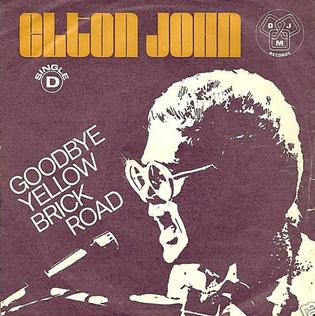
April 14: Elton John, "Goodbye Yellow Brick Road"

Artist: Elton John
Song: "Goodbye Yellow Brick Road"
Album: Goodbye Yellow Brick Road
Year: 1973


CLICK HERE TO LISTEN (will open in new tab)


Throughout the entire course of music history, one of the more frustrating situations to watch is when an artist or band ends up being grouped into a category that they do not belong, and the stereotypes that come with the genre in question prevent many from realizing the full range of the artist.  While many of these artists certainly achieve massive commercial success, there can still be large groups of music fans that never give their music a chance, simply due to the improper classifications that are passed down.  Though there are a number of clear occurrences of this, one can easily argue that nothing turns off "mainstream" rock fans quicker than the term "soft rock," and there has perhaps been no more inaccurate a use of this definition than when it is used to describe the diverse sounds found within the catalog of Elton John.  Pushing far beyond the perceived "constraints" of "a man and his piano," John has everything from winding ballads to outright rockers in his catalog, and one would be hard pressed to argue any other individual as a more successful pop star of the 1970's.  Due to his wide range in sound, picking a single song, or even a single album, as his finest is truly impossible, and it largely comes down to personal taste to make such an argument.  However, one can find almost every side of Elton John's musical approach, as well as what may very well be his finest vocal moment within his magnificent 1973 song, "Goodbye Yellow Brick Road."

As the title track to his extraordinary double-album, "Goodbye Yellow Brick Road" is without question the highlight of the record, and many of Elton John's own influences come through quite clearly throughout the song.  There is a certain tone within his piano that makes it immediately recognizable, and on "Goodbye Yellow Brick Road," there is a distinctive, almost somber march within his pace and mood that sets the song far apart from the rest of his catalog.  The way in which his piano seamlessly blends with the almost buried guitar of Davey Johnstone stands as one of the finest combinations in history, and if one listens closely to the guitar part, it is as psychedelic a progression as one will find anywhere.  The rhythmic duo of bassist Dee Murray and drummer Nigel Olsson are far more forward in the mix than usual, and the pair seem to almost each take half of each musical bar for their own, passing the rhythm back and forth.  This helps to reinforce the sway and emotion of the song, and there is a unique musical balance throughout "Goodbye Yellow Brick Road" that pushes the song far above the rest of John's catalog.  The final element of the string section serves as the ideal finishing touch, and it is this part of the music that makes the bridge and chorus sections truly soar, almost carrying the listener away in the emotion and power of the song.

The string section also helps to highlight the vocals of Elton John, and one can easily argue that his performances on "Goodbye Yellow Brick Road" is the finest of his career.  In terms of both vocal range and the emotion he conveys within the song, John knows no limits here, and it is within the almost blissful, lyricless bridge section where one is quickly reminded of the influence of the harmonies of The Beach Boys.  In many ways, this portion of the song could easily have come from one of their albums, as Elton John lets his voice reach its apex, and it remains one of the most stunning moments in all of music history.  Yet the power and emotion he brings to the verses is equally impressive, and there is perhaps no other song in his catalog where the vocals matched as perfectly with the lyrics and one can experience on "Goodbye Yellow Brick Road."  As is the case with much of his catalog, the words were written by Bernie Taupin, and one can interpret the defiant words on a number of different levels.  While many take the song as a reference to the contrast in the fame of John versus the want to have a "quiet" life that Taupin desired, lyrics like, "...you can't plant me in your penthouse, I'm going back to my plough..." can be applied to a wide range of situations.  It is this openly interpreted and wide-range of appeal within the words that serve as an ideal final element to the song, and they remain just as powerful and enjoyable today as they were upon first release.

While there is no arguing that Elton John is absolute "musical royalty," many have likely missed out on his absolutely fantastic recorded catalog due to his close association with the term "soft rock."  Yet if one actually listens to his songs, it is a rare occasion where such a term is fitting, as his music runs the gamut from "glam rock" to blues to soul to more "standard" rock songs.  In fact, a majority of his songs are blends of all of these styles, and it is certainly the case that one finds within "Goodbye Yellow Brick Road."  Bringing a massive amount of soul and emotion, and often pushing the sound and mood to one of the more aggressive points in his catalog, the combination of music, lyrics, and tone has rarely been as perfectly balanced as one finds on the song.  The way in which the emotion and tension build throughout the song remains just as potent even after countless listenings, and this in many ways is the true marker of a great song, and much the reason the song rises above the rest of John's catalog.  Furthermore, Elton John manages to walk the thin line of musical extravagance, managing to keep the song from coming off as "over done" or cliché, and this is perhaps the most difficult balance in all of music to achieve.  Though his name alone brings to mind countless songs and images, there is perhaps no more superb a musical moment or better a representation of the brilliance that "is" Elton John than what one can experience in his stellar 1973 single, "Goodbye Yellow Brick Road."

Wednesday, April 13, 2011

April 13: Mississippi John Hurt, "Avalon Blues"

Artist: Mississippi John Hurt
Song: "Avalon Blues"
Album: Avalon Blues (78" single)
Year: 1928


CLICK HERE TO LISTEN (will open in new tab)


Though every genre in history has a number of distinctive artists who have pushed that style into many different directions, there is perhaps no genre that has seen as wide a range of approaches as one can find in the long history of blues music.  From its earliest days as simply a man and his guitar to the way in which it has been incorporated into everything from heavy metal to hip-hop, there is little question that the blues remain the most important style in all of music history.  Yet even in the first few years of the sound being recorded, there was an massive amount of diversity in the approach, and many of the most iconic figures of the blues established themselves with a distinctive take on the style.  In most cases, it was due to a certain aggression or darker sound being presented, and it is the way in which he took the completely opposite approach that makes the music of Mississippi John Hurt so extraordinary.  Without question, he stands as the most gentle, almost unassuming figure in music history, and his songs have a simple beauty that cannot be found anywhere else.  Making almost all of his small catalog of recordings in the late 1920's, one can quickly understand why he stands so far apart from his peers, and there are few guitarists of that era that showed more talent that Mississippi John Hurt.  Though each of his recordings are brilliant in their own right, there is no other blues song in history that can compare to the uniquely charming, almost serene sound that can be found on Mississippi John Hurt's 1928 song, "Avalon Blues."

Much in the same manner as a majority of his peers, Mississippi John Hurt was an act of no more than his voice and his guitar, yet both his style and tone are completely distinctive.  On the original recording of "Avalon Blues," there are also a few rather significant key changes that occur at seemingly odd places within the music, and it is in these moments that his musical superiority becomes apparent.  Further separating himself from the other blues masters of the era, Mississippi John Hurt does not have the "twang" in his playing that is found in a majority of the Delta-based players, as he concentrates more on finger picking than outright strumming.  It is within this approach that one can quickly understand why he is held to be a far superior player than his peers, and the often looping nature of his playing gives his songs a sense of movement that is completely distinctive.  This approach also allows songs like "Avalon Blues" to have a slightly more positive or uplifting feel, and this is further supported by the uniquely soft touch that can be felt within the playing of Mississippi John Hurt.  It is the way in which he is able to deploy such a high quality and distinctive guitar progression in as unassuming and modest a manner as he does that makes Mississippi John Hurt's performance on "Avalon Blues" so fantastic, and it enables the song to be one of the few that easily appeals to almost every music fan.

However, while the simple instrumental approach would be enough to make "Avalon Blues" a classic, it is the way in which the vocals and lyrics of Mississippi John Hurt blend so perfectly into the mix that pushes the song into a category all its own.  At its core, there are few other early bluesmen who have as strong and captivating a voice as one finds on "Avalon Blues," and his straightforward, often spoken approach quickly gives his songs an "every man" feel.  Rarely needing to push his volume much past this style, one can easily see the link from the story-telling tradition to the blues and later genres within the voice of Mississippi John Hurt.  Furthermore, there is perhaps no other artist from any point in history that has so perfectly proven that one can be more mellow within a vocal approach and still have lyrical impact.  The spirit and soul behind the voice of Mississippi John Hurt never wavers, and with each line, he endears himself more and more to the listener, as there is often an underlying sense of pride and gratitude within his singing.  On "Avalon Blues," he becomes one of the first performers to extol the virtues of his home town, making it clear that he enjoys the comforts and simplicities that can only be found there.  Whether he is singing of the beauty and loyalty of its women or the idea that in many ways, these women are much the same as one finds in the "big city," there is an upbeat longing within his voice, and his performance quickly makes the listener want to seek out what sounds to be an amazing place to live.

Truth be told, while Mississippi John Hurt is without question one of the most important musicians in history, he was almost completely lost to history, mostly due to his modest, unassuming personality.  After making his recordings of the Okeh label in 1928, he returned to his work as a sharecropper, due to the lack of commercial success, as well as the financial realities of the early 1930's.  Nearly thirty years later, a man by the name of Tom Hoskins followed the "clues" within these recordings to track down Mississippi John Hurt, who was still living in Avalon, Mississippi, working the same job that he was at the time of the recordings.  With the "folk rebirth" in full swing, Mississippi John Hurt was finally given some of the credit he clearly deserved, playing to massive audiences who were completely enamored by his sound.  Throughout all of these performances, the genuine appreciation and almost shock of his sudden fame was quite clear, and this honest personality vaulted him to a cult-like status within music circles.  Yet even without these characteristics, the fact of the matter is, Mississippi John Hurt's recordings serve as the foundation for nearly everything that followed, and he was one of the first players to push the norm on what was considered blues music.  Though each of his few recordings are superb, there is not another song in history that has the same sound and feel as one finds in Mississippi John Hurt's stunning 1928 ode to his home town, "Avalon Blues."

Tuesday, April 12, 2011

April 12: Jewel, "You Were Meant For Me"

Artist: Jewel
Song: "You Were Meant For Me"
Album: Pieces Of You
Year: 1995


CLICK HERE TO LISTEN (will open in new tab)


Following the over-produced, highly artificial, almost annoyingly excessive sound and style that dominated a majority of the 1980's, the stripped down, straightforward sound that came back into style in the 1990's was beyond refreshing.  Whether it was the re-termed punk sound (grunge) or the return of the classic sound of hard rock ("alternative"), the 1990's gave new life to everything there was to love about a number of different musical genres.  Even the folk and jazz movements made brief comebacks within mainstream music, and it was this exceptionally eclectic mix that allowed some of the most uniquely beautiful artists in all of music history to emerge.  It was in this short-lived "folk revival" that one of the most definitive voices of the generation surfaced, and to this day, there is simply no other singer in the world that is quite like Jewel.  Bringing an amazingly innocent, yet soulful sound, it was rarely more than just her voice and guitar, and there are few records in history that are as outright endearing as one can experience within her 1995 debut, Pieces Of You.  Filled with lyrics to which all could easily relate, alongside one of the most stunning voices the world has ever known, Jewel quickly established her own, unique sound, and a string of hit singles vaulted her into the mainstream.  Though it is sometimes overshadowed by her other hits, there is no song that better displays everything that makes Jewel the icon that she remains to this day than the simple brilliance that one can experience within her 1995 single, "You Were Meant For Me."

Truth be told, there are actually two versions of "You Were Meant For Me," though they are extremely similar.  The "single version" was a re-recorded take, clocking in at about thirty seconds less than the original album version, and yet the overall tone and composition are nearly identical.  The core of the song, like a majority of Jewel's early music, centers around the lone sound of an acoustic guitar.  Though there are other instruments on the track, it is the guitar that retains the focus throughout the song, and it is this straightforward, unaltered sound that sets the mood for the song.  The way in which the guitar seems to sway gently defines the sorrowful, almost morose tone, and yet there are a few small touches within the guitar part that give the song a bit of an upbeat feel.  It is also the way in which the other instruments blend together with the guitar that makes "You Were Meant For Me" so delicate, yet perfect.  The organ in the background manages to heighten the mood whilst staying largely anonymous, and yet once one concentrates on this aspect of the song, the balance that it provides becomes quite clear.  Similarly, the rhythm section, and brief appearance of a second guitar prove to be an ideal example of how to make a song sound full, yet not over-crowded.  The final element that pushes the music on "You Were Meant For Me" into a category all its own is the fact that at its core, the melody is exceptionally catchy, and it remains one of the most easily recognized songs in all of music history.

However, as fantastic as the musical arrangement is on "You Were Meant For Me," there is no question that the key to this song, much like the entire catalog of Jewel, is her unparalleled vocal talents and emotion which she conveys through her singing.  Quickly showing her uncanny ability to work the entire vocal scale, there are points on "You Were Meant For Me" where the emotional level is almost overwhelming, and one can easily feel the proximity that Jewel has to the words that she sings.  Much like the music, it is the straightforward and unaltered nature of her voice that is so endearing, as even today, there are very few artists that present themselves in as open and honest a manner as one can find here.  The contrast between her more restrained, more introspective sound on the verses and the soaring, pained bridge and chorus section stands as one of the most breathtaking vocal contrasts ever captured on tape, and it is this aspect that serves as the key to the songs' longevity.  Furthermore, the lyrics which Jewel sings can be easily related to by listeners, and it was this "everyman" feel within her music that garnered her one of the most dedicated fan-bases of the era.  Even almost two decades later, the lyrics remain just as potent, and they are such that each listener can pull their own "favorite line," from the bevy of simple, yet unique musical phrasings.  The almost strangely ordinary wording that one can find on "You Were Meant For Me" proves the power of simplicity, and the stunning way in which Jewel delivers each line proves that it is often "how" you say something as opposed to the words which are actually being sung.

The impact of "You Were Meant For Me" is absolutely undeniable, as it delivered Jewel her first number one hit, largely overshadowing the first single from Pieces Of You.  To this day, the song remains one of the most memorable of the entire decade, and it has made a number of appearances in television and films since its first release.  Yet "You Were Meant For Me" also manages to separate itself from the rest of the record in more subtle ways, as when one looks at the entire album as a single work, it is a bit of an anomaly.  The unique swing that runs throughout the song gives it a tone unlike the rest of the record, and there is also a bit of a "grin" that can be felt, even with the rather somber and sorrowful nature of the recording.  This is perhaps due to the fact that "You Were Meant For Me" is one of two songs on Pieces Of You that was co-written by Steve Poltz, as within his catalog, one can find similar contrasts.  However, even with this rather distinctive sound, the song fits in perfectly with the rest of the record, and the fact that the album achieved such a level of success is not surprising in the least.  "You Were Meant For Me" remains one of Jewel's finest vocal displays, and it is the straightforward, untouched sound that vaulted her so far above the other performers of her generation.  Though she had a number of unforgettable hits, and Pieces Of You remains one of the definitive albums of the decade, there is simply no other song in history that combines the universally relatable lyrics and absolutely breathtaking vocal performance that one can experience on Jewel's magnificent 1995 single, "You Were Meant For Me."

Monday, April 11, 2011

April 11: Daily Guru, "Gurucast #67"

CLICK HERE TO LISTEN (will open in new tab)


(Left Click (PC) or Command-Click (Mac) to save it to your desktop...it's about 75MB)

One hour of amazing music and commentary from "The Guru" himself. 

Tracklist (all links are to MY write-up of that artist, song, or album) :
1. The Beach Boys, "Wouldn't It Be Nice"  Pet Sounds
2. The Stooges, "Down On The Street"  Fun House
3. Blind Melon, "Soak The Sin"  Blind Melon
4. The Fugees, "How Many Mics"  The Score
5. Rage Against The Machine, "Bombtrack"  Rage Against The Machine
6. John Coltrane, "Giant Steps"  Giant Steps
7. The Rolling Stones, "Gimmie Shelter"  Let It Bleed
8. Beastie Boys, "Jimmy James"  Check Your Head
9. The Clash, "The Magnificent Seven"  Sandinista!
10. Bob Marley & The Wailers, "Positive Vibration"  Babylon By Bus
11. Marylin Manson, "Cake And Sodomy"  Portrait Of An American Family
12. Cream, "Strange Brew"  Disraeli Gears
13. Medeski, Martin, And Wood, "Sugar Craft"  Combustication
14. Operation Ivy, "Knowledge"  Energy

Sunday, April 10, 2011

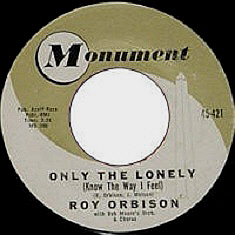
April 10: Roy Orbison, "Only The Lonely"

Artist: Roy Orbison
Song: "Only The Lonely"
Album: Only The Lonely (single)
Year: 1960


CLICK HERE TO LISTEN (will open in new tab)


While there are virtually no performers that would be frustrated by a hit single, there are a number of cases throughout music history where such success can give listeners the wrong impression of the artist in question.  Though such a song may show the talents of a performer, often times, they are not representative of the career in question, and yet one can even find cases where this was true, and the musician completely compromised their sound and made this "new" sound the approach on later recordings.  However, there is one performer who found commercial success both in his own sound, as well as one that was slightly out of the norm, and it is the latter of these songs that seems to overshadow the style he played for a majority of his career.  Even the name Roy Orbison almost instantly brings to mind his immortal song, "Oh, Pretty Woman," as it has become almost a cliché part of music history, and yet on many levels, it was not representative of he sound he had been playing for years prior to its release.  Having been long associated with the crossover sound between rockabilly and rock and roll, Orbison often highlighted the darker, more dramatic tones that could be conveyed in music, and it is this approach that continues to influence artists to this day.  While it somewhat lives in the shadow of his previously mentioned hit, few songs better define Roy Orbison than his breakthrough 1960 single, "Only The Lonely."

On many levels, "Only The Lonely" has as much of a "classic" sound as one will find anywhere, and yet even within the musical arrangement, one can hear the difference in the overall sound that defined Orbison.  The most dominant sound on the song is the perfectly balanced, swinging drums, and this sound alone instantly places the song into its time, as one can easily imagine the song being played in the shops and cars of that era.  This softer, smooth sound is complimented by a light guitar that at times, almost disappears from the track.  It is the constant, yet simple piano that seems to present the greatest contrast, and when one looks at the entire arrangement on "Only The Lonely," it is this aspect that almost stands out as "odd."  The piano seems to be playing at a different tempo, and even has a slightly different tone, and yet it somehow manages to fit in with the almost melancholy sound of the rest of the song.  The way in which the music seems to slowly sway is the key to matching the voice of Roy Orbison, and it is one of the few songs that strikes the ideal balance in that it is too slow to be a real "rock" song of the era, but not slow enough to be a "slow dance" tune either.  It is this aspect that sets the song almost completely in its own category, and the strings that highlight the musical pauses add the ideal finishing touch, making "Only The Lonely" a musical masterpiece unlike any other in history.

Yet even as uniquely perfect as the music may be, there is simply no other singer in history that is worthy of being mentioned in the same breath as Roy Orbison.  In terms of both his vocal ability, as well as the uncanny level of emotion which he was able to convey, Orbison knew no peers, and it is much the reason that so many later performers cite him as a major influence.  It is on "Only The Lonely" that one can better experience the sheer power and beauty of Orbison's voice, as his almost operatic sound is rarely present on his other hit singles.  The way in which his voice soars remains just as stunning after repeated listenings, and it is also in these moments that one can better feel the pained, almost tragic sound within his voice.  After hearing his performance on "Only The Lonely," it becomes abundantly clear that Orbison was the master of singing of heartbreak, as there is a sorrow within his voice, yet there is also a clear sense of strength.  The way in which Roy Orbison was able to have these two elements co-exist is what makes him so unique, and the lyrics which he penned serve as the final piece of proof that one needs to understand his massive importance and influence.  While the songs' title makes the theme quite clear, there are few moments in music history that are as simple, yet powerful as when Roy Orbison croons, "...there goes my baby, there goes my heart, they're gone forever, so far apart..."

Though many may assume that it was his chart-topping follow up single that most musicians cite as their main influence from Roy Orbison, the fact of the matter is, "Only The Lonely" is mentioned far more often when the Orbison catalog is discussed.  Along with lyrical references from the likes of Bruce Springsteen, as well as both the Orbison biography and stage-musical sharing the name of the song, the song itself was inducted into the Grammy Hall Of Fame in 1999.  It is due to these reasons, along with the sound and mood that can be heard on "Only The Lonely" that makes for an easy case when one looks to find "the" defining song of Roy Orbison.  Furthermore, there are few songs from anywhere in history that convey the "I'm hurt, but I'll be fine" sentiment as perfectly as one finds here, and it is this very attitude that Orbison would deploy time and time again throughout his career.  It is this mood and approach that also helped to separate Orbison from the other rockabilly-based singers that had dominated the charts for years, and it in many ways paved the way for the "darker" musical acts that would follow over the next few generations.  The way in which Orbison's voice contrasts with the "doo wops" of his backup singers remains one of the most beautiful musical contrasts in history, and it is one of the many reasons that there are few recordings from any point in music history that come close to the sheer mastery and drama that can be experienced on Roy Orbison's defining 1960 single, "Only The Lonely."

Saturday, April 9, 2011

April 9: A Tribe Called Quest, "Bonita Applebum"

Artist: A Tribe Called Quest
Song: "Bonita Applebum"
Album: People's Instinctive Travels And The Paths Of Rhythm
Year: 1990


CLICK HERE TO LISTEN (will open in new tab)


Whenever there is any sort of dominant sound, there will be those artists that make a point of playing music that is as far away from it as possible.  This was the reason why sounds like punk, heavy metal, and even bop-style jazz all came into existence, and yet one can easily see how even within each of these styles, the same idea can be found in the sub-groups therein.  Though each genre has had many occurrences of this trend, it was perhaps never as obvious as when the "underground" scene began to emerge from the shadow of the so-called "gangsta rap" movement of the late 1980's and early 1990's.  While many of the artists in this underground scene had their own, unique takes on the hip-hop sound, it was the more artistic, intelligent approach that offered not only the starkest contrast, but the most exciting and original sounds of all.  Groups like De La Soul and digital underground paved many inroads of this "alternative" rap sound, yet there is no question that high atop the list of influential bands of this style stands the unrivaled trio, A Tribe Called Quest.  Ignoring the "macho" themes and sounds that were dominating hip-hop, A Tribe Called Quest quickly proved that there was a place for more serious matters within the genre, and their 1990 debut, People's Instinctive Travels And The Paths Of Rhythm.  Fusing together brilliant rhymes with more subtle and deeper grooves, the unique genius that is A Tribe Called Quest was rarely better than what one can experience on their first single, 1990's, "Bonita Applebum."

At the time that "Bonita Applebum" was released, more aggressive, confrontational sounds were the "in" sound within hip-hop, and for a group to take such a blatant step in the other direction almost guaranteed them little commercial success.  However, within the first few moments of "Bonita Applebum," the groove establishes itself, and it becomes a song that is impossible to forget.  There is a smooth, yet upbeat nature to the music, and it is in this song that one can quickly understand and appreciate the "artsy" achievements that can be found within hip-hop music.  The two main samples being used are "Daylight" by RAMP and "Memory Band" by, Rotary Connection.  The way in which these two pieces are blended together to give the song its distinctive "knock" remains one of the greatest moments in hip-hop history, and even more than two decades after its first release, it is still just as captivating.  The music helps to solidify the mood and themes at play within the lyrics, as there is a sensual, almost intoxicating feeling throughout the musical arrangement, and at the time, such a sound was almost completely unheard of within hip-hop.  It is also this sound that links the band to the smooth soul movement of the 1970's, and the key to the success of the music is that it sounds so natural and unforced, and in many ways, the music could have easily stood on its own.

However, the presence and performance of the one and only Q-Tip is what truly pushes "Bonita Applebum" to legendary status, and his rhyming here remains some of the finest of his career.  Much in the same way that the music was a contrast, Q-Tip's more refined and relaxed sound manages to have more impact than his aggressive peers, and the visuals that he builds within his words would go on to inspire an entire generation of more poetic emcees.  It is the almost conversational style with which he delivers his rhymes that brought many new fans to the world of hip-hop, as he found a way to bring an almost jazz-style vocal to his songs, and this further highlighted the almost free-form nature of the groups' music.  Furthermore, Q-Tip rarely even comes close to any themes explored within a majority of hip-hop, and on "Bonita Applebum," he takes a unique look at the idea of lust, making it clear that he understands the difference between that and the cliché theme of love.  Managing to find a way to be explicit without cursing or being lewd, there is something far more alluring when Q-Tip rhymes, "...I'd like to kiss ya where some brothas won't, I'd like to tell ya things some brothas don't..."  Yet it is the songs' refrain that has become an iconic part of hip-hop history, and Q-Tip forever cemented his legacy with the simple line, "...Bonita Applebum, you gotta put me on..."

In the decades since "Bonita Applebum" was released, it has made appearances and been referenced to in a wide number of hip-hop classics.  From The Fugees re-sampling the sound to P.M. Dawn outright quoting the chorus (but changing the name) to Jay-Z taking a similar approach on his song, "I Know," it is clear that the song touched every corner of the hip-hop world, and remains just as fresh and relevant more than twenty years later.  This alone would be enough to prove just how influential a group lived within A Tribe Called Quest, but it is also the way in which so many emcees have taken Q-Tip's sound and style and made it their own that shows just how much of a shift the group was able to create.  Granted, the groups' other emcee, Phife, does not make an appearance on this track, but the impact of the song remains just as strong.  Furthermore, Q-Tip is also able to drop a bit of subtle social commentary, as he advocates for the use of "proper protection" when he rhymes, "...satisfaction, I have the right tactics, and if you need 'em, I got crazy prophylactics..."  It is this socially aware and responsible theme that would prove to be the final element in the "alternative" hip-hop scene, and even to this day, one can still clearly hear the impact of A Tribe Called Quest and their game changing musical approach.  Though it is difficult to find a "bad" song within their catalog, there is no question that the world of hip-hop was forever changed following the released of A Tribe Called Quest's monumental 1990 single, "Bonita Applebum."

Friday, April 8, 2011

April 8: The Kingsmen, "Louie, Louie"

Artist: The Kingsmen
Song: "Louie, Louie"
Album: Louie, Louie (single)
Year: 1963


CLICK HERE TO LISTEN (will open in new tab)


Often times throughout the long course of music history, the reason why a song was so significant can be lost due to a large number of reasons.  Perhaps the sound of a song does not seem as "edgy" due to changes in music trends; or maybe it was due to the societal realities of a certain time that pushed the song to its fame, but there are situations where one must step back and re-evaluate the impact of a given recording.  Yet there is one song and one group that had a long-reaching impact, and yet when one looks at their most memorable musical achievement, it is almost baffling to think that the song in question holds such an iconic spot.  Though they are not often given credit for their influence on the punk and "DIY" movements, there is no question that The Kingsmen were one of the "fathers" of these styles of music.  While the band only lasted for a few years, going through a large number of changes in lineup, they were able to release a pair of hit singles, with their first remaining one of the most well known songs in all of music history.  Yet within this legendary single, there lives a moment in music history that goes against nearly everything that one assumes "must" be present for a song to find success.  However, from the unique tone to the unmatched level of energy to the unforgettable riff, there is simply no other song in history that can measure up to The Kingsmen's iconic 1963 single, "Louie, Louie."

Though there are many riffs throughout the history of music that cannot be mistaken, few have kept such a status across generations as one hears in the opening notes of "Louie, Louie."  The riff, played by keyboardist Don Gallucci and guitarists Mike Mitchell and Jack Ely, is as simple as they get, and yet within it there is some intangible element that helps it seem like something far more complex.  Perhaps it is the spirit that can be felt through the playing, as there is no question that The Kingsmen are playing something far more defiant that the "standard" rock style of 1963.  The way that this sound combines with the deep bounce of bassist Bob Nordby is where "Louie, Louie" finds its unique dance rhythm, and makes it a bit understandable why the song was embraced as widely as it was upon first release.  Yet it is drummer Lynn Easton that becomes impossible to ignore, and the rough, echoing sound of his playing give the song a tone like nothing else in history.  It is this rough, unpolished feel that the entire band presents which makes "Louie, Louie" so special, and this sound would develop into the "DIY" movement that rose to prominence in the early 1980's.  The fact that the mix on the song is so strange is due to the fact that there were only three microphones used for the recording, with the majority of the sound being picked up by a microphone hanging from the ceiling of the studio.  The fact that this odd sonic balance manages to somehow become endearing is the "magic" behind the appeal of "Louie, Louie," and also the reason no other band has been able to match the sound of The Kingsmen's recording.

However, one cannot overlook the fact that the tone and swagger that Jack Ely brings to the vocals are surely what pushed the song to the top of the charts, as the attitude he conveys is "exactly" what teenagers still look for in their music.  Bringing a growl and a shout, the volume of his voice seems to waver at times, and this was again due to the microphone situation during the recording.  As legend has it, Ely had to stand on his tip-toes and "push" himself up toward the microphone on the ceiling to record his vocals, and one can hear this "movement" at various times throughout the song.  Yet it is also his singing that brought a great deal of controversy to "Louie, Louie" shortly after it was released, and there was a time when the band was being investigated by the FBI for "indecent" performance.  However, the lyrics are as tame as any other recording of "Louie, Louie," aside from what remains the most often overlooked "f-bomb" in music history.  This occurs about a minute into the song, when you can hear Lynn Easton accidentally knock his drum sticks together, and he swears in frustration.  Again due to the nature of the microphones in the studio, his voice is quite clear (if you listen for it), and you can even sense a giggle in Ely's voice has he begins the next verse.  Even today, most radio stations play the song without an edit, as most are unaware of this rather clear vocal addition.

Strangely enough, the "f bomb" is not the only "screw up" that can be found on "Louie, Louie," and the fact that the song was still released with a number of "problems" is in many ways the true essence of the punk rock ethos.  As the band approaches the third verse, it becomes clear that they are not on the same page, as Ely seems to enter the verse section too early, and quickly cuts off his singing.  This is "covered" by Easton playing the "fill" two times in a row, before the band slides back into the song.  The fact that the group kept this blatant error on the final recording makes the song all the more endearing, as it is clear that they were more concerned about the "feel" of the song than about playing it perfectly.  Then again, the band spent less than an hour recording the song, paying just under forty dollars for the studio time.  Furthermore, the released version of "Louie, Louie" was recorded in only one take, and the slightly sloppy feel of the song is on many levels "what" rock and roll is all about.  Yet The Kingsmen were not the first or last artists to record "Louie, Louie," and yet it is their version that remains definitive nearly half a century later.  In fact, many of the "errors" that appear on their recording have become "part" of the song, with many later artists purposefully copying these odd instances.  This is the final piece of evidence that proves just how significant and influential a song one can experience within The Kingsmen's recording, and while many assume that hit singles must exhibit perfection, it is the 1963 recording of "Louie, Louie" that proves that attitude and musical honestly can be far more appealing, and since that time, there has never been a recording of equal impact.