Tuesday, December 7, 2010

December 7: Tom Waits, "San Diego Serenade"

Artist: Tom Waits
Song: "San Diego Serenade"
Album: The Heart Of Saturday Night
Year: 1976


CLICK HERE TO LISTEN (STUDIO) (will open in new tab)


CLICK HERE TO LISTEN (LIVE) (will open in new tab)


While it is perhaps the most common theme throughout the history of recorded music, it is impossible to argue that writing a good love song is an "easy" task.  Furthermore, to write from an original perspective may appear as almost a laughably difficult task, as one can argue that over the decades, the subject has been approached from every angle.  Thankfully, there have always been musical visionaries and other such performers of great stature that have built their careers on their unique perspectives, and this is much the reason that Tom Waits remains one of the most highly respected and truly brilliant performers in all of music history.  Whether it has been due to his gruff vocals, his mind-bending lyrics, or the unmatched musical creations he puts together, there are few artists in history that have shown as wide a range of sounds with as consistent a level of superior sound as one finds in the Waits catalog.  As the decades passed, Tom Waits has pushed the boundaries on what can be achieved musically, and yet on his early records, he cemented his name as one of the most talented writers in history, bringing a unique beauty to characters that lived on the "other side" of the tracks from the traditional subjects of more melodic songs.  This was never more clear than on his 1974 release, The Heart Of Saturday Night, and the pure genius and beauty that makes Tom Waits so extraordinary can be experienced in the song "San Diego Serenade."

Though the studio version of "San Diego Serenade" is a brilliant moment in music history, it is in the live performances of the song where one can truly understand the deeper facets of the song.  Just a few short weeks after the albums' release, Waits appeared on a New York radio station for a stunning, intimate performance, and it circulates as a bootleg called, Nighthawks On The Radio.  With little more than a piano, his voice, a hi-hat, and a few bottles of beer, the version of "San Diego Serenade" found here stands as one of the most beautiful moments in all of music history.  The key musical phrase around which the entire song is built brings with it a sense of movement and imagery that is rarely found within such a sparse musical arrangement.  Even without the lyrics, the music conveys the scene of a late-night walk down a city street, and one can feel a light rain falling as the song progresses.  The fact that these images are so vivid is a testament to the talents of Tom Waits, and the way in which the song seems to move slowly, yet never lulling, only adds to the fantastic mood of "San Diego Serenade."  Furthermore, one can hear the notes as being played by the stories' protagonist at a dingy piano, either in an empty bar of in a run-down apartment.  It is this beauty in "urban decay" that makes Waits so unique, and also serves as proof that even an idea as "sacred" as love can be approached from any angle.

If there is one aspect of the career of Tom Waits that has become more distinctive over the decades than his music, it is without question his amazing singing voice.  Few artists from any time period have been able to capture as much emotion in vocals as Waits does on nearly every song, and his gritty, gruff voice is instantly recognizable.  While the studio recording of "San Diego Serenade" offers a fantastic vocal performance, on the live take, Waits sinks deeper into the character, and the true spirit of the song becomes more clear.  Waits also sings in a lower octave on the live version, and in retrospect, it seems a far better fir for the overall mood of "San Diego Serenade."  Regardless of how he is singing, the lyrics of "San Diego Serenade" are stunningly beautiful in a manner unlike any other song in the entire history of music.  Though at first glance, the words may seem a bit harsh for a "real" love song, once one experiences how Waits delivers each line, it is clear that this is perhaps the most sincere and honest love song ever written.  Leaving the cliché, romanticized ideas of love behind, few cannot relate when Waits sings lines like, "... I never spoke 'I love you' 'til I cursed you in vain...," and it is more honest and "real" observations such as this that set "San Diego Serenade" far apart from nearly every other song.  Capturing the true emotions and frustrations of an undeniable love, and combining it with a bit of an edgier, grittier mood, "San Diego Serenade" stands as what one can see as the love song for "everyman."

As the decades have passed, Tom Waits has pushed the envelope on what is capable within recorded music, often times making songs that are so eccentric, they defy any type of musical classification.  Yet in his early days of recording, he penned darker, more realistic portraits of characters that were far easier to relate to than the subjects of most other songs to that time.  It is this sense of realism that defines the music of Tom Waits, as he is a story-teller like none other, and it is due to this that one can easily argue his place among the greatest writers and performers in all of music history.  His 1974 album, The Heart Of Saturday Night, captures the romance of late-night in the city in a way unlike any other artist, and one can only assume that the songs come from people he saw firsthand, if not his own personal experiences.  With "San Diego Serenade," Waits created what can be seen as the "ultimate" love song in terms of the deeper, more honest realities of love, and one cannot help but be moved when he croons lines like, "... I never saw your tears until they rolled down your face..."  The song captures the struggle of coming to terms with "true" love, and though it may be surprising to some, a similar approach to the subject has rarely been attempted anywhere else in music.  Yet the song remains romantic in its own, sweet way, and it is this ability to craft non-traditional musical moments that serves as proof of just how fitting the term "genius" is for Tom Waits, and his 1974 song, "San Diego Serenade," remains nothing short of a musical masterpiece.

Monday, December 6, 2010

December 6: Daily Guru, "Gurucast #49"

CLICK HERE TO LISTEN (will open in new tab)


(Left Click (PC) or Command-Click (Mac) to save it to your desktop...it's about 75MB)

One hour of amazing music and SOME commentary from "The Guru" himself. 

Tracklist:
1. The Ruts, "Something That I Said"  The Crack
2. The Four Tops, "Reach Out I'll Be There"  Reach Out I'll Be There (single)
3. The Noisettes, "Sister Rosetta (Capture The Spirit)"  What's The Time Mr. Wolf?
4. Smashing Pumpkins, "Hummer"  Siamese Dream
5. Baxter, "Ballad Of Behavior"  Baxter
6. John Coltrane And Johnny Hartman, "Dedicated To You (Mono version)"  John Coltrane And Johnny Hartman
7. Tori Amos, "Icicle"  Under The Pink
8. Liz Phair, "6'1""  Exile In Guyville
9. Jane's Addiction, "Mountain Song"  Nothing's Shocking
10. Joe Strummer And The Mescelaros, "Arms Aloft"  Streetcore
11. The Descendents, "Suburban Home"  Milo Goes To College
12. Breakestra, "Family Rap"  Hit The Floor
13. King Sunny Adé, "Ja Funmi"  Juju Music

Sunday, December 5, 2010

December 5: Slayer, "Raining Blood"

Artist: Slayer
Song: "Raining Blood"
Album: Reign In Blood
Year: 1986


CLICK HERE TO LISTEN (will open in new tab)


One of the most frustrating, yet consistent trends within the heavier, louder styles of music is that as bands age, their music almost always loses its edge and becomes softer and more mellow.  Additionally, many of these same bands find their themes moving from those of more aggressive and frustrated ideas to more sentimental songs, with some bands even going as far as writing love songs.  While many of the bands in question attempt to justify these changes as the band "growing" or "exploring new musical ideas," the fact of the matter is, very few bands can perform with such aggression over a long period of time.  Thankfully, there are bands like Slayer that stand as a reminder that not only is it possible to stay true to such a sound, but if a band does, they can get better and more focused as the years pass.  Without question, Slayer stands as one of, if not the most important thrash-metal band in history, and they also stand as the pinnacle of a band that refuses to compromise any aspect of their music.  Boasting a number of truly phenomenal records, it is their 1986 release, Reign In Blood, that stands as nothing short of an absolute classic.  Packed from beginning to end with the ripping guitars and stunning vocals that have defined the band for nearly thirty years, there is perhaps no better definition of the band and their sound than one finds on their monumental 1986 song, "Raining Blood."

Much like a majority of their songs, "Raining Blood" wastes absolutely no time setting the mood, as there is really no introduction to the song, as it begins with an aggressive, distorted guitar piece, and within moments, drummer Dave Lombardo kicks in at top speed.  It is this aspect, combined with the guitars of Jeff Hanneman and Kerry King, that defines both the song and the band, and the aggression found therein is truly unlike anything else ever recorded.  Within seconds, "Raining Blood" whips into an unprecedented frenzy, with the band walking the line between music and chaos in absolutely perfect fashion.  The final musical element of bassist Tom Araya pushes the song into a musical space that can only be defined by the song itself.  It is due to this unequaled sound that one can easily place Slayer at the top of the list of thrash metal bands, and one cannot deny the fact that the large shift in sound from their earlier efforts was likely due to the presence of producer Rick Rubin.  Throughout all of Reign In Blood, but most clearly on this song, Rubin's deep understanding of the sound the band was trying to achieve becomes clear, and after this album, Slayer would almost exclusively work with Rubin as their producer.  It is perhaps due to this long-standing relationship that Slayer has been able to retain their vicious, decimating sound, and there are few songs that better represent their sonic assault better than "Raining Blood."

While the music certainly knows no match, one can also make the case that Tom Araya is the greatest metal vocalist in history.  Rarely presenting anything close to what one would consider "singing," Araya's aggressive, straightforward vocals are arely anything short of perfect.  Furthermore, one can look to Araya's work as the definition of the "heavy metal scream," as countless artists since have copied his high-pitched wail, yet none have come close to matching it in terms of either tone nor emotion.  On "Raining Blood," Araya is in perfect form, as he almost raps the lyrics over the break-neck pace of the music.  The intensity in his voice is truly unparalleled elsewhere in music, and the lyrics which he sings are about as perfect as one could imagine for the type of music which Slayer plays.  Written by Hanneman and King, "Raining Blood" speaks of a person who has been kicked out of heaven, and whilst in Purgatory, he plots for revenge.  As the song progresses, the character's power builds, and this can be heard when Araya states, "...return to power draws near..."  The band leaves nothing to question, when a bit later, Araya delivers the line, "... abolish the rules made of stone..."  Eventually, the character succeeds in his overthrow, and the final line of, "... now I shall reign in blood!" serves as one of the most evil, yet not cliché moments in music history.  The way in which Araya delivers every line helps the song to stay more on the side of dark and brutal, and there are simply no songs since that can match its intensity and impact.

Truth be told, along with the lead track on Reign In Blood, it was this song that vaulted Slayer into the most elite groups in the entire history of heavy metal.  The way in which the mood on "Raining Blood" is punctuated by the interludes of a thunderstorm manages to work perfectly, and it adds to the overall intensity of the song.  One cannot overstate the importance or lasting impact of "Raining Blood," as over the decades it has been covered a number of times, as well as making appearances in television, movies, and video games.  Perhaps the most unique re-appearance of "Raining Blood" appeared on piano-songstress Tori Amos' 2001 release, Strange Little Girls, and it is instances such as this that prove the long lasting and wide ranging impact of the song.  Yet one can also make the case that "Raining Blood" is a bit off from Slayer's usual musical approach.  Within the song, one can find a bit of a slower pace to the music, and there is also a bit more of a sense of melody on "Raining Blood."  However, while this cannot be denied, the overall intensity and aggression that defines Slayer as a band is in top form, and this is largely why the song stands out among the bands' finest moments.  Setting the standard for what could be achieved within the genre of thrash-metal, there is simply no other song in music history that carries a similar punch and aggression than one finds in Slayer's 1986 masterpiece, "Raining Blood."

Saturday, December 4, 2010

December 4: Jay-Z, "The Takeover"

Artist: Jay-Z
Song: "The Takeover"
Album: The Blueprint
Year: 2001


CLICK HERE TO LISTEN (will open in new tab)


As hip-hop music began to take hold as the dominant sound in popular music during the mid and late 1990's, one can easily see how the genre slowly lost focus from its original intent.  Artists seemed to become more concerned with image and how fast they could rhyme or how vulgar they could be, instead of paying attention to lyrical content and the true "craft" of rapping.  This trend continues to this day, but thankfully, there are a handful of emcees that refuse to "dumb down" the art, instead showing why "real" hip-hop will always rise above others.  Standing as what one can see as the "savior" of hip-hop in modern times, there are few emcees in history that bring a similar performance energy or tone as one finds in the music of Brooklyn, New York's Jay-Z.  Epitomizing "cool," his rhymes never sound forced, and his lyrics are always original and powerful.  While he has had a number of hit records and singles during his career, one cannot argue the sheer perfection that he achieved with his 2001 release, The Blueprint.  Every track on the album has its own style, yet taken as a complete piece of work, few albums from any point in hip-hop history can compare even in the least.  Though the album boasted some of his most memorable singles, to experience the true lyrical punch and stunning skill that "is" Jay-Z, one need look no further than his 2001 song, "The Takeover."

The moment "The Takeover" begins, Jay-Z sets the bar for performance extremely high as he treads on what many see as "hallowed" grounds, sampling one of the most iconic moments in all of music history.  Lifting the bassline, along with Jim Morrison's unforgettable yell from the song "Five To One," Jay-Z not only proves his deep knowledge of all forms of music, but it also gives "The Takeover" a feel like no other hip-hop song.  The songs' producer, a then unknown artist by the name of Kanye West, goes further with the composition of the song, as he loops part of David Bowie's, "Fame," which adds a fantastic level of depth to the bassline.  The final piece of the musical backing is a slightly more subtle use of KRS-ONE's iconic, "Sound Of Da Police," and the combined track remains today one of the most hard hitting and original ever recorded.  "The Takeover" further sets itself apart as it does not follow the rather annoying trend of the time which called for the bass on the song to be such that it blurred the rest of the music.  Each sample has its own space on the song, and this enables the overall sound to become larger than the sum of its parts.  Furthermore, once one hears the complete song, it is easy to see that not only were these songs selected for their musical merits, but the song titles themselves perfectly echo the overall spirit of the rhymes from Jay-Z.

Leaving his exceptional skills in terms of making hit songs elsewhere, Jay-Z uses "The Takeover" to prove that at the end of the day, he was perhaps the most capable artist on the planet when it came down to the original roots of hip-hop music.  Bringing his measured, clear tone, "The Takeover" stands today as one of the most brutal and brilliant "dis" tracks ever recorded.  One of the keys to Jay-Z's power on record is the fact that his rhyming never sounds forced, and it is this natural sound that automatically gives him far more "street cred" and authenticity than a majority of his peers.  While he had already released a number of singles that dominated the pop charts, on "The Takeover," Jay-Z settles two of his biggest "beefs," as he destroys both Nas and Prodigy (of Mobb Deep) simultaneously.  Rarely resorting to "easy" attacks such as swearing or insulting their families, Jay-Z goes after them line after line, slamming their personal history, as well as their lackluster efforts in the hip-hop arena.  Whether he is calling out Nas', "...one hot album every ten year average..." or Prodigy for their inability to ever follow their legendary "Shook Ones Part II," Jay-Z manages to decimate the pair with every line, taking far more of his attack to Nas.  Though Nas would respond in song, the fact of the matter is, "The Takeover" packs a lyrical punch from which one simply cannot recover.

Though "The Takeover" was certainly not recorded for commercial success, it became a hit within the hip-hop community.  Those who understood the aim and aggression behind the song could do nothing but stand in awe of its power, and the idea and sound were even reused in 2004, as Mos Def released a song attacking the hip-hop industry in general called, "The Rape Over."  Even the talentless, pretty-boy band Fall Out Boy reference the song, as on their 2007 album features a track called, "The Take Over, The Breaks Over."  Furthermore, the fact that "The Takeover" still hits as hard today as it did upon first release serves as a testament to what an extraordinary song the team of Jay-Z and Kanye West created.  The fact that they used three of the most well-known songs ever recorded, yet manage to do justice to them all makes the song even more unique, as in most cases, when one uses such "sacred" music, it ends up coming off as disrespectful to the original performers.  Though there was not much of a question by the time "The Takeover" was released, it was the sound and music found on the track that solidified Jay-Z's place as the "King" of New York City hip-hop, and it can also be seen as a "warning" to any other emcees that might have wanted to test Jay-Z's "rap battle" talents.  From his strong, clear lyrical pummeling of his targets, to the perfectly orchestrated musical backing, there are very few, if any tracks in hip-hop history that bring a similar mood and sound to that which one finds on Jay-Z's 2001 classic, "The Takeover."

Friday, December 3, 2010

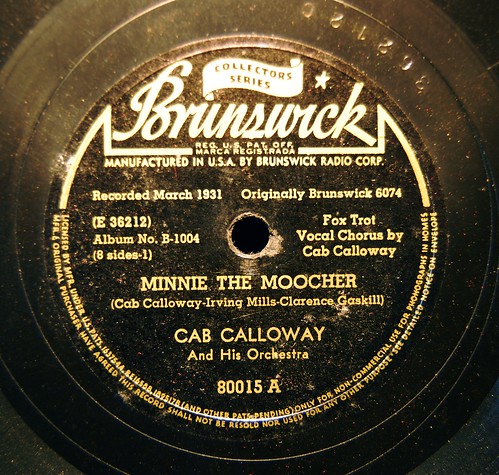
December 3: Cab Calloway, "Minnie The Moocher"

Artist: Cab Calloway
Song: "Minnie The Moocher"
Album: Minnie The Moocher (single/78)
Year: 1931


CLICK HERE TO LISTEN (will open in new tab)


Though many artists and bands have had lengthy careers, in nearly every case, as the decades pass, their popularity and relevance decline, or there are at least some periods where they seem to "disappear" for a few years.  This is rarely the "fault" of the artist, and more easily attributed to the natural ebb and flow of musical tastes and trends.  When an artist is able to stay a key player through such times, they are almost always later seen as some of the most important performers in history, and when one considers this fact, a single name rises to the very top of the list.  Though many performers would consider a career of two or three decades more than enough to earn the most elite standing in the history of music, there is a single artist who was a key player in music for more than sixty years.  While some may argue that he hit his artistic peek in the 1930's, one can see the continual influence and relevance of the one and only Cab Calloway across nearly the entire history of recorded music.  In both his exceptional talent as a writer and composer, as well as his unparalleled stage presence, there is simply no other artist in history that is on the same level, and this is much the reason that he remains one of the most revered performers of all time.  Due to his exceptionally long career, there are a number of bright spots in his recordings, yet one cannot argue any other song having the same feel or influence as Cab Calloway's seminal 1931 single, "Minnie The Moocher."

There are few songs that have transcended both generations and genres in the way that "Minnie The Moocher" has over the decades, and it stands as one of the few songs that "everyone" knows, and with the mere mention of the name, the unforgettable musical hook comes instantly to mind.  Originally performed by Cab Calloway's band, over the years his backing band employed some of the most famous names in history, with the likes of Dizzy Gillespie and Doc Cheatham all spending time in his employ.  The song itself is loosely based on the 1927 song, "Willie The Weeper" by Frankie "Half-Pint" Jaxon, yet Calloway's version has completely exclipsed it over the decades.  The trademark horn progression and "walking" bassline are perhaps the most infamous in all of music history, and they have been used in countless films, commercials, and cover versions over the years.  It is this aspect that highlights the brilliance of Calloway, as even though the sound perfectly represents the early hybrid of big band, swing, and jazz, it carries with it a certain mood that has never gone out of style.  The dancing piano provides the ideal compliment to the rest of the music, yet one cannot help but sit in awe of the phenomenal trumpet work, and there are few moments in history that are as perfect as the muted, almost vocal progression that precedes the lyrics.  Even those who are not fans of big band or swing cannot help but be drawn in by the arrangement on "Minnie The Moocher," and this is the most clear sign of the genius that was Cab Calloway.

However, as unforgettable and influential as the music is, one cannot discuss anything about "Minnie The Moocher" without giving credit to the groundbreaking vocal performance of Cab Calloway himself.  His personality and stage presence manage to come through in brilliant fashion on the song, and even after hundreds of listenings, it remains just as enjoyable and fresh as the first time.  Clearly well before the era of any ability to modify the vocals, Calloway is without question one of the most truly talented artists in music history, and his flawless execution of the "scat" lyrical section is nothing short of a historical moment.  The core lyrics of "Minnie The Moocher" are a rather unsubtle send-up to a life of drug use and abuse, and while many will easily understand references like someone being "cokey," it was Calloway's jive terms like "kick the gong around" (an allusion to smoking opium) that make the subject matter well beyond taboo for the time period.  However, it is the "scat" section of "Minnie The Moocher" that have become absolutely legendary, and the "call and response" portion remains an unparalleled moment in music history.  The way in which Calloway begins with an easy line, making them more difficult as they go never gets old, and one cannot help but smile when the audience can no longer follow his tongue-twister.  Again, considering the fact that overdubs were not possible, one can only sit in awe of Cab Calloway's phenomenal performance on "Minnie The Moocher."

Whether it was the smooth, yet slightly dangerous sounding musical arrangement or the exceptional vocal performance of Calloway, there is truly no other song in history that commands the same respect and reverence as "Minnie The Moocher."  Though one would think a song from the 1930's could not carry such longevity, it still pops up regularly throughout popular culture.  The song was given its most famous revival when it was performed in full in the 1980 film, The Blues Brothers, where it was played by some of the greatest musicians in history, with Calloway working the modern audience brilliantly, while he was well past seventy years of age.  It was this moment that proved the unending relevance of Calloway and his music, and it is performances like this that solidify his place as one of the most important figures in all of music history.  The other fact that supports just how influential "Minnie The Moocher" was over the years is in the fact that the original recording sold over one million copies.  While in modern times this may not seem significant, in the 1930's, such a sale is almost unfathomable, especially considering that due to his race, Calloway was largely confined to playing smaller venues and "cotton clubs."  To put it simply, while many songs may have been more popular in their time, there is no other song or performer in history that has proven to have the impact and staying power that one finds in Cab Calloway's magnificent 1931 single, "Minnie The Moocher."

Thursday, December 2, 2010

December 2: Social Distortion, "Ball And Chain"

Artist: Social Distortion
Song: "Ball And Chain"
Album: Social Distortion
Year: 1990


CLICK HERE TO LISTEN (will open in new tab)


As the hardcore scene and sound of Los Angeles began to fade in the mid-1980's, it gave way to two primary offshoots.  One of them was the decadent, and often under-talented world of so-called "hair metal," and the other was a rather diverse, yet connected group of bands that attempted to keep the spirit of hardcore and punk alive.  While a handful of these bands found moderate musical success, due to the unique and uncompromising sound they played, a majority of the bands in this category remained relatively unknown until the onset of the 1990's.  Among these groups was one band that fused together the angst and energy of punk and hardcore with the true roots of nearly all music, and it is much the reason they have endured over the decades.  Though they began their career during the high-point of the Los Angeles hardcore scene, it was not until that scene was all but dead that the world began to notice the brilliance of Social Distortion.  In many ways, the demise of the L.A. hardcore scene can be seen as benefiting Social Distortion, as it was following this time that the group truly began to hone their distinctive sound, and they reached their artistic apex with their self-titled 1990 release.  Striking the ideal balance between punk anger and what one can see as both folk and country influences, the band redefined what was possible within the punk and hardcore genres.  Standing as perhaps their finest musical moment, there are few songs in history that are as uncompromising, unapologetic, and unsubtle as Social Distortion's 1990 song, "Ball And Chain."

From the first note of "Ball And Chain," the unique blend of sounds and styles that define Social Distrtion are instantly clear.  The blaring, crunching guitar from Dennis Danell and Mike Ness scream with the discontent of punk, yet there is a swing and softness to the sound within one can cearly hear a strong connection to the country style.  The way in which the acoustic guitar plays behind the more prominent, distorted electric is sheer musical perfection, and in many ways, it is this interplay that defines the band.  The rhythm section of drummer Christopher Reece and bassist John Maurer are equally impressive, as the winding bassline plays alongside the dry, yet forward drumming.  Reece's snare is far more prominent in the mix than most drum-work, and it is this aspect that gives "Ball And Chain" an steady walk, almost marching sound.  The combined sound gives a clear nod to the rockabilly sounds of the 1950's and 1960's, and it is in songs such as this that one can understand why so many people associate Johnny Cash as one of the earliest musicians that performed with the attitude of punk.  Furthermore, on "Ball And Chain," Social Distortion prove that to capture this attitude, one need not be loud OR fast, and that "true" punk is more about spirit and honesty than it is about volume and image.

If there was ever a singer that made it quite clear from where he pulled his style, Mike Ness makes no excuses for his love for blues, country, and folk singers.  In both his delivery, as well as the words which he writes, there is an honesty and authenticity that is rarely found elsewhere in any genre from any era.  Furthermore, Ness possesses one of the most instantly recognizable voices in history, and the grit in his singing always manages to perfectly capture the emotions within the words he sings.  "Ball And Chain" is no different, as one can easily sense the pain and frustration, as well as the close proximity that Ness has to his lyrics.  It is in lyrics like those on "Ball And Chain" that Mike Ness separates himself from any of his peers, as the honesty and agony within them remain truly unparalleled.  Though his own battle with various vices has been well documented, "Ball And Chain" is a lament that can be applied to nearly any situation, giving it a universal appeal unlike any other song.  Ignoring any ego or expectations of sound, Ness opens completely and one cannot help but feel his pain when he sings lines like, "...times are hard getting harder, I'm born to lose and destined to fail..."  Buried in his words of struggle and strife, Ness also drops one of the most brilliant lyrics ever written, and one cannot deny the simple genius found when he sings, "...you can run all your life, but not go anywhere..."

Without question, "Ball And Chain" remains today one of the most moving and overall impressive "hard luck" songs ever recorded.  Due to the authenticity that one can experience in both the singing and music, it stands far above the rest of the Social Distortion catalog, and in nearly every aspect, it defines everything that makes them such a phenomenal band.  The way in which the guitars bring the tone and attitude of punk and hardcore, yet simultaneously come off as far more roots-based gives the group a far wider appeal, and it also shows that they were clearly more talented and musically knowledgeable than a majority of their peers.  Though it took the band the better part of a decade to master this sound and style, no group since has been able to balance the hardcore attitude with the fundamentals of roots music as perfectly as one finds on Social Distortion's third album.  Throughout the record, Mike Ness puts his past and present emotions and situations on display, and it is his honesty that makes many of the songs so intriguing.  The words he sings can often be applied to a number of situations, yet the pain and frustration are rarely anything short of universal.  This ability to speak to so many different circumstances through a single lyric is a testament to his extraordinary talent, and there are few songs in history that hit as hard and in as brutally honest a fashion as one finds in Social Distortion's 1990 song, "Ball And Chain."

Wednesday, December 1, 2010

December 1: George Harrison, "Awaiting On You All"

Artist: George Harrison
Song: "Awaiting On You All"
Album: All Things Must Pass
Year: 1970


CLICK HERE TO LISTEN (will open in new tab)


To make it as a solo artist is a difficult task to begin with, but if you add in the complication of attempting to do so after being involved with a well known band, the probability becomes quite small.  Though many artists in this position will find small success with their first solo effort, to completely redefine themselves as a singular performer is often nothing short of impossible.  Furthermore, the larger their previous band was, it only makes sense that it makes a solo career proportionately more challenging.  With this in mind, it is nothing short of inexplicable to consider the fact that George Harrison made a strong case for being a more talented solo artist than for being a part of The Beatles.  Though he played a key role in the status and success of The Beatles, the fact of the matter is, once he began as a solo performer, his true talents became obvious, and one can easily make the case that overall, he was the most musically talented member of that band.  Creating musical landscapes that were far more complex and adventurous than anything The Beatles had ever done, as well as anything the other members would do as solo artists, there are simply no other albums in history that can even remotely compare to his epic 1970 triple album, All Things Must Pass.  Filled with a wide range of sounds, as well as some of the most memorable songs in history, there are many high-points from which one can choose a "best" song.  Though it was not the biggest hit off the album, there are few songs that better define the overall talent and vision of George Harrison than one finds in his 1970 song, "Awaiting On You All."

Harrison wastes no time in setting both the tone and mood for the song, as "Awaiting On You All" begins with an upbeat, almost spiraling progression that is filled with a number of instruments.  Few songs in history boast as full a sound as one finds here, and yet even with all the instruments being played simultaneously, the song never becomes cluttered or overwhelming.  This, in many ways, was the genius of George Harrison, as he proved throughout his career that whether it was a full arrangement like one finds here, or a more stripped down sound, he understood in a way unlike anyone else exactly how to ensure that each part of a song has "its place," and does not invade the space of another.  The music seems to come at the listener from every angle, and perhaps the only thing more impressive than the music itself is when one inspects the lineup that was present during the sessions.  Musicians ranging from Eric Clapton to Gary Booker to members of Badfinger all make appearances throughout the album, and "Awaiting On You All" happens to have a man by the name of Ringo Starr handling the drumming duties.  Whether it is the tambourine which is very far front on the mix, the grooving bassline, or the soaring horns, there is simply no way to accurately capture the gigantic presence that defines "Awaiting On You All," as Harrison's dancing guitar almost takes a backseat to the overall instrumentation.  The combined sound is nothing short of pure joy, and this in many ways defines one of the two "faces" that one finds within the songs on All Things Must Pass.

Along with his extraordinary talents in arranging the various instruments, on "Awaiting On You All," George Harrison also solidifies the fact that he is one of the greatest vocalists and lyricists of his generation.  There is a certain swagger to his vocal performance on "Awaiting On You All," and yet he also makes it very difficult for a listener to NOT sing along.  This universal quality to his voice is what set him aside from his former bandmates, as Harrison presented a far more humble and "everyman" style in comparison.  Along with the attitude in his voice, the range he shows on "Awaiting On You All" makes it impossible to argue that he had the most diverse voice in his former band, and through this, one can easily make the case that his talents were under-used within that group.  However, "Awaiting On You All" fits perfectly with the overall themes found on All Things Must Pass, as the record makes no attempt to hide the religious and communal ideals.  Yet there is not a moment where any of the songs come off as "preachy," and "Awaiting On You All" feels more as if it is trying to inject happiness and peace into the lives of all who hear the song.  This, in many ways, is another example of the genius of George Harrison, as he also takes a few shots at organized religion, such as when he sings, "...you don't need no rosary beads or them books to read to see that you have fallen..."  The fact that the lyrics come off as inspirational without "feeling" religious is one of the most amazing aspects of the song, and Harrison's voice has a sense of honesty and pure happiness than makes "Awaiting On You All" nothing short of infectious.

While there are many songs in the solo catalogs of the other members of The Beatles that one can easily argue were simply "leftovers" from that band, George Harrison completely redefined himself, and songs like "Awaiting On You All" make it clear that his own musical vision went far beyond the confines of his previous group.  This is not to detract from the work of The Beatles, but when one inspects the songs found on All Things Must Pass, it becomes quite obvious why that band could not go any further.  The lead single from the album, "My Sweet Lord," spent more than a month atop the charts on both sides of the Atlantic Ocean, and it was the first number one hit for any of The Beatles as solo artists.  Though that song remains an absolute classic, one can get a far better and more complete picture of the direction in which Harrison was going through "Awaiting On You All."  Few songs in history have as perfectly balanced, yet completely full a musical arrangement as one finds here, and it is the sort of song that even after hundreds of listenings, one can still discover new aspects.  The energy found on the song mirrors the lyrics in the fact that it is so perfect and absolutely beautiful that it borders on spiritual.  There is simply no way to accurately put into words the sheer brilliance that one finds here, and it is much the reason that one must experience firsthand the musical magic that is George Harrison's legendary 1970 song, "Awaiting On You All."