Wednesday, July 7, 2010

July 7: Weezer, "My Name Is Jonas"

Artist: Weezer
Song: "My Name Is Jonas"
Album: Weezer
Year: 1994


CLICK HERE TO LISTEN (will open in new tab)


At some point in their career, nearly every band will encounter a point where a large group of music listeners openly voice their distaste for the band due to a wide variety of reasons.  From image to sound to something the band may have said, it is often moments like these that draw strict lines of separation within the music community as you are either "with" or "against" that band.  Then of course, there is the odd situation of one band finding themselves in this position from nearly the moment they first appeared on the national music scene.  Deemed as "posers" from day one, over the decades, there are few groups that endured the scorn of music fans in a similar manner to that of the band Weezer.  Furthermore, regardless of "when" it hit in their career, few groups have taken such distaste with so little evidence to back up the claims of the "haters."  The main argument that the group were "posers" is nothing short of ludicrous in retrospect, as their "indie" image, combined with their hard rocking style was about as far from the mainstream (read as: grunge) sound as one could find.  Their 1994 self-titled debut (AKA "The Blue Album") yielded a number of massive hits, and perhaps people only hated the band due to their overwhelming popularity.  Regardless of the reason, Weezer were certainly disliked loudly by many, but pushing this to the side, one simply cannot deny the solid musical performances that grace their first record, and yet the albums' most brilliant song was never even fully released as a single.  While the so-called "deep cuts" from bands are usually buried in an albums' final tracks, Weezer defied this norm with the first track from the album, their irresistible song, "My Name Is Jonas."

For many reasons, "My Name Is Jonas" is an oddity in the complete Weezer catalog, perhaps most notably because it is the only song which gives writing credit to guitarist Jason Cropper.  It is Cropper who composed the songs' opening acoustic riff, yet there remains a large discrepancy as to who actually played it on the recording.  By the time the band went to record, Cropper was already gone from the band, and frontman Rivers Cuomo claims that he himself played both rhythm and lead for "My Name Is Jonas."  However, Cropper's replacement, Brian Bell asserts that it is in fact his playing on the rhythm sections for this song, and to this day, neither have rescinded their statements.  Regardless, one cannot deny the fantastic power behind the song, as the distorted, crushing guitar gives "My Name Is Jonas" a tone and attitude that play a brilliant contrast to the almost detached vocal performance.  Truthfully, "My Name Is Jonas" offers something musically for every music fan, as the central hook is absolutely irresistible, and yet there is an aggression and mood of chaos that can speak to the fans of metal and hardcore.  It is this ability to reach into so many different musical groups that perhaps incurred so much hatred, as on a musical level, it is almost impossible to relegate Weezer to a single musical category.  Driving this point home, the rhythm section of bassist Matt Sharp and drummer Patrick Wilson push the song forward throughout the track, as they are on the attack from the get go, whipping the mood into a superb frenzy of sound.  The fact that in the waning moments of "My Name Is Jonas," the band is able to seamlessly add in a harmonica solo somehow works perfectly, and the contrast between this sound and the forceful playing of the rest of the band in many ways sums up everything that "is the sound of Weezer.

Along with their original approach to their musical construction, there is an attitude and tone within the voice of Rivers Cuomo that has come to not only define the band, but in many ways, the entire "indie rock" scene as well.  With his powerful voice that sounds just as good speaking on tracks as when he is singing or yelling, Cuomo has an intangible element to his performance that is, in essence, "what" makes him so hard to ignore.  Perhaps it is the unrestrained approach he takes on "My Name Is Jonas," perhaps it is the seemingly endless sounds and styles he presents on the track.  Regardless of "what" it is, one cannot deny that there is a sound to Cuomo's singing that is rarely found elsewhere in music.  Working in perfect harmony with the music and singing, the lyrics and theme on "My Name Is Jonas" are just as unforgettable, and many interpretations of the song have been made over the years.  In reality, the song was influenced by the issues that Cuomo's brother (who is NOT named Jonas) was encountering with his insurance company following a severe car accident.  This point is instantly made clear with the opening lines of, "...my name is Jonas, I'm carrying the wheel..."  The rest of the song features lyrics that beg to be sung along with, and though they may at times seem absurd, the fact that they are so memorable shows the genius they contain.  Perhaps speaking to the music scene at the time, which was beginning to become somewhat stale, Cuomo sings the strangely profound lyric of, "...they're fresh out of batteries, but they're still makin' noise..."  Taking nearly any line from the song, there are many ways in which it can be interpreted, and this is the final piece that makes "My Name Is Jonas" such a fantastic musical accomplishment.

Truth be told, as the lead track on Weezer, it is rather strange that the song was never "fully" released as a single.  The band had already solidified their success with the first two singles, "Undone - The Sweater Song" and "Buddy Holly," and many Canadian radio stations began playing "My Name Is Jonas," leading the band to release a small number of "promo" copies of the song.  Yet for whatever reason, this idea was quickly nixed, and "Say It Ain't So" became the "official" third and final single to be released from the record.  While the Canadian promo singles remain one of the most highly sought collectors items for the band, it leaves one wondering why such a change was made, as clearly "My Name Is Jonas" had caught on without any "push" from the band.  This in many ways proves the genius behind the song, as even the biggest skeptics of Weezer cannot deny the fact that "My Name Is Jonas" contains irresistible hooks and lyrics, and the vocal performance from Cuomo stands as one of the most impressive of the entire era.  It is this fact that leads one to seriously ponder exactly why Weezer received as much disdain and negative feedback as they did, as their music defied the pop norms of the time, and is far harder rocking than the whiny drivel that would define the "indie" sound over the next few years.  Perhaps better termed as "alternative rock" as opposed to "indie rock," Weezer clearly took their influences as much from the likes of The Pixies and Dinosaur Jr. as they did from bands like The Buzzcocks, and all of these musical influences can be heard clearly on what may very well be Weezer's greatest musical achievement, their 1994 song, "My Name Is Jonas."

Tuesday, July 6, 2010

JUly 6: Suicidal Tendencies, "Institutionalized"

Artist: Suicidal Tendencies
Song: "Institutionalized"
Album: Suicidal Tendencies
Year: 1983


CLICK HERE TO LISTEN (will open in new tab)


Anger and frustration, regardless of the cause, have long been the inspiration behind songs from a wide range of genres.  From anger at power structures that fueled much of the late 1960s folk scene to the alienation that was behind a new style of hip-hop in the early 1990's, when artists find themselves painted into a corner, this is often when their finest work comes into being.  Then of course, there is entire genre which, at its core, draws all its power and inspiration from the injustices and unfairness experienced in the world.  From the early days of Minor Threat, the "hardcore" sound has always been about an unrestrained, unrelenting musical assault that became a lifeline of sorts for countless disenfranchised youth and it remains one of the few genres that has changed little over the decades.  While there have been an incalculable number of bands who have attempted the "hardcore sound," most fail and come off as little more than "kids yelling" over noise.  However, those few bands that have managed to master the sound stand as giants of music, and few groups brought the hardcore sound as perfectly or as consistently as the unforgettable Suicidal Tendencies.  One can easily make the case that their finest work was on their 1983 debut, as their unabashed, crushing sound was far beyond that of the early hardcore bands, laying the blueprint for a massive number of bands that followed.  Standing as a testament to their greatness, nearly thirty years after it was first released, there are few songs that can compare to the overall impact of Suicidal Tendencies iconic song, "Institutionalized."

The moment the song begins, it instantly lays out the circling, unsettling mood with the almost hypnotic hook that lasts runs throughout the entire song.  Led by the winding, repeating guitar riff from Grant Estes, the band is able to build a mood that is absolutely uncanny in terms of tension and pummeling power.  The bass of Louiche Mayorga is rather significant as there is a deep, almost funky groove on "Institutionalized" that is not really found anywhere else in the bands' work before they brought Robert Trujillo on board.  Regardless, Mayorga's playing on this track is nothing short of fantastic, and the way he and drummer Amery Smith create the strict, looming rhythm is the key to the songs' almost intimidating sound.  Truth be told, it is songs like "Institutionalized" that were able to show up and coming hardcore bands that there was much to be said for the idea of strong musical structure, and this song proved that the genre was far beyond just "musical chaos."  The way in which the band is able to keep building the nervous energy on each verse before exploding into the chorus sections is nothing short of stunning, and it became the formula for countless bands that followed.  Understandably, the song was heavily protested by parents across the U.S. (as was the album itself), and yet even with this factor, and the single never hitting the charts, "Institutionalized" gained a modest amount of radio air-play, and it remains one of the most important and influential songs in the history of the hardcore genre.

Working in perfect harmony with the agitating music created by his band, it was also on "Institutionalized" that Mike Muir introduced himself to the world.  Only needing to speak and scream, there are few performers of any genre that have delivered a vocal performance with the power and honesty that one finds on "Institutionalized."  The song itself is nothing short of a rant, but it is the way in which Muir seems to slowly become unhinged that not only gives him great credibility for his candor, but makes the song absolutely mesmerizing.  In many ways, Muir defines the "everyman" persona, as his voice and the way he speaks are quite "normal," and this was surely one of the key factors in the band gaining such a dedicated following.  Taking this idea of being easy to relate to and connect with, it is the words and theme of "Institutionalized" that spoke to so many, and one would be hard pressed to find a more clear and direct song of youth angst.  Though perhaps not the most poetic writer the world has known, it is simple ideas like, "...sometimes I try to do things but it just doesn't work out the way I want it to, and I get real frustrated..." that made legions of youth flock to the work of Suicidal Tendencies, as many felt as if they could easily relate to the words.  The song takes on a handful of altercations between a kid and his parents, showing how much disconnect there is between the two, and in the end, it is Muir who finally snaps, spitting the hypocrisies of the adults back in their face in grand fashion.

Though many bands have made their careers out of little more than chaotic music and screaming vocals, there are few that would exist had it not been for the pioneering work of Suicidal Tendencies.  Making a conscious effort to create firm, tension-filled musical arrangements that surely whipped countless audiences into borderline riots, it was Suicidal Tendencies that also proved that there was far more to the genre than "just screaming and noise."  On their first single, "Institutionalized," the band creates a tension and release cycle that remains largely unmatched to this day, and the wild guitar that jumps in and out of the song only helps to heighten this amazing mood.  With the rhythm section of Mayorga and Smith executing brilliantly in both distinct tempos, one simply cannot deny the high level of musicianship shown throughout the song.  It is these musical aspects that made it impossible to claim that the band were sub-standard musically, and likely the key reason why both the band and their debut record remain so highly revered all these years later.  Without question, it is their first single, "Institutionalized" that defines the band, and one would be hard pressed to find a more fitting example of the term "teen angst" or a better showing of everything it means to be a hardcore band.  From the unnerving musical progressions to the explosive choruses to the straightforward, unrestrained vocal rant of Mike Muir, there has simply never been another song with the power and lasting impact that one finds in Suicidal Tendencies stunning 1983 single, "Institutionalized."

Monday, July 5, 2010

July 5: Daily Guru, "Gurucast #27"

CLICK HERE TO LISTEN (will open in new tab)


(Left Click (PC) or Command-Click (Mac) to save it to your desktop...it's about 75MB)

One hour of amazing music and SOME commentary from "The Guru" himself.


Tracklist:
1. Goldfinger, "Just Like Heaven"  Darrin's Coconut Ass
2. Mighty Blue Kings, "Manic Depression"  Live From Chicago
3. Phish, "Gettin' Jiggy Wit It"  Hampton Comes Alive
4. Nouvelle Vague, "Dancing With Myself"  Bande A Part
5. Eddie Hazel, "California Dreamin'"  Game, Dames, And Guitar Thangs
6. U.K. Subs, "She's Not There"  Brand New Age
7. The Breeders, "Happiness Is A Warm Gun"  Pod
8. The Doors, "Alabama Song (Whisky Bar)"  The Doors
9. Johnny Cash, "Rusty Cage"  Unchained
10. Cake, "Excuse Me, I Think I've Got A Heartache"  B-Sides & Rarities
11. Cowboy Junkies, "Sweet Jane"  The Trinity Session
12. Les Claypool's Fearless Flying Frog Brigade, "Locomotive Breath"  2002/06/21
13. Black Crowes, "Hard To Handle"  Shake Your Money Maker
14. PJ Harvey, "Highway '61 Revisited"  Rid Of Me
15. Mike Gordon & Leo Kottke, "I Am A Lonesome Fugitive"  Clone
16. The Rugburns, "Take The Skinheads Bowling"  2004/12/31
17. Black Flag, "Louie, Louie"  Unreleased Track
18. The Clash, "I Fought The Law"  Live At Shea Stadium

Sunday, July 4, 2010

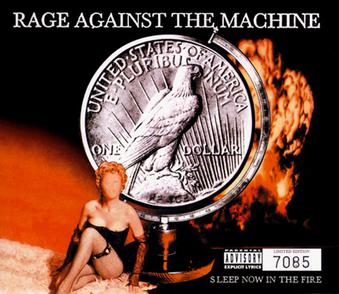
July 4: Rage Against The Machine, "Sleep Now In The Fire"

Artist: Rage Against The Machine
Song: "Sleep Now In The Fire"
Album: The Battle Of Los Angeles
Year: 1999


CLICK HERE TO LISTEN (will open in new tab)


Nearly every performer or band in the entire history of music has attempted to make a "political statement" or some sort of social critique at some point in their career.  However, the problem usually is, the band or performer in question usually takes such a different musical approach on this type of song that the argument always comes up, "...yeah, it's a good lyric, but the music is lacking..."  This often leads to the song being "written off" and lost among the rest of the artists' catalog, and largely loses any impact it may have had.  Yet there are a handful of musicians throughout history that have been able to make political and social awareness work perfectly within their music, or in some cases, this type of writing WAS their music.  From the early rallying cries of Woody Guthrie to the calls for unity of Bob Marley to the anti-everything stance of punk rock, such statements can be found across the musical spectrum and decades, as there is always "something" to fight against.  Then of course, there is the one band that made social criticism their trademark, and few bands in history have been as polarizing or as captivating as the one and only Rage Against The Machine.  Dominating the 1990's with their aggressive, unrelenting political statements and raising awareness on a large range of issues, the band created some of the most uniquely stunning music to back the brilliantly poetic yet unrelenting verses of Zack De la Rocha.  The bands' final studio effort, 1999's The Battle Of Los Angeles, found the group at the top of their game, and everything that make the group so fantastic can be found in their 2000 single, "Sleep Now In The Fire."

Perhaps the only thing that Rage Against The Machine is more well known for than their firey lyrics is the mind-boggling musical performances led by Tom Morello.  Unquestionably one of the most innovative and talented guitarists in history, there are few performers of any instrument that have pushed the boundaries on what is capable with that instrument than Morello has with the guitar.  Taking the idea of "feedback" to an entirely new level, his work on "Sleep Now In The Fire" is some of his most aggressive, yet there is a powerful groove underneath it as well.  Furthermore, any fan of punk rock who has done their homework will instantly recognize the opening guitar riff as a slight variation on the main riff from The Stooges' legendary song, "TV Eye."  Pushing the sense of urgency on the song, drummer Brad Wilk brings an opening cadence that is quite similar to a military march before he drops into a full scale assault, sounding as if he is trying to destroy his drum kit.  Rounding out the musical portion of the band is bassist Tim Cummerford, and it is his playing that whips the sound into a frenzy with his winding, agitating bassline that runs through the verses.  The trio jerks around the track as a single, wild unit, and this is where one can truly hear the amount of progress they had made as a band, as the song is far more "together" than the excellent efforts on their previous two records.  The song pummels the listener from start to finish, and even during the songs' breakdown, the almost overwhelming mood is never lost, making "Sleep Now In The Fire" one of the greatest moments in the bands' history.

Yet as stunning and influential as the music of the band is, there is no question that without the vocal work of Zack De La Rocha, it is simply "not" Rage Against The Machine.  Though he rarely deviated from his single note, beat-style speaking and screaming, the vocal work of De La Rocha was rarely anything short of completely mesmerizing.  Clearly taking massive influence from the likes of Ian MacKaye and Mike Muir, on "Sleep Now In The Fire," the level of pure fury and frustration at his targets has rarely been as high, and it is why his performance here ranks as one of his best.  Never anything short of a "call to action," it is these words that brought countless issues around the world into the minds of millions, and inspired a generation to "question authority" and get involved.  On "Sleep Now In The Fire," Zack De La Rocha takes dead aim at a handful of atrocities carried out by the U.S. government, and he raises topics on everything from slavery to mistreatment of Native Americans to war crimes.  In what stands as one of his most powerful, yet slightly chilling lyrics, he raises the idea of people simply keeping quiet to what they know is wrong with the lines, "...there is no other pill to take, so swallow the one that made you ill..."  Painting the U.S. government out to be little more than a blood-thirsty monster, he leaves nothing to subtlety when he rattles off the list of accusations in the form of the lines, "...the noose man, the rapist, the fields overseer...the agent of orange, the priests of Hiroshima..."  It is lines like these that polarized people across the U.S. as radio stations were often fined for playing the song, while many questioning youth used songs like these as their inspiration for change.

Unquestionably one of, if not the most controversial band in history, there are few groups that delivered as mighty a musical punch as one finds in the music of Rage Against The Machine.  Powered by sheer frustration and atrocities across the globe and throughout history, the band was never at a loss for targets or subject matter, and yet they are also one of the few groups in history that understood when it was the proper time to "bow out" and called it a career after a bit less than a decade.  Thankfully, the band left a trio of stunning albums, and their final effort, The Battle Of Los Angeles, is perhaps their most musically complete of their career.  Powered by a rhythm section that had an uncanny knack for creating hypnotic patterns that exploded off the records, it is Rage Against The Machine that was worthy of taking Black Flag's nickname as "the perfect band for a full scale riot."  The always unique and masterful guitar work of Tom Morello lent a massive amount of credibility to the bands' sound, as it was impossible to deny that the sounds he was creating were anything short of groundbreaking.  Truth be told, countless bands attempted to mimic the musical style of Rage Against The Machine, but no band since has come even close to their combination of crushing music and infuriating lyrics.  Standing as a perfect finishing touch, the scathing poetry of Zack De La Rocha and the manner with which he delivered these words brought the true aggression and anger of the music to a stunning climax.  Though it would be one of their final recordings, one can get everything there is to love about Rage Against The Machine from their mind-blowing 2000 single, "Sleep Now In The Fire."

Saturday, July 3, 2010

July 3: The Doors, "Riders On The Storm"

Artist: The Doors
Song: "Riders On The Storm"
Album: L.A. Woman
Year: 1970


CLICK HERE TO LISTEN (will open in new tab)


While making a poppy, upbeat song is not the easiest thing a band can attempt, history has proven that it is far less of a challenge than trying to create the opposite mood on record.  Though most bands take a few shots at making a dark, eerie, perhaps introspective song in their career, most fall short, and this is why most bands go for this approach so sparingly.  Yet the bands that are able to create rich, complex songs around more somber, often haunting moods on a consistent basis stand among the finest in music history, and nearly all of them remain the massively influential groups, regardless of genre.  Taking this idea into account, there is perhaps no band that was able to create music with as much depth and complexity, filled with unique, often unsettling moods than one finds within the records of The Doors.  Though they found great commercial success with more fast paced songs like "Light My Fire" and "Touch Me," it was the bands' knack for injecting a slow, creeping malice into their music, and the dark themes ran through nearly every song they wrote.  As the years passed, the musical arrangements of The Doors became more and more complex, as the band found new ways to create their bluesy jazz rock, and nearly every one of their records can be seen as "perfect," as they contain no "filler" tracks.  In reality, due to the odd tension and other circumstances behind it, one can make the case that it is the bands' final album, 1970's L.A. Woman, that stands as their most unique work, and everything that makes The Doors so uniquely fantastic can be found within the final song recorded for the album, the legendary track, "Riders On The Storm."

When it comes to creating a sense of the dramatic and original musical arrangements, The Doors were able to do so on a truly unparalleled level throughout their brief existence as a band.  Setting themselves instantly apart from nearly every other band in history, they are one of the few rock or blues bands to forge ahead without a bass player, and in its place, one finds the amazing keyboard work of Ray Manzarek.  On "Riders On The Storm," it is largely his contributions that set the mood, as the interplay between his playing and the guitar of Robby Krieger here remains one of the finest in the bands' entire catalog.  The duo create an amazingly deep groove with their playing, and the solo that Manzarek takes halfway through the song remains one of the most iconic musical progressions in music history.  Accentuating The Doors' love for jazz and heavy mood, drummer John Densmore is nothing short of perfect on "Riders On The Storm," as his light playing works as an extraordinary compliment to the overall "stormy" mood that the band is pushing toward for the the entire song.  Yet it is also this aspect that led to the entire L.A. Woman album being produced by the band themselves.  After hearing some of the tracks, longtime producer, Paul Rothchild, felt the songs were too much like "cocktail music," and stated that he wanted no part in this album.  One can therefore make the case that one of the key reasons the songs on this album are so different from the rest of the bands' catalog is due to his absence, and "Riders On The Storm" serves as a testament to what can happen when a band refuses to compromise their own musical vision.

Along with the theme of brilliantly complex musical arrangements, the other consistent aspect of the music of The Doors is the captivating vocal performances of Jim Morrison.  Truth be told, "Riders On The Storm" was the final song he ever recorded with The Doors, as he passed away under strange circumstances on July 3, 1971.  It is a massive understatement to say that Morrison had a flare for the dramatic; and it is perhaps more fitting to argue that nearly every vocalist that followed him took at least some aspect of their stage presence from "The Lizard King."  In reality, "Riders On The Storm" is a rather unique piece of vocal work from Morrison, and the second vocal track one can hear was Morrison whispering in hopes of creating an echo on the vocals.  Though the echo effect did not really work, the second vocal track instead gives the song a far more haunting mood, and it remains one of the "trademark" aspects of the song.  This also shows that on "Riders On The Storm," Morrison is clearly feeling very much at home, as the dark, almost menacing mood that the band creates allows him to spin his amazing tale with all the suspense and mystery that he wishes.  The lyrics speak of isolation and loneliness, and this is perhaps the "true" meaning behind the songs' title, as Morrison shows off his knack for fantastic comparisons and spinning uncanny creepiness into his words.  The combination of the almost ominous mood of the music and words, along with the almost noir-style lyrics makes "Riders On The Storm" stand as what one can argue as the "ultimate" Doors track, as without any producer to alter their vision, they achieve a sound to which everything they'd previously recorded had alluded.

"Riders On The Storm" made a strange appearance a few years later, when the surviving members of the band created new music behind poetry that Morrison had recorded and called the album An American Prayer.  The track "The Hitchhiker" presents "Riders On The Storm" fading in and out as the background music to Morrison spinning a tale of a man who picks up a hitchhiker and kills him.  The nonchalant way in which Morrison spins the tale and the use of "Riders On The Storm" takes the song to an entirely new level, and it highlights the dark, mysterious mood of the song.  The fact that the song was so easily able to be transitioned into an almost "film" setting furthers the idea of it having film-noir characteristics, and it also highlights the "movie quality" of the thunderstorm that runs throughout the entire track.  In reality, this theory is made into fact when one finds out that "The Hitchhiker" was, in fact, part of a film that Morrison had been writing at the time, and one is left to wonder if the film piece led to "Riders On The Storm."  Regardless, the mood found on the song is nothing short of stunning, and even The Doors rarely achieved sonic creation at this level.  The entire band is clearly "in the groove" throughout the entire song, and their unique musical approach rarely sounded as masterful as it does on this track.  In many ways fitting, as it was the last song the band ever recorded with Morrison, one can easily make the case that it is their crowning achievement, as the ominous, dusky mood and stellar performances from all four members makes The Doors' 1970 song, "Riders On The Storm" nothing short of a musical masterpiece.

Friday, July 2, 2010

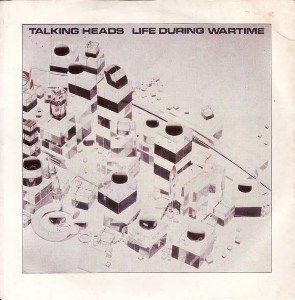
July 2: Talking Heads, "Life During Wartime"

Artist: Talking Heads
Song: "Life During Wartime"
Album: Fear Of Music
Year: 1979


CLICK HERE TO LISTEN (will open in new tab)


Though every band in history has an image of some sort, there are few groups that take this image and turn it into a complete persona that touches every aspect of the bands' existence.   Perhaps due to the fact that a majority of bands find this "image" after they have been around for awhile, in many cases, the character of the band does not always match up correctly with their sound or stage presence.  However, there are a few bands who have the "complete package," and it is impossible to separate the music from the bands' personality, and this is perhaps no more obvious than when one looks to the "art rock" movement and the early years of punk rock.  As most of these bands came out of the massively creative breeding ground of the late 1970's East Village in New York City, a number of similarities run from group to group, yet even with this sharing of sound, there was truly no other band at the time (or since) that sounded quite like Talking Heads.  Combining an almost nervous energy and unquestionable musical talent, the band is perhaps the most successful "experimental" band in history, as they constantly tried to incorporate new elements into their music, and there has truly never been another band that had anything resembling their unique sound.  Churning out one stunning musical masterpiece after another, the group possesses one of the most impressive catalogs in history, and one of their finest efforts was 1979's Fear of Music.  Far darker and bringing their love for poly-rhythm to the forefront, the tone of the album is perfectly summed up on its most well known and impressive song, the ominous and unsettling, "Life During Wartime."

The song begins innocently enough, as the synthesizer riff which the other instruments would copy to different extents does not seem that "out of place" within the era in which it was created.  This progression, played by Jerry Harrison, took on a life of its own, and more than thirty years after its initial release, it remains one of the most easily recognizable riffs ever recorded.  The song almost instantly gains its "punch" as well as slightly unsettling mood, as the rhythm section of bassist Tina Weymouth and drummer Chris Frantz create one of the many brilliantly complex rhythmic patterns that in many ways defined the sound of Talking Heads.  The interplay of tempos between the various instruments make "Life During Wartime" one of the most exciting songs ever recorded, and the drumming implies everything from jazz to punk, and this ability to intermix sounds was one of the key elements that made the band so influential.  This sense of excitement and urgency takes many turns during the song, but never loses focus, and the synth solo found here can easily be seen as the beginning of the "new wave" movement.  Furthermore, when the song slows and quiets in the third verse, the fact that the overall mood is heightened serves as a testament to the absolute genius of the band members, as few songs retain such a mood during such a stark change in tempo.  It is this interplay of complex sounds and rhythms that gave Talking Heads their signature sound, and more than thirty years after their first songs, they've yet to be matched.

While the musical landscape on "Life During Wartime" is nothing short of stunning, one can easily make the case that the vocals and lyrics of Talking Heads were always equally, if not more important to the song.  Without question, there has never been another vocalist on par with David Byrne, and everything from his somewhat dry, unwavering voice to the unique rhythms with which he delivered the words nothing short of iconic to this day.  In many ways, his performance on "Life During Wartime" captures every aspect that makes his voice so unique, as the spoken parts, as well as the sung phrases, along with the shouted portions are all nothing short of mesmerizing.  Yet as is the case with nearly every song from Talking Heads, "Life During Wartime" contains so much within the words, that the lyrics become as essential as any other aspect of the music.  This time around, Byrne paints a stark, gloomy picture of a wide-spread war zone, and he takes on the persona of an emotionless operative buried deep in the conflict.  Peering into every aspect of the life of this character, few songs have ever been able to so perfectly capture the nervous, mysterious lifestyle, and Byrne does a brilliant job of painting it to be a less than glamorous way of life.  From the warning of, "...you oughta know not to stand by the window, somebody might see you up there..." to the troubling, introspective idea of, "...I changed my hairstyle so many times now, don't know what I look like!" Byrne leaves nothing out, and this is where the almost tragic nature of the song comes into play.  Taking the tense elements of the music and working them perfectly into vocal and lyrical patterns, "Life During Wartime" remains one of the most complete and captivating musical visions ever recorded.

Proving the strength and overall impact, as well as their undeniably amazing talent, "Life During Wartime" also contains one of the most iconic lyrical phrases ever penned, and it has been copied and referenced by artists across every genre in the decades since it was first recorded.  Though the lines, "...this ain't no party, this ain't no disco, this ain't no fooling around..." may seem "too simple," the fact of the matter is, not only did they fit perfectly with the overall theme of the song, but it can also be read as a manifesto of the punk movement, and these words personified the attitude and approach that was going on at New York clubs like C.B.G.B.'s and the Mudd Club.  Throwing all conventional musical wisdom to the side, "Life During Wartime" is an attack on the dominant paradigm of music in every aspect.  From the stunning blend of traditional and African-style drumming to the wild synthesizer progression to the prominently placed, nervous groove of the bass, the song pushed music forward whether it wanted to or not.  This was one of the key characteristics of Talking Heads, as everything from their amazing music to their stage presence gave them a persona like no other band, and in every element of their group, they were constantly seeking out new approaches and innovating on every level.  Combining extraordinary musical arrangements with the signature vocal style of David Byrne and finishing it off with some of the most bleak and anxious lyrics ever penned, there are few songs that exude as much musical perfection as one finds in Talking Heads' 1979 masterpiece, "Life During Wartime."

Thursday, July 1, 2010

July 1: Chad & Jeremy, "A Summer Song"

Artist: Chad & Jeremy
Song: A Summer Song
Album: A Summer Song (single)
Year: 1964


CLICK HERE TO LISTEN (will open in new tab)


For an overwhelming majority of people, the term "British Invasion" refers to a very specific few years, and perhaps more directly, refers to three, maybe four VERY specific bands.  While the first half of this is correct, the truth of the matter is, there were dozens of bands and singers involved in this "invasion," yet a majority of them where overshadowed by the few "big" bands that seemed to take over the world over night.  In some cases, this "invasion" was spurred by the fact that the sounds being created were so "fresh" and unique that the masses flooded to them; while in other cases, the reality was that bands having trouble "catching on" in the " U.K. were finding far better success with U.S. audiences.  Fitting into this latter category, as well as showing the "non-rock" side of the British Invasion, on many levels, the duo known as Chad & Jeremy were just as important to the progression of music as their contemporaries.  Responsible for a handful of hits on both sides of the Atlantic, this duo took the base of the folk style and found a way to make it more hip and give it a pop sensibility that few other artists of the time were able to achieve.  Bringing a fantastic sense of subtlety to their music, Chad & Jeremy stood in stark contrast to the long line of bands that were basically copying the formula of the "big" rock bands, and their beautiful, original sound is perhaps no better personified than in their 1964 hit single, "A Summer Song."

While at first look, this song may seem like little more than a simple acoustic-based ballad, there is far more going on in "A Summer Song" than nearly any other song of the time.  Upon closer inspection, there is little that can be argued against the songs' complexity, as both in terms of musical arrangement as well as variety in instrumentation, the song stands all on its own.  Though the base of the song lives within the lone, soft acoustic guitar line, it seems that with every verse, the duo incorporates yet another musical element into the song.  While the similarly gentle string arrangement comes off as a "natural" addition to the musical background, when the horn section enters the fold halfway through "A Summer Song," it not only gives the song greater depth, but it also injects a bit of a Latin flavor into the tune. It is this factor, this manner of blending sounds together that sets "A Summer Song" so far apart from the rest of the music being made at the time, and one can find influences of the music of Chad & Jeremy in later artists ranging from Nick Drake to Belle & Sebastian.  Furthermore, the way that the soft guitar playing is able to make the song "sway" is perhaps the key to its beauty, and the duo somehow found a way to perfectly capture the mood of a summer breeze within their instrumentation and musical arrangement on this song.

However, as fantastic and influential as the music is on "A Summer Song," there is never any question that this track is all about the sensational vocal work from the duo of Chad & Jeremy.  Powered by their blissful harmonies, this more subdued vocal approach was yet another way that the pair stood in stark contrast to the "popular" sound of the time.  Few vocal pairings can claim the synergy that is found within the voices of Chad & Jeremy, and the attitude with which they approach their music seems to bridge the gap between the more "hip" Beatnik sound and the more mainstream style of music.  Rarely pushing their voices above the steady, delicate power of the verses, the duo stand as early proof of the idea of volume not being equal to quality, and the overall beauty of the song remains intact more than forty years after its first release.  Yet, the lasting impact of the song is certainly due as much to the lyrics as it is to the vocals, as this is the final area where Chad & Jeremy show that there is much power to be found within subtlety.  Taking a very unique approach to the "standard" love song, it is perhaps this unsuspecting, perhaps more intelligent method that shows the true genius of the duo, and their words are as perfectly crafted as the music and singing on the song.  From the soft breeze of summer air to the often overlooked grace of summer rain, the pair manages to turn every verse into a mesmerizing ode to the simpler things in life, and one would be hard pressed to find a song from any era that can compare in this aspect.

Using subtlety as their core ethos, the duo of Chad & Jeremy were able to create one of the most understated, yet unquestionably beautiful songs in history with their 1964 classic, "A Summer Song."  Even the title itself leaves little to the imagination, but at the same time, the title sets the listener in the correct state of mind, and the music that follows perfectly captures every characteristic of a calm summer afternoon.  As the guitar delicately meanders across the track, regardless of the location of the listener, things seem to slow down, and "A Summer Song" remains one of the most uniquely enjoyable songs ever recorded.  Integrating harmonic techniques that draw inspiration from the "doo wop" groups of the previous musical era, many British rock bands took a page from Chad & Jeremy and found ways to place such vocal textures into their own music over the following years.  Yet there is perhaps no finer example of just how talented this duo was than in the fact that the entire song itself can be interpreted in a number of seemingly contrasting ways.  While at face value, the song may seem as a tribute to te beauty of a summer afternoon, one can also read the song as a lament to lost love and times shared together.  This ability to inject an almost sorrowful mood alongside one of relaxation and happiness is truly unprecedented, and it is the final piece that makes Chad & Jeremy's 1964 hit single, "A Summer Song" such an unparalleled musical feat.