Tuesday, June 22, 2010

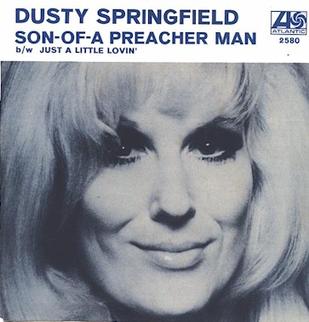
June 22: Dusty Springfield, "Son Of A Preacher Man"

Artist: Dusty Springfield
Song: "Son Of A Preacher Man"
Album: Dusty In Memphis
Year: 1969


CLICK HERE TO LISTEN (will open in new tab)


The idea of “cool” is rarely something that can be defined in words; it simply “is” cool and everyone just “knows” that it is such.  Whether it is a progression from Miles, a lyric from Lou, or Jay-Z simply being Jay-Z, that which is truly “cool” can rarely be argued.  Often times, such feeling comes from unexpected places, and one cannot argue that all of this comes into play when one discusses the woman who can lay claim to being the finest white soul singer of her time, Dusty Springfield.  From her sliding, sultry voice to the amazing melodies created by her band, over the years, Springfield brought an unparalleled level of style and emotion to the world of music.  It was through this uncanny ability to make the listener feel her pain that Springfield was able to create moods that while often heartbreaking, were always portrayed with a level of comfort and “cool” that was not found elsewhere among female performers.  Churning out a staggering ten records in under five years, it was on this tenth record that Dusty Springfield cemented her name among the greatest vocalists in history.  While Springfield had made her name already by singing a soulful, country style, the fact of the matter was that England’s prized voice had never visited.  So her record label flew her to Memphis, Tennessee, and the resulting album, 1969’s Dusty In Memphis, was sheer perfection in every sense of the word.  From the song choice to the orchestration, the album oozed with Springfield’s soulful “cool,” and there is perhaps no better example of this than her classic 1969 single, “Son Of A Preacher Man.”

More than four decades after it was first released, few hooks are as instantly recognizable as that found on “Son Of A Preacher Man,” and the song found a resurgence when it’s “cool” factor was validated when it was a central part of the 1994 film, Pulp Fiction.  The song also proved that it was able to cross genres, as hip-hop legends Cypress Hill looped the hook on their 1993 song, “Hits From The Bong.”  The key to the songs’ longevity and wide appeal is undoubtedly it’s unforgettable guitar introduction that becomes the riff for the entire song.  Played by Reggie Young, the riff proves that there is a certain “magic” to simple, yet sincere musical performances.  The riff is further punctuated by the bright horns, which were arranged by producing legend, Tom Dowd.  The way in which the horns hit gives the song an amazing amount of depth, and offer a fantastic contrast to the almost lulling mood that a majority of the instrumentation brings.  Whether they are adding emphasis to the guitar line or working in opposition to it, it is this interplay between sounds that gives "Son Of A Preacher Man" its distinctive sound.  The song also features a "walking" bassline from Tommy Cogbill that when combined with the horns, gives the song almost a Motown feel, and this aspect surely played a major part in the songs' overall success.  When one considers the state of popular music at the time of the release of "Son Of A Preacher Man," it is almost unthinkable that the song became such a hit on both sides of the Atlantic.  Psychedelic music was still dominating the charts, and the "Motown sound" was on its last legs with harder rock on the rise.  The fact that it became a top ten hit serves as proof that regardless of trends, the great songs always find a way to make a splash.

However, one cannot deny the fact that along with superb instrumentation, the voice of Dusty Springfield surely played a massive role in the songs' success.  Filled with an almost uncanny level of emotion and smoothness, there are few U.K. singers of any style who can compare with her sound, and only a handful from elsewhere in the world that are worthy of the same breath.  On "Son Of A Preacher Man," Springfield displays a limitless octave range, as well as putting her full ability to express her deep emotions within a song.  It is amazing to consider the fact that, though every word comes from deep in her heart, Dusty Springfield did not write the song, and one can then deduct that the story of the song had little actual relation to her real life.  The song itself was written by the team of John Hurley and Ronnie Wilkins, and one must pause for a moment to consider just how two men were able to pen such a touching and sultry love ballad from a female perspective.  Furthermore, the song was originally offered to Aretha Franklin, but after she turned it down, Springfield was given the tune.  Ironically, after hearing Springfield’s rendition, Franklin made her own recording of “Son Of A Preacher Man” in 1970.  Regardless of who wrote the song, Springfield instantly made it her own, and her performance is so moving, so raw, that one can easily take the story as her own.  Furthermore, few songs have as sensual, yet subtle a phrasing of this "coming of age" tale, and there are not many lyrics in the history of music as truly perfect as when she sings, "...stealin' kisses from me on the sly, takin' time to make time...tellin' me that he's all mine...learnin' from each other's knowin', lookin' to see how much we're growin’..."

Though it is nearly always left out of the "greatest riffs" lists, one cannot argue the significance of Reggie Young's guitar progression that is the core of "Son Of A Preacher Man."  Working in stunning subtlety, it is these light touches that perfectly compliment the singing of Dusty Springfield as well as the somewhat delicate lyrics.  These three aspects work together to create an amazingly intimate mood, and even after more than four decades, this mood remains intact, and few songs can boast such a quality.  The depth presented by the small horn section only help to heighten the mood, and few songs so perfectly capture the entire mood of "teenage innocence."  Taking all this into account, one can easily make the case that in an age when most musicians were "searching" for a new sound, Dusty Springfield had found hers, and had no intention of deviating from a sound she knew and loved.  The manner with which she makes the song sway and swing is nothing short of fantastic, and few artists have achieved this with such a subtle vocal approach.  Furthermore, for a female to take such a bold and straightforward set of lyrics was still largely a risqué musical venture, and one cannot deny that this performance from Springfield still remains one of the most progressive songs in the history of music.  Proving why she was one of th U.K.'s most treasured artists, there are few songs that have become as iconic and proved to have a staying power comparable to Dusty Springfield's 1969 single, "Son Of A Preacher Man."

Monday, June 21, 2010

June 21: Daily Guru, "Gurucast #25"

CLICK HERE TO LISTEN (will open in new tab)


(Left Click (PC) or Command-Click (Mac) to save it to your desktop...it's about 75MB)

One hour of amazing music and SOME commentary from "The Guru" himself.

Tracklist:
1. The Ramones, "Teenage Lobotomy"  1978/01/07, NYC
2. The Ramones, "Blitzkrieg Bop"  1978/01/07, NYC
3. Vic Ruggiero, "Innocent Girl"  Hamburguru
4. Blondie, "Call Me"  American Gigolo Soundtrack
5. RUN-DMC, "You Be Illin'"  Raisin' Hell
6. The Clash, "London Calling"  Shea Stadium, October 1982
7. Tom Waits, "I'll Take New York"  Franks Wild Years
8. U.K. Subs, "New York State Police"  Brand New Age
9. Charlie Parker & Dizzy Gillespie, "Dizzy Atmosphere"  Diz n' Bird At Carnegie Hall
10. Wu-Tang Clan, "Da Mystery Of Chessboxin'"  Enter The Wu-Tang: 36 Chambers
11. Gogol Bordello, "American Wedding"  Super Tatanta
12. Talking Heads, "Psycho Killer"  1984/01/25, Milwaukee, WI
13. Notorious B.I.G, "Juicy"  Ready To Die
14. Leonard Cohen, "Suzanne"  The Best Of...
15. Vivian Girls, "Where Do You Run To?"  Vivian Girls
16. Jay-Z, "Never Change"  The Blueprint
17. Woody Guthrie, "New York Town"  This Land Is Your Land: The Asch Recordings
18. Velvet Underground, "I'm Waiting For The Man"  Velvet Underground & Nico

Sunday, June 20, 2010

June 20: Beastie Boys, "Jimmy James"

Artist: Beastie Boys
Song: "Jimmy James"
Album: Check Your Head
Year: 1992


CLICK HERE TO LISTEN (will open in new tab)


Though one can make arguments for other cities "founding" various genres of music, from jazz to punk, New York City is one of many that can make a solid claim to this title.  Perhaps due to the unique geography of the city, perhaps due to the social realities, one cannot deny that the city has been a hotbed for all types of music for the entire history of recorded music.  However, there is one genre to which no other city on the planet can take credit for creation, and New York City remains the dominant force more than three decades after it gave birth to hip-hop music.  From the early days of Afrika Bambaataa to the crossover success of Run-DMC to the dominance of Notorious B.I.G. and Jay-Z, as the decades have passed, the city has retained its space at the top of hip-hop towns.  Among the most original and successful of all the New York City hip-hop groups is a trio of Jewish white boys from Brooklyn who call themselves the Beastie Boys.  Truth be told, the group began in the early 1980s as a hardcore punk band, but in 1982, the group altered their lineup and with the help of Rick Rubin, "changed" into a rap trio.  After spending a few years playing in support of groups ranging from Madonna to Public Image, Ltd. to LL Cool J, the trio entered a studio and released their monumental 1986 debut, Licensed To Ill.  The album was a massive success, and the group toured in support of the record before releasing the more creatively impressive Paul's Boutique in 1988.  However, it is the third album from The Beastie Boys that shows the group at their creative height and completely re-wrote the books on hip-hop music.  There is perhaps no song that better personifies everything that makes The Beastie Boys great and captures the magic of their 1992 record, Check Your Head, than the albums' lead track, "Jimmy James."

In reality, when the song was first created by Adam Yauch (AKA MCA), it was made as purely an instrumental track, with the samples and record scratching all done by him.  However, since a majority of the samples he wanted to use were from Jimi Hendrix songs (as the song is said to be a tribute to Hendrix), the estate of the late guitar god denied him the right, so the band was forced into a position that would forever change the genre.  The Beastie Boys wanted to have the track on Check Your Head, and seeing no other choice, the trio picked up their instruments and created music very similar to the desired samples, and this is what one hears on the album release of "Jimmy James."  With MCA on bass, Ad-Rock on guitar, and Mike D on drums, the group laid down wonderfully funky grooves, and this would be the beginning of a trend that the trio would explore deeper and deeper with every album that followed.  Furthermore, the groups' use of "live" instrumentation paved the way for countless other groups to do similarly, and the approach remains alive and well nearly twenty years later.  Strangely enough, after the album was released, the Hendrix estate relented, and gave clearance for the samples to be used, and the group "remade" the song and released it as a single, so there are two very different versions of the song available.  Along with the Hendrix samples, both versions of "Jimmy James" feature samples ranging from The Turtles to Cheap Trick to The Fearless Four, and this diverse sampling group shows just how well rounded the musical tastes were within The Beastie Boys.

Though "Jimmy James" was originally created as an instrumental track, after Ad-Rock and Mike D heard the amazing groove MCA had created, they convinced him to put vocals overtop parts of it, and this addition made a great song even better.  On many levels, "Jimmy James" defines the style and approach of The Beastie Boys perfectly, as there are few groups that so perfectly trade lines with one another.  As they have nearly their entire career, the trio weave in and out of one anothers' rhymes, and this remains one of the most distinctive aspects of their music.  The fact that each of the three have a rather distinctive voice further drives home just how well they flow alongside one another, and there are few groups that better define the idea of a "group effort" on a track.  Yet the manner and attitude that they bring to the vocals on "Jimmy James" represents an almost complete opposite to the sounds of their first album, as the yelling and almost reckless abandon within their music was all but gone.  Throughout nearly all of Check Your Head, it is clear that The Beastie Boys were maturing and finding far more to rhyme about than girls and drinking.  While the upbeat mood of their songs persists, there is clearly "something" different in the way that they are delivering the lines, and in retrospect, the work on "Jimmy James" was a sign of a complete change in their style and subject matter that would follow on their next two records.  The "new" ethos of the group can be summed up in the songs' final line, when all three chant, "...but the music brought the people into harmony..."

Having survived the explosion of their first record, and the cooler reception to its follow-up, The Beastie Boys continued to make music how they wanted, and in the process completely changed the rules with their third record, 1992's Check Your Head.  Using heavy amounts of live instrumentation intertwined with the "standard" samples and scratching, one can point to this record as putting the "music" back into "hip-hop music."  Clearly, this was the focus of The Beastie Boys at the time, as on a majority of tracks, the lyrics are not up to par with their previous efforts, yet there were no other hip-hop records from ANY artist at the time that could compare in terms of both music and mood.  Regardless of "which" version of the "Jimmy James" you hear, the bassline brings a fantastic groove and the way the group mixes it seamlessly with the "classic" scratching and samples of hip-hop truly changed "how" rap music was made.  A far cry from the "women and beer" ethos of their first album, clearly by this point, all three members of The Beastie Boys were maturing, and their new focus on more positive fun and world peace began to appear as early as "Jimmy James."  It is this more universal feel that makes both the song and the album so alluring, and the lo-fi sound that is also present makes Check Your Head one of the most uniquely intriguing records ever made.  Setting high expectations for the rest of the album, many listeners were shocked by the hybrid sound and unexpected mood found on The Beastie Boys' stellar 1992 track, "Jimmy James."

Saturday, June 19, 2010

June 19: The Ramones, "Sheena Is A Punk Rocker"

Artist: The Ramones
Song: "Sheena Is A Punk Rocker"
Album: Rocket To Russia
Year: 1977


CLICK HERE TO LISTEN (will open in new tab)


One must be careful when attempting to categorize the bands that defined genres, as often times, a simple one word classification omits much of the talent and sound of the band.  Even bands and performers that have become synonymous with their particular genre have some songs or nuances of their music that seems to defy the sound with which they are most closely associated.  Whether it is Miles Davis and the psychedelic movement or Freddie Mercury and opera, these instances run across all styles of music and throughout the entire era of recorded music.  There is perhaps no more clear an example than when people attempt to write of The Ramones as "just a punk band."  While they were unquestionably THE band that kick-started the punk movement, and they certainly laid out the best way to play simple, frenzied music, when one looks closer at many of their songs, one can find a wide array of sounds and influences within their music.  Released less than a year after their groundbreaking 1976 self-titled debut, the band gave the world another fourteen songs totaling just over a half hour with their 1977 album, Leave Home.  A few months later, the group dropped their Rocket To Russia album, proving beyond a doubt that they were "the real deal."  It is within these three records that one can hear everything from the "classic" punk sound to surf rock to experiments that are slightly heavy metal, and this ability to blend so many influences in such a subtle manner is one of the many reasons that the music of The Ramones remains so vibrant and fresh after so many decades.  Though it appears on versions of both their second and third record, there is perhaps no song that better defines The Ramones' ability to blend these styles together than one finds in the song, "Sheena Is A Punk Rocker."

The song was actually recorded during the sessions for Leave Home, but it was initially left off of that record and pushed onto Rocket To Russia.  However, after controversy around one song on Leave Home, and then a switch of distributors, the song was released on the "third" version release, as well as on Rocket To Russia. Regardless of the version, the power and sound of "Sheena Is A Punk Rocker" remain the same, and it is easily one of The Ramones' catchiest and most "poppy" tunes of their entire career.  From the moment the song begins, it is like no other in their catalog at the time, as the great Johnny Ramone brings a brilliantly simple guitar progression, yet with it brings a swagger and mood that immediately evokes the spirit of surf rock, and it could have easily been a song from that genre.  The rhythm section of Dee Dee on bass and Tommy on drums follow right along with this tone, and the hand clapping finishes off a pop appeal that drove the song to moderate placement on the singles chart.  By the time the song came out, punk had gained a reputation for being angry, dark, and aggressive, and yet it is songs like "Sheena Is A Punk Rocker" that proved that punk is about how you approach the music as opposed to how you try to portray your music.  Regardless of whether you're a fan of punk or not, "Sheena Is A Punk Rocker" is irresistible, and the effect remains the same even after countless listenings, proving the overall greatness of this simple composition.

While there is perhaps no other voice that more defines punk rock, it is also within the words Joey Ramone sings on "Sheena Is A Punk Rocker" that he spells out the "story" of so many youth of the time.  Though the argument can easily be made that Joey Ramone doesn't exactly have a "singing voice," the manner with which he delivered his vocals are absolutely unique, and it is on "Sheena Is A Punk Rocker" that the group employs harmonies with the full band, further making the link to bands like The Beach Boys.  Most people do not make any connection between these two bands, but after hearing this song, the similarity and influence is undeniable.  This relationship between punk and surf rock is further reinforced within the lyrics, as the first verse speaks of a group of kids and, "...they've got their surfboards, and they're going to the discotheque a-go-go..."  Painting a picture of "wholesome" youth at the time, Joey quickly introduces an at-first unnamed member of the group who, though they are her friends, can clearly no longer stand that sort of lifestyle.  Putting lyrics to the pilgrimage that so many continue to make to this day, Joey sings of her plight with the lines, "...but she just couldn't stay, she had to break away...well New York City really has it all..."  Not only does Joey give "props" to his hometown here, but he was basically saying, "if you want punk rock, come to New York."  The song implies that Sheena found her "home" once arriving in New York City, and the chorus of "...Sheena is, a punk rocker..." begs for sing-alongs and remains one of the finest of all of Joey's lyrical contributions to the band.

Overall, "Sheena Is A Punk Rocker" has a more direct pop appeal, and though one can easily make the case that all of the songs of The Ramones have such an appeal, there are few that have it so directly and so strong.  Keeping the punk ethos of simplicity firmly in place, The Ramones make their love for surf rock and catchy tunes abundantly clear, and in many ways, the song made it "ok" for other bands to pursue similar musical ventures.  Though it is a bit slower than a majority of the rest of their catalog, "Sheena Is A Punk Rocker" still contains the high energy drive that defines The Ramones as a band, and one can easily argue that it is songs like this that turned a completely new group of music fans onto both The Ramones as well as the punk style in general.  The fact that the band "call out" disco as the "anti-punk" on the song also speaks to the times, as at the time the song was recorded, disco was fading fast, and the youth were looking for "the next big thing."  In many ways, The Ramones' character of "Sheena" is the archetype of the punk rock lifestyle and can easily be seen as a rebel, yet few songs of rebellion have been recorded with such pop appeal and simple brilliance.  Bands from across the world have covered "Sheena Is A Punk Rocker" over the years, and it remains one of the groups' most beloved songs, likely due to the fact that is has such wide ranging appeal, and to this day keeps its "sing along" quality.  Summing up everything he saw in the "punk scene" of 1977, there are few songs that so perfectly define the genre, yet simultaneously incorporate a number of elements rarely associated with the punk sound than one finds in The Ramones 1977 classic, "Sheena Is A Punk Rocker."

Friday, June 18, 2010

June 18: Charlie Parker, "Ornithology"

Artist: Charlie Parker
Song: "Ornithology"
Album: Ornithology (single recording)
Year: 1946


CLICK HERE TO LISTEN (will open in new tab)


When it comes to musicians, the term “icon” is thrown around and doled out so often, that in some cases, a far more prestigious term is necessary to describe the most elite and influential artists the world has ever known.  Though the list is short, there are certain performers without whom, music simply would not have progressed, and one can see them as paragons of their particular genre.  Though he passed away at the age of thirty-four, it is nearly impossible to make a case that any other performer was as critical to the development of jazz as the band called “Bird,” Charlie Parker.  With his lightning-fast lines on his saxophone, along with the liked of Dizzy Gillespie and Bud Powell, Parker is unquestionably one of the “creators” of the bebop sound, and one can further argue that remains the greatest saxophone player in music history.  Honing his sound alongside some of the finest players of the early jazz era, it was when he began playing with Gillespie that Parker truly began to progress.  Much of the early work of the bebop sound was never recorded due to the recording ban by the Musicians’ Union that ended in 1944, but shortly after the ban was lifted, Parker entered Radio Recorders Studio in Hollywood, CA and recorded a session that would cement his place high atop the jazz hierarchy.  Though he was responsible for a large number of jazz tunes that have become “standards,” there is perhaps no better an example of Charlie Parker’s superior ability, as well as the essence of the bebop sound than one finds within his legendary 1946 recording, “Ornithology.”

While bebop, like jazz itself, was a relatively freeform style, on “Ornithology,” there is a rather clear structure within the music.  Truth be told, the song represents the idea of a contrafact, which occurs when a musician creates a new work out of a previously existing piece of music.  In the case of “Ornithology,” Parker spins a new melody over the chord progression of the song, “How High The Moon.”  This link becomes more clear in “cover” versions of “Ornithology,” as often times, vocalists perform the lyrics to “How High The Moon” in a scat-style over the musicians.  Everyone from Ella Fitzgerald to various incarnations of the bands of Powell and nearly every other “jazz giant” has taken a run at “Ornithology,” yet as is often the case, there is nothing quite like the original.  On the Parker version, he finds himself in the company of his fantastic septet, and as the track progresses, one can clearly hear that his band is doing everything they can to simply keep pace with Parker’s stunning musical lines.  For a majority of the song, Parker is trading licks and working in and around the playing of “Ornithology’s” co-writer, trumpet master, Benny Harris.  Their work on this song shows that the pair had an obvious musical chemistry, and Harris’ work here certainly played a large part in his own revered status within jazz history.  The rhythm section stays largely in the background on the recording, yet the speedy ride cymbal and almost dizzying bass prove that the players were certainly up to the task of following Parker’s lead.  Rounding out the septet is the scattered piano of Dodo Marmarosa, and this is largely where the “How High The Moon” chords live, and one can see his playing as a fantastic representation of the vocals of the song.

With his amazingly skilled musicians in tow, Parker wastes no time, as the moment “Ornithology” begins, he is already in top gear, ripping across the track with stunning energy and precision.  Even when he takes small pauses for emphasis, it is awe-inspiring to hear just how many notes Parker is able to pack into the song.  With this in mind, it is also quite remarkable that with such a compact musical progression, not a note is lost, and each note has a clear place and purpose.  While many players have impressed the masses by being able to play a long string of fast notes, few have done so with the feeling and flow that Parker brings to "Ornithology."  At no point of the three-minute run-time does Parker show any sign of slowing down or “cooling off,” and live recordings of the track show that there was far more within the song than was captured during the studio session.  In fact, the studio version almost seems to “cut off,” and one can only wonder why this version of the song seems almost “unfinished.”  Regardless, Parker’s performance on “Ornithology” shows how far beyond his peers he was in terms of both talent and feeling, and he is playing so fast, that one often has to listen to the song a few times through to simply catch everything that he is playing.  In every aspect, “Ornithology” is a tribute to Parker’s unparalleled skills, as not only is his performance extraordinary, but also due to the fact that the songs’ title is refers to the scientific name for the study of birds.

Due to the recording ban that overshadowed some of the most innovative years in music history, when the bebop sound finally found its way to recording studios, many saw the sound as “coming out of nowhere.”  Yet the fact of the matter is, Charlie Parker had been leading jam sessions to develop the style for quite some time.  These sessions featured many other jazz superstars, and it is likely due to this concentration of talent that the style was so well formed by the time the musicians entered studios.  Everyone from Gillespie to Max Roach to Coleman Hawkins released their interpretations of the new style, yet nothing compared to the power of the Parker composition, “Ornithology.”  The song itself sums up Parker in every way possible, and more than six decades after it was first released, it has yet to be equaled in terms of power or influence.  This song is the reason why Charlie Parker remains such a highly respected name across all musical genres, and without this recording, one can make a case that bebop would not have “caught on” in the manner that it did, nor re-shaped the other jazz styles that followed in its wake.  From Coltrane to Mingus, nearly every jazz player cites Charlie Parker as an influence on some part of their methodology, and one must assume that his septet was simply in awe of the blistering performance he delivered on “Ornithology.”  Rising far beyond a label such as “icon,” there is really no way to do justice to the influence and importance of Charlie Parker, and one can quickly learn just why he is such a hallowed figure in the world of music by experiencing his breathtaking performance on his 1946 composition, “Ornithology.”

Thursday, June 17, 2010

June 17: Tony Allen, "Black Voices"

Artist: Tony Allen
Song: "Black Voices"
Album: Black Voices
Year: 1999


CLICK HERE TO LISTEN (will open in new tab)


True musical geniuses never lose their talent, but sometimes they need a bit of a break to refocus and refresh their minds.  Whether it was Joe Strummer taking more than a decade away after ending The Clash or DEVO returning after nearly three times that length, those whose souls feed on music always return to aid in reshaping the musical landscape.  After the tragic passing of Fela Kuti, drummer extraordinaire Tony Allen took a similar hiatus, and when he returned, he proved to be just as strong, and gave the world some of the most progressive and musically stunning work of his storied career.  Without question, the highpoint of his post-Fela catalog was his 1999 record, Black Voices, which crosses over so many musical boundaries that it is impossible to name them all.  A group effort in every sense of the word, Allen found himself surrounded with some of the most innovative, talented, and energetic musicians on the planet, and the sounds and moods they created as a group represent the pinnacle of what can happen when such talent is properly focused.  Each of the tracks on Black Voices explode with positive energy and irresistible grooves, yet there are also social criticisms and observations running underneath the stunning musical arrangements.  Taking the core of the AfroBeat sound that he helped to create, on Black Voices, Tony Allen fuses it together with funk, jazz, and elements of electronica, and the resulting product is as special and unique a record as has ever been released.  With the 10th anniversary of the record yielding a re-release containing the "raw" tracks from the session, there are few tracks that better define everything that was magic about the Black Voices session than the title track of the original 1999 release.

It is on “Black Voices” where the true teamwork of all of the musicians involved becomes most clear.  While Tony Allen lays down one of the finest rhythms of his career, it is as if each musician found their own, individual groove within the larger sound they create together.  From the brilliant keyboards of Fixi to the warm bass of Caesar Anot, “Black Voices” has an absolutely stunning tone that cannot be found anywhere else in music history.  The keys and bass weave around one another in grand fashion, making “Black Voices” one of the most irresistible dance grooves ever recorded.  Yet underpinning their work is the complex rhythms that Allen brings, proving that he was without question the spirit behind the recordings of Fela Kuti.  As he effortlessly switches tempos and takes off-beat pauses, one can feel the enjoyment he clearly had whilst recording the track, and it helps to push the mood to amazing heights.  Though it is a fantastically funky groove in its "pure" state, the modern flare that Doctor L brings to the mix makes "Black Voices" a song that truly defies categorization.  Spinning dub sounds and subtle sound effects over the track, Doctor L morphs "Black Voices" into a track that could even fit in within a dance club setting, and it turns the song into an absolute musical anomaly.  While attempting to blend the old and new together is not all that rare an occurrence, it rarely works as brilliantly as it does on "Black Voices," and it is even more impressive when one takes into account that at the time of its recording, Allen was sixty years old.  Furthermore, the fact that Tony Allen chose to push forward with new musical ideas when he could have just as easily stuck with the sound that made him famous serves as a testament to both his talent and integrity as a performer.

Adding to the group element as well as bringing a vast amount of musical knowledge and experience, the duo of Michael "Clip" Payne and Gary "Mudbone" Cooper handle the amazing vocals that are staggered across the track.  Furthermore, though they hailed from completely different ends of the musical spectrum, Payne and Cooper shared a common ground with Allen in that they had all paid their dues in support of a prominent frontman.  Payne and Cooper both spent many years within the ranks of Parliament-Funkadelic, and their ability to find the ideal spot and style to deliver the vocals pushed "Black Voices" to the brink of musical perfection.  From deep, almost growling words to soft whispers, both vocalists show a great amount of diversity in their delivery, and their voices truly become an instrument onto themselves.  Again, from the manner with which they are singing, it becomes instantly clear that they too are having a blast performing on the track, as there is a joy within their vocals that cannot be denied. There is perhaps no aspect of the music where the personality of each musician becomes more clear, as the small touches which both vocals place into "Black Voices" show the high level of dedication and love that they had for the song and record.  It is also within the words they sign that the entire ethos behind the album, both in and out of the studio, rings through.  The idea of "black voices everywhere" can be seen within the makeup of the band, and at the same time, the music crosses into so many genres and cultures that the song itself becomes a common place for all of the various cultures to come together.  This is perhaps the finest representation of the combined genius on "Black Voices," in that while making a song they all could take ownership of, they gifted the world with a universal anthem.

When an artist or group are making music for "the right reasons," the joy they have in recording comes through clearly on the album.  Looking back on the sessions for Tony Allen's Black Voices record, Michael "Clip" Payne said, “…it wasn’t a record where we thought about having a hit...we just all wanted to play with each other.”  In many ways coming off as a "jam session," the energy and spirit behind the record are perfectly captured on the title track, and it remains one of the most uniquely fantastic recordings in music history.  Led by the distinctive and almost free-form playing of Allen, the rest of the band puts their own stamp on the song whilst simultaneously creating a whole that is far larger than the sum of its parts.  Smashing together the "old school" styles of AfroBeat with the fundamentals of funk, then given a healthy dose of electronic music, there are few songs that can be seen as kindred to the sounds of "Black Voices."  Mixing these elements together, the band truly created a completely new sound, and though some have tried to duplicate it, nothing since has even come close.  Throughout "Black Voices," while each band member performs with the utmost precision, there remains a very loose feeling to the entire track, and it is juxtapositions such as this that make the song so special.  Seeming to pick up right where he left off decades earlier, Tony Allen leads from behind, using his uncanny drumming ability to turn 1999's Black Voices into an almost futuristic musical experience, and the title track spotlights everything that makes this combined effort so magnificent and important to the present and future of music.

Wednesday, June 16, 2010

June 16: 2Pac, "Dear Mama"

Artist: 2Pac
Song: "Dear Mama"
Album: Me Against The World
Year: 1995


CLICK HERE TO LISTEN (will open in new tab)


If there is one thing that can be easily proven by the long history of hip-hop, it is the fact that a male emcee showing any sense of weakness or sensitivity will be exiled by his peers.  Due to the overwhelming machismo that overshadowed the entire "gangsta rap" movement of the 1990's, if you weren't rapping about "bitches and money," then you simply weren't "keeping it real."  Yet, there are certain circumstances where an event may lead to a massive change in a person, and such was the case when iconic emcee 2Pac Shakur released his 1995 record, Me Against The World.  The album was recorded shortly after his near fatal shooting, and it was actually released while he was in prison.  Having survived the shooting, Shakur had more than enough "street cred" to pretty much do anything he wanted on the album, and this shows in the fact that he gets more violent than ever, but also more introspective.  His forays into more thought-provoking territory, often showing emotions that were shunned within the hip-hop world, remain today some of the most highly respected tracks in the entire history of the genre, and it was on this record that 2Pac's true talents as a writer came clearly into focus.  Much of the album involved Shakur looking back on his own life, speaking of those he had already lost to violence, as well as a deep study of his own upbringing.  There is not a sub-par moment anywhere on the record, and yet 2Pac outdoes himself, as he throws down the gauntlet completely when he penned one of the most powerful and touching hip-hop tracks in history in the form of his 1995 single, "Dear Mama."

From the moment "Dear Mama" begins, it is clearly unlike any other track that had been released by a "hardcore" emcee to date.  With the melodic keyboards and string-type arrangement, the focus musically is far less on hard-hitting beats and more on creating the proper mood for the lyrics 2Pac had penned.  The keyboard piece is actually a sample, taken from Joe Sample's song, "In Your Wildest Dreams," and the inclusion of this rather unorthodox source material is one of the many ways in which "Dear Mama" re-wrote the books on what was "acceptable" from gangsta-style emcees.  The looping string section also stays in place for the entire song, and the combination of these two elements gives the song a mood that is almost like that of a eulogy.  It is also largely due to this less aggressive musical arrangement that the song became more accessible to even casual hip-hop fans, and in combination with the moving lyrics, the song stormed its way up the charts, topping the "Rap Singles" and going to number three on the "Hot 100" charts.  This success led to the song being one of the most famous of all of 2Pac's tracks, and fellow hip-hop icons Eminem and Snoop Dogg both repeatedly cite the track as a massive influence on their own careers.  Such success and reverence are not surprising, as in many ways, "Dear Mama" strikes the perfect balance with the powerful, yet non-violent lyrics, and the smooth, almost R&B style music over which 2Pac delivers his brilliant words.

Though the music certainly adds a key element to the song, one cannot deny that the true magic behind "Dear Mama" lies within the voice and words of 2Pac himself.  Never using any sort of distortion or vocal alterations, there is a mesmerizing raw and honest feel within every one of his verses across his career.  On "Dear Mama," 2Pac rarely even pushes his voice behind what one assumes is his "speaking voice," and this allows for every word to come through clearly, and not only brings an amazing impact for what he is saying, but allows the spotlight to shift to his uncanny ability to work within poetic verse.  Standing today as one of the most talented lyricists in history, 2Pac had already proven that he could write the most gritty and violent lyrics ever, yet here he proves that there is nothing "wrong" with an emcee turning the pen on himself.  Every line of "Dear Mama" is a tribute, as he speaks of his own mother's battle with drugs, yet consistently makes points about how hard she worked to make sure that 2Pac had a "good" upbringing.  Taking much of the blame for the problems between them, he states one of the most stunning lines ever in, "...I reminisce on the stress I caused, it was hell...huggin' on my mama from a jail cell..."  Though it may seem like nothing special in retrospect, the fact of the matter is, until 2Pac dropped "Dear Mama," such introspection and almost sensitivity from emcees was simply unheard of.  2Pac later presents both sides of his mother, and clearly "buries" any issues between them with the rhyme, "...and even as a crack fiend, mama, you always was a black queen, mama..."  It is lines like these that showed a completely new side of one of hip-hop's most "dangerous" rappers, and it is due largely to the courage and honestly that he showed here that 2Pac remains so highly revered in the world of hip-hop.

Though an overwhelming majority of emcees point to their "toughness" as the reason they are so much more manly than their peers, one can easily make the case that it is due to 2Pac's open and honest nature that he stands so far above the rest of the history of the genre.  Clearly not caring what others may have thought, 2Pac takes full responsibility for his mistakes in childhood and "buries the hatchet" with his mother on the moving track, "Dear Mama."  Yet he goes even further, promoting the virtues of finding success in life, and when he states, "...it feels good puttin' money in your mail box...I love payin' rent when the rent's due, I hope ya got the diamond necklace that I sent you...'cause when I was low you was there for me, and never left me alone because you cared for me..."  It is passages like this that made it "ok" for other emcees to delve into deeper subjects, and the song is also consistent with 2Pac's overall aim to try and promote unity and forgiveness within the "street culture" from whence he came.  Though he had previously dabbled in more sensitive subjects, those beyond simple street violence, before "Dear Mama," there had simply never been another such outpouring of thanks and love, and one can easily make the case that it was his more introspective songs that made 2Pac the legend he remains today.  Backed by a more soulful, restrained musical arrangement, the focus shifts completely to 2Pac's magnificent lyrical talents, and there are very few songs of any era or genre that can compare to the beauty and emotion found within his monumental, genre re-defining 1995 single, "Dear Mama."