Friday, October 15, 2010

October 15: Throwing Muses, "Call Me"

Artist: Throwing Muses
Song: "Call Me"
Album: Throwing Muses
Year: 1986


CLICK HERE TO LISTEN (will open in new tab)


Though in modern times, it has become known as “alternative music,” in the decade before it was given this name, that certain brand of rock and roll was more often referred to as “college rock,” and in many ways, it had a more negative image.  Largely coming out of the post-punk movement, bands started to splinter off in all directions, and bringing out various incarnations of the hard rock sound, the wild sounds that filled the 1990’s were birthed.  While “hair metal” may have ended up as the decades’ public persona, it was the “underground” rock bands that truly created the musical setting for the next generation.  Bands like R.E.M., Echo & The Bunnymen, and Hüsker Dü all made names for themselves during this time due to their unique take on rock music, and yet it was a group of relative “youngsters” that produced one of the most earth-shattering records in history.  Started by a pair of high school friends, few bands shaped modern music and brought the “college rock” sound to the mainstream than Providence, Rhode Island’s own Throwing Muses.  The fact that their self-titled 1986 debut was the first American band to ever be released on the legendary 4AD record label should have been enough proof of their greatness, yet every moment of the album remains as stunning and powerful as it sounded upon first release.  Filled with an unparalleled ferocity and overall uneasy mood, Throwing Muses serves as a unique bridge between the aggression of punk rock and the introspection of folk.  Perhaps the groups’ finest recording, there are few songs that define the band in every aspect as accurately as Throwing Muses’ 1986 song, “Call Me.”

As the introduction to the bands’ first record, “Call Me” is an all-out warning that after hearing this album, nothing will ever be the same again.  It wastes no time in diving head-first into the dizzying guitar progression, and the playing here of Kristin Hersh and Tanya Donelly quickly set the standard for the new sound they were founding.  There is an amazing urgency in their playing, and the agitated bass from Leslie Langston only adds to the mood set forth by the guitars.  Though the playing of these three is nothing short of superb, it is the seemingly nervous, strangely scattered drumming of Dave Narcizo that is the most jarring aspect of the music.  The quartet move as a single, destructive unit, constantly pushing the energy and gloomy mood harder, and then bring an even bigger shock when they suddenly sift into one of the most beautiful rock-waltzes ever captured on tape.  The suddenly grand and oddly charming progression, with the addition of sleigh bells, somehow works in amazing fashion on “Call Me.”  Along with this unexpected shift in tempo, the guitars begin a wild, twisting progression that lasts until the end of the song.  It is in this juxtaposition that one can clearly hear how the well-documented mental issues of Hersh were reflected in the music of Throwing Muses. It is in this part of “Call Me” that one can easily draw a line to bands like Joy Division, as even in this more melodic section, the overall aggression behind the music is never lost.

Along with their distinctive dual-guitar sound, the team of Hersh and Donelly were equally stunning in their shared vocals.  Though Hersh write “Call Me” and handles a majority of the lead vocals, it is often the atypical harmonies from Donelly that give the song its massive depth and gloomy, unsettling mood.  Throughout “Call Me,” Hersh brings an extraordinary combination of sung and spoken vocals, and at times, when she is almost yelping, her full commitment to the words and emotions of the song seems to be almost overwhelming her.  Nearly all of her singing is underlined by an odd trembling in her voice, and this again can be a sign of just how much of her soul Hersh was willing to bare through her performances.  When Donelly joins in throughout the song, the result is one of the most uniquely hypnotizing vocals in history, and one can easily hear traces of Donelley’s later bands on “Call Me.”  However, regardless of who is singing, there is a murkiness that pervades, and it is this aspect that would define the music of Throwing Muses.  Holding nothing back and clearly exorcising her own demons, the words Hersh penned here run from the philosophical to deeply personal, and it is lines like, “…I'm in a deep hole I've dug myself five feet deep…” that offer a small peek into her mental state.  However, it is the final three stanzas of “Call Me” that show the deep-rooted pain in Hersh, and they hit with a power unlike any other words ever sung.  With her completely commitment to every aspect of the song, along with the sincere words she sings, “Call Me” is a musical catharsis that remains unparalleled to this day.

Though many musicians have used their songs to deal with their own issues, few did so with as much potency and almost painful honesty as one finds in the writing of Kristin Hersh.  With their self-titled debut still standing as one of the most uniquely brilliant records in history, one can easily make the case that modern music would not exist in its current form without the work of Throwing Muses.  Quickly showing just how wide a range of skills they possessed as a band, Throwing Muses blends together the moodiness of post-punk with the beauty of folk, and then pushes the combined sound into something completely indescribable.  While there were a number of bands that were thrown into the genre of “college rock,” the fact of the matter is, few of these bands had a similar sound to one another, and it is this independent spirit that would become the “alternative” sound at the onset of the 1990’s.  Setting the standard with their very first song on their first major release, Throwing Muses were instantly catapulted to the forefront of the “underground” music movement, and the energy and anguish found on “Call Me” is truly something that must be experienced to be properly understood and appreciated.  Whether it is the way in which the guitars and voices of Hersh and Donelly intertwine, or the anxious, jittery tone set by the rhythm section, Throwing Muses clearly understood the best way to convey the emotions in their music.  With its jarring tempo changes and trend-setting musical arrangement, there has simply never been another song that quite compares to the overall impact of Throwing Muses 1986 song, “Call Me.”

Thursday, October 14, 2010

October 14: G Love & Special Sauce, "Astronaut"

Artist: G Love & Special Sauce
Song: "Astronaut"
Album: The Hustle
Year: 2004


CLICK HERE TO LISTEN (will open in new tab)


Over the course of their career, nearly every artist has “lost their way” at one point or another.  Though this does not always yield “bad” albums, it is almost always a seemingly odd diversion from the sound and style that made that particular artist so enjoyable and unique.  As the 1990’s came to a close, it seemed that it was in this space that the chilled-out, multi-genre sound that was G Love & Special Sauce was veering off into a number of different directions.  After releasing their brilliant debut, the group seemed to want to do everything at once, and this led to somewhat muddled efforts in the later years of the decade.  However, as any truly talented group would, G Love & Special Sauce refocused their aim, and the result was the album that may very well be the finest of their career: 2004's The Hustle.  Filled with deep grooves and the playful funk and mood that defines the groups' persona, the album also boasts some of the best lyrics of the bands' career.  Bringing a few other musicians into the fold alongside their long-standing trio, The Hustle has something to offer every listener, as there are deep, soulful moments right alongside the playful, late-night jams that fans have come to love from this group.  Bringing together the deep grooves and "good times" vibe in brilliant fashion, few songs show true talents of G Love & Special Sauce quite like one finds in the groups 2004 song, "Astronaut."

The mood for both the song and album are immediately put forth, as the fuzz-filled bassline that begins the song brings an almost hard-rock sound that had never been presented through the music of G Love & Special Sauce.  This tone runs throughout the entire song, yet bassist Jimmy "Jazz" Prescott is able to make it funkier than almost anything else previously recorded.  It is this deep groove that has largely defined the sound of the band over the years, and its presence on "Astronaut" almost forces the listener to bob their head along with the music.  The other half of the rhythm section, drummer Jeff "Houseman" Clemens is absolutely on fire, as his brilliantly deploys his signature "aggressively-cool" sound that gives "Astronaut" a fantastic sting.  Working the cymbals to their fullest, along with bringing some of the finest fills of his career, one can easily feel the sheer joy that the trio had whilst recording this track.  Rounding out the sound on "Astronaut" is the guitar and harmonica from G Love himself.  Seamlessly transitioning between rhythm and lead parts, the tone has a similar distortion to the bass, and this completes the superb sound on the song.  With notes panning from side to side throughout the verses, the overall sense of movement found on the song is absolutely unparalleled, and it is aspects like this that makes the music of G Love & Special Sauce so wonderfully unique.

Matching the mood and sound of the instruments, G Love (AKA Garrett Dutton III) drops some of his most high-energy and exuberant vocals of his entire career.  Bringing his trademark style of singing and rapping together, G Love seems to let all expectations fall to the side, and he works the entire vocal range, singing, rapping, and yelling across the track.  This raw and unhindered vocal approach works perfectly for G Love, and the distortion on his vocals are equally intriguing, sounding as if he is singing through a vintage "Green Bullet" microphone.  Throughout "Astronaut," G Love works a number of different vocal cadences, and the way in which he makes them all flow so perfectly with one another serves as a testament to how well he honed his skills over the years, as well as his unique arrangement talents.  While all of these elements are far beyond his previous work, it is the lyrics on "Astronaut" that ties the song back to the bands' history, as G Love pens another song on his favorite subject: women.  Seeming to speak of the frustration of being torn in a relationship, G Love captures a universal emotion when he rhymes, "... some of the days I love you despite all the shit you said..."  Though many other artists have approached this idea, it is the blunt, honest way that it is characterized here that makes both G Love and "Astronaut" such a fantastic musical work.

Often times, a great musician only needs a small change to bring out the best they have to offer, and the fact that The Hustle was the first G Love & Special Sauce release on Jack Johnson's Brushfire Records cannot be overlooked.  As a longtime friend of the band, he makes a few appearances on the record, and there is an "all bets are off" feel to the entire album.  Taking their completely original sound and turning it up to a much louder, almost dirtier level, "Astronaut" kicks off the album in stunning fashion, and it is easy to see this song as the "marker" of the "new" stage in the career of the band.  As the song moves into the final sections, one can feel the energy building to a point where it almost overflows, and it is this part of the song that attempts to mimic the vigor and spirit that the trio brings to their live shows.  Yet even with this more upfront and powerful approach, it is still impossible to accurately classify the music of G Love & Special Sauce, as there is simply no other band in history that has brought a similar sound.  Fusing together blues, jazz, funk, soul, punk, and folk into an extraordinary combination, it is their unending quest to constantly find new sounds that has earned them a dedicated following over the years.  Bringing an enthusiasm usually reserved for young, "starting" bands, G Love & Special Sauce reinvented themselves with their phenomenal 2004 song, "Astronaut."

Wednesday, October 13, 2010

October 13: Air, "All I Need"

Artist: Air
Song: "All I Need"
Album: Moon Safari
Year: 1998


CLICK HERE TO LISTEN (will open in new tab)


Though it is often far more difficult to track than the progression of a single style and its combination with newer sounds, there are a number of points in history where one can see actual trends in society shape new musical styles.  While a majority of these occurrences are due to drastic social change or other instances of historical significance, there is at least one case where the impact that the mood of the general public seemed to seap into new musical styles.  After the initial crush of "grunge" kicked off the 1990's, there was a rather widespread sense of relaxation, often to the point of almost slothful behavior.  This was reflected in the more laid-back, carefree music that began to emerge, and there are few genres that it impacted more than that of the electronic style of music.  While the 1980's and early 1990's were dominated by techno and house music, as the decade waned, down-tempo and ambient sounds began to gain traction, and few artists pushed this style forward more than the French duo known as Air.  After releasing a few albums that showed great promise, the group catapulted the genre of ambient electronic music into the mainstream with the release of their 1998 record, Moon Safari.  Filled with unparalleled sonic journeys, the album remains one of the finest even more than a decade later.  Serving as a brilliant diversion from the rest of the album in every sense of the word, few songs in the down-tempo/ambient genre command the same respect and attention as one finds in Air's 1998 single, "All I Need."

From the moment "All I Need" begins, the clashing of styles is instantly evident, as the spaced-out pulses descend into the deep grooving bassline and acoustic guitar.  Completely the work of Nicolas Godin and Jean-Benoît Dunckel, it is songs like "All I Need" that show that the group paid close attention to what made their previous work good, as well as the work of others making similar music.  Through this study of their own creations, they found the ideal balance in sounds, and it is this aspect that sets both the song and the album so far above the work of their peers.  The way in which the various, often distant sounds are able to fuse together into a single, meandering musical landscape is perfect in a way all its own, and it is this formula that served as the blueprint for countless acts that followed.  Not only do the instruments themselves clash with one another, but the duo are able to strike a similar balance in the actual arrangement behind the verse and chorus sections of the song.  "All I Need" serves as yet another example of the idea of "less is more," as there are moments when the music is uncharacteristically sparse for electronic movement, but then swells at other points, taking the listener on a wonderfully unique musical journey.  Though the guitar anchors the song in a consistent mood, it is the synthesized progressions and sounds that give the song its amazing level of depth and lull the listener into an almost hypnotic state.  The way that Air is able to mesmerize the listener, whilst never becoming boring is "the" trick of down-tempo/ambient music, and it has rarely been carried out better than one finds on "All I Need."

However, just looking at the musical aspect of "All I Need," it is largely similar to the rest of the songs on Moon Safari, and the one piece that sets the song far above the others is the presence of the one and only Beth Hirsch.  Much like the music over which she sings, Hirsch is able to bring an amazing power and mood to the song, yet never gets too loud or breaks the overall mellow feeling.  Without question one of the strongest vocalists of her generation, there is a pure, simple beauty to her voice, and as it soars across the bridge and chorus sections, it is as close to musical bliss as one will find anywhere.  It is in the performance of Beth Hirsch that the song moves away from the rest of the album, as her vocals alone make the song the most emotional and gripping point of the entire record.  The uncanny power and soul in her singing are reminiscent of the great jazz and soul singers of decades earlier, and this is further enforced by the simple, yet moving lyrics.  There is a strange understanding between Hirsch and the listener when she sings, "...all I need is a peace of this mind, then I can celebrate..." as there is a unique tension that can be found within the way she delivers the lines.  Open to many interpretations, the vocals on "All I Need" could just as easily been recorded decades earlier, and yet they manage to fit in perfectly with the modern feel of the music created by Air.

Proving that good down-tempo/ambient music need not be exclusively created from trip-hop often overflowing with overused samples or techno oddities, Air managed to create an entire album of groundbreaking music that firmly cemented this new style of electronic music.  Presenting vast musical landscapes, the duo managed to convey great amounts of emotion through their unique brand of chilled-out, mind-twisting music.  Nothing short of a classic, Moon Safari remains the blueprint for the genre, and the songs sound just as fresh today as they did when they were first released.  While an overwhelming majority of the album is lyricless synthetic musical mastery, it is when they involve vocalist Beth Hirsch that their style moves to an entirely new level.  The delicate, yet warm and almost enchanting voice of Hirsch is what truly makes "All I Need" such a special song on an album that is already so far beyond its peers.  Though the other songs on Moon Safari are just as mesmerizing, it is Hirsch's vocals that create a strong emotional connection, and it is this aspect that separates the song from the others.  In literally every aspect, "All I Need" pushed the boundaries on what was thought to be possible within the realm of electronic music, and it is much the reason that all these years later, Air's 1998 single remains such an extraordinary musical achievement.

Tuesday, October 12, 2010

October 12: Pharoah Sanders, "The Creator Has A Master Plan"

Artist: Pharoah Sanders
Song: "The Creator Has A Master Plan"
Album: Karma
Year: 1969


CLICK HERE TO LISTEN (will open in new tab)


Certain musicians cannot be copied.  Due to their extraordinary talents or musical vision, they are far too beyond their peers in so many ways, that such an idea is impossible.  In these cases where a "direct copy" is not possible, aside from making it known from whence an influence came, there are few ways to properly "thank" these amazing performers.  Perhaps the only "proper" way to do so is though a song dedicated to that artist, and such songs are best when done by those who knew the initial artist closely.  In July of 1967, the world of jazz was shaken to its core with the passing of John Coltrane.  Unquestionably the most important saxophone player in music history, at only forty years old, and clearly still at the apex of his talents, many could not find the proper words to convey their frustration at this loss.  Having performed on some of Coltrane's finest work, as well as studying his style and blending in his own approach, one can make the case that few felt the pain of the loss of Coltrane more than fellow saxophone master, Pharoah Sanders.  Bringing his own unique style of playing, there are few musicians of any era that have shown as much raw emotion as one finds within the recordings of Sanders.  It is this combination of sadness and understanding of Coltrane's style that led to the recording of one of the truly epic compositions in music history, as there is quite literally nothing that can compare to Pharoah Sanders' 1969 recording, "The Creator Has A Master Plan."

Within the first few minutes of the thirty-minute-plus musical journey that is "The Creator Has A Master Plan," Sanders shows his own style in all its glory, as well as gives a clear nod to his teacher, Coltrane.  The opening moments are unlike any other jazz recording in history, filled with an all-out sonic assault with everything from the over-blown saxophone of Sanders to a wild flue progression, hand bells, and a wide array of other sounds.  From the first note, "The Creator Has A Master Plan" is almost overwhelming, as there is so much going on musically, that it often takes multiple listenings to fully appreciate every aspect of the composition.  After about two minutes of what can almost be seen as a "musical catharsis," the entire band refocuses and shifts into a far more "normal" jazz progression.  However, it is also at this moment that Pharoah Sanders makes his love for Coltrane completely clear, as the main musical theme presented cannot be mistaken for a nod to the classic Coltrane song, "A Love Supreme."  It is the way in which Sanders and his band take this well-known theme and spin it into something all their own that proves their greatness, and it also serves as an ideal tribute to show all that Sanders learned from Coltrane.  Yet this is where any comparison to Coltrane ends, as the final half-hour of "The Creator Has A Master Plan" as a mind-blowing musical experience that is unlike anything else in history.

While the entire band behind him plays brilliantly, the focus rarely shifts from the saxophone and arrangement skills of Pharoah Sanders.  Remaining today one of the most distinctive players in history, it is his raw, over-blown sound that makes him so easy to identify, and this aspect of his playing is on full display throughout "The Creator Has A Master Plan."  The way in which he plays gives the song a sultry, almost Middle-Eastern tone, and the addition of the bells over this reinforces this mood.  Furthermore, the way in which the saxophone of Sanders wraps through and around the flute playing of James Spaulding stands today as one of the most stunning musical duos ever recorded.  Mixing together brilliant modal progressions with true "free form" exploration, as well as lyrics in both the instrumental and spoken style, "The Creator Has A Master Plan" is quite literally the "complete package" when it come to jazz music.  The lyrics, written by Sanders and Leon Thomas are only heard in part on Karma, yet there are other recordings of "The Creator Has A Master Plan" available that present the entire lyric which can be found in the gate-fold of the original vinyl release.  Regardless, Sanders explores every inch of the theme that the band works from, and eventually lends a smooth progression into the next stage of the song.  It is in these shifts, that flow perfectly, yet are musically jarring, where one can see the true genius of Sanders, as he is able to perfectly bridge sounds and arrangements that seem to have nothing in common.  Combining this idea with his extraordinary performance, it is "The Creator Has A Master Plan" that solidifies Pharoah Sanders' place as one of the finest jazz players in history.

However, if one fully considers the sound and mood found on "The Creator Has A Master Plan," there is another theory which cannot be denied.  In every aspect of the song, one can clearly imply that while the song is a tribute, it is also serving as a release of grief which Sanders feels due to the loss of his mentor.  One can even see the title of the song as a sort of self-assurance that there was a reason Coltrane was taken at such a young age.  As one gets deeper and deeper into the song, there are a number of interludes that feature wild, abrasive playing from Sanders, and one can interpret these moments as his musical expression of frustration, and in many ways, this is the true power that can be found in music as both a performer, as well as for the listener.  Taking this into account, one can then look at the massive wall of sound that flows throughout the song as a "choir," backing the eulogy played by Sanders, and completing the overall idea that "The Creator Has A Master Plan" is his final tribute to his mentor and friend.  Whether it is the deep bassline, the ever-present bells, the wide-array of string and percussion, or the phenomenal performance of Sanders himself, there is simply no way to accurately capture the pure musical majesty that occurs throughout the half-hour of this song, and in terms of both length, as well as the unwavering level of emotion, there is simply nothing else in music history that even remotely measures up to the standard set by Pharoah Sanders on his monumental 1969 recording, "The Creator Has A Master Plan."

Monday, October 11, 2010

October 11: Daily Guru, "Gurucast #41"

CLICK HERE TO LISTEN (will open in new tab)


(Left Click (PC) or Command-Click (Mac) to save it to your desktop...it's about 75MB)

One hour of amazing music and SOME commentary from "The Guru" himself. 

Tracklist:
1. The Clash, "Remote Control"  The Clash
2. Nirvana, "Frances Farmer Will Have Her Revenge On Seattle"  In Utero
3. Beck, "O Maria"  Mutations
4. NewS, "Chop, Chop, Chop"  Murder Punk: Volume 2
5. Descendents, "I Wanna Be A Bear"  Milo Goes To College
6. Blues Traveler, "100 Years"  Live From The Fall
7. Ella Fitzgerald & Louis Armstrong, "Moonlight In Vermont"  Ella & Louis
8. Chuck Ragan, "Hearts Of Stone"  Feast Or Famine
9. Metallica, "Stone Cold Crazy"  Garage, Inc.
10. Phish, "When The Circus Comes To Town"  Live Phish 06, 1998/11/27
11. Rollins Band, "Ghostrider"  The Crow Soundtrack
12. Leningrad Cowboys, "Sweet Home Alabama"  Happy Together
13. Black Eyes, "Speaking In Tongues"  Black Eyes
14. Nick Cave & The Bad Seeds, "Lie Down Here (And Be My Girl)"  Dig, Lazarus, Dig!!!
15. Dinosaur Jr., "Ocean In The Way"  Farm

Sunday, October 10, 2010

October 10: Tim Barry, "Wait At Milano"

Artist: Tim Barry
Song: "Wait At Milano"
Album: Rivanna Junction
Year: 2006


CLICK HERE TO LISTEN (will open in new tab)


While there have been many, perhaps the most interesting style to emerge over the past decade has been that of the "folk-punk" performer.  Taking the attitude of punk rock and the stripped down, softer sounds of folk, a number of punk frontmen have used this style as a release for some of their more introspective songs.  Though these genres may seem quite distant, it is the honest, soul-bearing sentiment that can be found in both that serves as a bridge between the two.  Though many singers have taken this solo approach, few have done so with as much sonic beauty and heavy emotion as one finds in the work of Avail frontman, Tim Barry.  While one can easily make the case that Avail was a punk band that concentrated on melody far more than a majority of their peers, the true abilities of Barry were not seen until the early 2000's when his first solo album his shelves.  After a few attempts, Barry achieved what is without question his finest musical moment in the form of 2006's Rivanna Junction.  Touching all sides of his talents, the album offers a song for every music fan, yet when taken as a single work, it is without question one of the most moving and beautiful records of the entire decade.  Each track offers an amazing lyrical journey, as Barry proves to be one of the finest writers of his generation, and the varied musical approach keeps the album fresh.  Though every song on Rivanna Junction is worth hearing, few carry the emotion and impact as one finds in Tim Barry's 2006 track, "Wait At Milano."

As soon as it begins, the mood of "Wait At Milano" is immediately clear, as there is a somber, almost lonely tone to the music.  The soft, dejected sound of the music is a stark contrast to the borderline-hardcore sound that Barry played with Avail, and yet it works brilliantly, as there is a deep sense of honestly that comes out in the music.  The song itself is able to appear as completely stripped down when in fact there is a great deal happening in terms of the musical arrangement.  As one would expect, the most prominent instrument is Barry's guitar, and yet the way it is played alongside what sounds like a Dobro from Josh Small is nothing short of musical perfection.  There is no distortion whatsoever to be heard, and this reinforces the raw and unguarded mood that runs throughout every aspect of "Wait At Milano."  Adding to the heavy emotion is the light piano work of Daniel Clark, and the combined sonic presentation almost sounds as if this was an "accidental" musical creation as opposed to a fully planned song.  The fact that this mood is achieved serves as a testament to the pure and raw emotions that are conveyed through the music, and few songs in history have been able to present a similar sound.  The manner with which the music seems to envelop the listener is an effect that must be experienced firsthand, and it is what sets "Wait At Milano" apart from the rest of the songs found on Rivanna Junction.

Presenting a perfect combination to the musical arrangement, Tim Barry's vocals stand as some of the most moving and sincere ever recorded.  Showing that there was a great deal more to his vocal range and abilities than were shown through his work with Avail, Barry clearly has a solid understanding of where and when to push his singing to what is almost a scream, and it creates one of the most heartbreaking, yet mesmerizing vocal performances ever recorded.  Perhaps this is due to the fact that Tim Barry has a rather simple, yet unique voice, and his voice is the sort to which nearly anyone can easily sing along.  Regardless of "why" his voice is so intriguing, on "Wait At Milano," Barry unleashes what may very well be his most poignant, yet universal lyric of his entire career.  Set in what is a loose blues progression, Barry holds nothing back, and one can easily hear the pain in his voice as he delivers these completely candid, yet somehow ingenious words.  Touching deep on the overall idea of loneliness, Barry is able to phrase the feelings in a way far beyond that of anyone else who has ever approached the subject, and it is due to how perfectly he captures these feelings that one understands how often he himself must have dealt with that pain.  Yet there is a uniquely deep genius on his words, and few writers have ever penned lines as brilliant as when Barry sings, "...and if what you seek ain’t free then steal it, if it ain’t necessity you don’t need it, just leave what’s left for who comes next..."  Though these are perhaps the brightest words of the song, there is not a moment anywhere on "Wait At Milano" that is anything short of true musical beauty.

Proving that there is far more in common than one might assume, it is artists like Tim Barry that have been able to find success within the relatively new musical approach of "folk-punk."  Largely due to the fact that most styles are based in honest and simple musical arrangements, whether the music is being played loud or soft, the two genres are able to combine with one another in a number of fantastic ways.  In many ways, Tim Barry was a perfect candidate for this new musical approach, as his work with Avail was far more musically complete than a majority of their peers, and his ability to write superior lyrics was evident from his first recordings.  However, regardless of his previous work, there is simply nothing that could have shown the exceptional musical talent that one finds on his 2006 release, Rivanna Junction.  Perfectly capturing the spirit of folk music, yet giving it a more modern sound and just enough attitude, the album stands as one of the most unique and overlooked musical achievements of the entire decade.  Throughout the record, Barry holds nothing back, and it is largely due to this unguarded sense of emotion that the songs are so moving and enjoyable.  In an era when musical integrity in every sense of the word has become a rare occurrence, it is music like that found on Rivanna Junction that keeps hope alive that there are still performers making impassioned, honest music.  While the entire album is well worth hearing, everything that makes Rivanna Junction such a superior musical achievement can be found in Tim Barry's 2006 song, "Wait At Milano."

Saturday, October 9, 2010

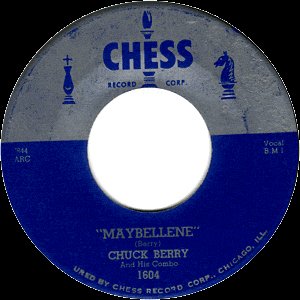
October 9: Chuck Berry, "Maybellene"

Artist: Chuck Berry
Song: "Maybellene"
Album: Maybellene (single)
Year: 1955


CLICK HERE TO LISTEN (will open in new tab)


While all songs and artists have their wide range of origins, in the end, nearly every song that has even the slightest bit of rock or pop to it can be traced back to one single artist.  Whether it was due to the brilliantly simple musical arrangements, the fantastic spirit and energy behind the music, or the universally common themes of which he sang, there is no other artist in the history of music that carries the same influence and importance as the one and only Chuck Berry.  Though there were a few other artists that broke through into the mainstream with the rock sound before him, there is simply no other artist that shaped the future generations in nearly every musical aspect as one finds in the massive amount of legendary singles in the Chuck Berry catalog.  From iconic numbers like "Johnny B. Goode" to the slightly risqué "No Particular Place To Go" to the rock and roll anthem that is "Roll Over Beethoven,"one can find countless covers and re-workings of Chuck Berry songs all over the past six decades of recorded music.  Yet try as they might, none even come close to the fantastic energy and honest sound that one finds within the Berry originals.  Though nearly every song he ever recorded can be labeled as a "classic," there is one song that stands above the rest in terms of both lasting impact as well as the initial significance to the formation of rock music.  Pulling together every element, both musical and lyrical, that makes rock and roll so great, there is simply no other song in history that carries the same weight as Chuck Berry's 1955 classic, "Maybellene."

From the moment "Maybellene" begins, it is clearly a song unlike any other, as the quick opening riff from Berry immediately injects the attitude of the song, and the rest of his band quickly joins in with a steady, hard back-beat.  The song itself owes most of its mood to the drumming of the great Jasper Thomas, as it is his hard hitting rhythm that drives "Maybellene."  When combined with the lyrics, one can easily feel each drum beat sound like someone hitting the side of their car whilst driving and listening to the song.  Adding a second layer to this sound as well as to the sense of movement is the bass playing of Willie Dixon, and their combined effort easily makes them one of the finest rhythm sections in all of music history.  If one listens carefully, there is pianist Johnnie Johnson playing, yet his contributions are largely buried under the other performers.  It is somewhat due to the volume of the rhythm section and guitar that makes "Maybellene" so significant, as it is one of the more "in your face" recordings of the era, and is one of the key reasons it retains its impact all these decades later.  Berry's brief solo highlights the deep groove on the song, and the slight distortion on his guitar is nothing short of perfect.  Needing no fancy studio tricks or lengthy instrumental passages, "Maybellene" proves that the true magic of rock and roll lies within simple, honest, and high energy arrangements.

Along with composing what remains one of the most perfect musical pieces in history, "Maybellene" is made all the better due to the fantastic voice and equally brilliant lyrics from Chuck Berry.  Well before the advent of any studio manipulation, Berry has one of the most pure voices in history, and there is never any mistaking him when he is singing.  Combining a youthful energy with a clear nod to blues vocalists, Chuck Berry brings as much soul and spirit at any other singer in history.  It is due to this straightforward, honest approach that his songs gain an unrivaled sense of authenticity, and many of his songs take on an aura of being autobiographical.  However, though both the music and vocals on "Maybellene" are legendary, it is the lyrics of the song that make it a true classic.  In short, "Maybellene" boasts everything that "is" rock and roll, as it speaks of fast cars, fast women, and the frustrations of love and lust.  The fact that Chuck Berry delivers this with the energy and slight humor that he does is what catapults the song far above its peers, and it is also why one can look to "Maybellene" as the foundation for the entire "idea" of rock and roll.  The words Berry sings takes the listener on the high speed pursuit in his V8 Ford, and from the rain to the thrill of the chase, "Maybellene" is able to mesmerize listeners unlike any other song in history, solidifying its place as "the" ultimate rock and roll song.

Truth be told, "Maybellene" is actually inspired and adapted from another song, as Berry adapted it from the traditional fiddle-folk tune, "Ida Red."  For a number of reasons, this fact is largely unknown, though Berry has openly admitted it throughout his career.  However, this only goes to prove the roots from whence rock and roll music came, and the similarity between the two songs is so distant that unless you are told firsthand, one would rarely connect the two.  The unmatched status of "Maybellene" is further reinforced by the fact that when it was released in July of 1955, it achieved what is seen as the "Triple Crown," as it simultaneously topped the pop, country, and R&B charts.  This is an achievement that never been matched, and the song itself sounds as fresh and enjoyable today as it did nearly sixty years ago.  Furthermore, "Maybellene" was able to break down many racial barriers, as the songs' protagonist is racially and geographically ambiguous.  It was due to this fact that Chuck Berry became one of the first musicians to regularly play in both sides of the segregated music clubs that were prevalent at the time.  In nearly every aspect, "Maybellene" completely changed the entire face of popular music, and all these decades later, the song still stands as one of the greatest and most influential recordings.  From the simple, yet unforgettable musical arrangement to the trend-setting lyrics, there is simply no other song in history that can boast as much impact or true musical perfection as one finds in Chuck Berry's iconic 1955 single, "Maybellene."