Friday, April 16, 2010

April 16: Busdriver, "Imaginary Places"

Artist: Busdriver
Song: "Imaginary Places"
Album: Temporary Forever
Year: 2002


CLICK HERE TO LISTEN (will open in new tab)


While one can make the case that it is not easy to be original or unique in any genre, one can similarly argue that there is perhaps no genere in which it is more difficult than that of hip-hop.  Largely due to the fact that the genre is filled with countless "wannabes," a majority of the hip-hop scene simply watches for what style is "in" and copies it, hoping for similar success.  Therefore, many of the most creative and unique artists end up having little more than a "cult" following, with an extremely small number breaking through into mainstream success.  Yet it is within these so-called "underground" acts where the true spirit of the hip-hop genre lives, and where new ideas and musical experiments are carried out with the greatest talent and most courageous emcees on the planet.  Bringing undeniable talent and in most cases, the most creative and intelligent rhymes anywhere in the hip-hop scene, these "underground" talents stand as the driving force behind any true progression of the hip-hop style.  Among these brilliant, yet much maligned performers, there is one who stands far above his peers for everything from his delivery style to the content of his rhymes to the beats and music over which he flows.  Having released a handful or records, containing some of the most exciting and mind-blowing hip-hop in history, if one wishes to consider themselves a "true" hip-hop head, then the music of Busdriver must be in their collection.  Among his impressive catalog of dizzying lyrical treats, Busdriver truly outdoes himself on the stunning and wonderfully original 2002 track, "Imaginary Places."

In an era when all creativity has been shunned in favor of a bland, loud bass thump and high-treble keyboards, "Imaginary Places" is well beyond a breath of fresh air.  Unquestionably, the first thing that catches your ear is the fact that the song is based around a looping flute progression.  This alone should be enough to make the song amazing, yet the fact that the hook being played is, in fact, completely lifted from Johann Sebastian Bach's "Minuet and Badinerie Orchestral Suite No 2 in B Minor."  Though one might write this off as a "one trick" move, near the end of the song, during the absolutely superb "DJ breakdown," the flute progression switches to Paganini's "5th Caprice," and this shows that Busdriver and his D-Styles have exceptionally wide knowledge of all forms of music.  Yet in some ways, it is not so much "what" the flute is playing as how insanely fast it is being played that is so impressive.  One must wonder if Busdriver's rap-pace is pushing the flutist faster, or if it is vice versa, as the performance is truly unlike anything else in any genre.  The flute is actually performed live on the track by Josef Leimberg, and the contrast in styles between the flute and the record scratching stands as one of the most fantastic musical pairings ever recorded.  Along with the clashing classical and modern hip-hop sounds, "Imaginary Places" gives a nod to the mainstream trends with a bass kick that rolls beautifully across the track.  While it is far more subtle than nearly anything else at the time, the song "hits" just as hard as a majority of hip-hop songs, yet it is able to do so in a more understated, musically fitting manner. 

Playing a perfect compliment to the completely unorthodox musical backing, there is simply no other emcee in history that quite compares to Busdriver.  From his lightning fast delivery, to his almost tongue-in-cheek attitude, to some of the most thought provoking and truly unique lyrics ever, Busdriver stands high above his peers in nearly every aspect.  Using a handful of different vocal inflections on "Imaginary Places," as well as one of the most brilliantly amusing one liners in music history, Busdriver has a voice and delivery style that are instantly recognizable.  On every rhyme, his voice brings with it an innate feel of intellectual prowess, an aspect that is nearly void elsewhere in the genre.  Rhyming at a speed that is far beyond that of anyone else, the fact that he is able to spin so much content and emotion into this words also pushes Busdriver into a category all his own.  Throughout "Imaginary Places," Busdriver puts on display his wide range of writing themes, from the completely absurd to gloriously crafted social critiques like the somewhat subtle lines, "...HMO how I hate him so, he wants to charge me for a halo..."  Lines like this can be interpreted on many different levels, and it is complex ideas such as this that make Busdriver nearly peerless when it comes to writing.  Later in the song, Busdriver even takes a quick swipe at the image-conscious, materialistic society when he drops the lines, "...she's not in love but I thought that she was...she doesn't love me because I don't have the right haircut..."  The pace at which he spits these rhymes is absolutely stunning, and the combination of all this together makes "Imaginary Places" one of the most uniquely impressive hip-hop tracks ever recorded.

Over the decades, truly talented emcees have proven that regardless of the mainstream sound, there music will be heard as it simply cannot be ignored.  Performers like Mos Def, Common, and Jurassic 5 have pushed this idea into more large-scale success, and proved that there is a market for "smarter," more original hip-hop music.  Leaving the mindless lyrics and over-done bass to others, Busdriver is easily among this elite group of performers, and in many ways, he rises far above them.  Bringing what is unquestionably one of the fastest rhyme deliveries in history, both literally and metaphorically, Busdriver leaves the competition in the dust with tracks like "Imaginary Places."  His ability to keep the mood light, and yet drop some of the most thought provoking rhymes ever makes him one of a handful of rappers that simply cannot be ignored.  Though it may seem a silly thought at first, his spoken line of, "...kids...if you really want to piss off your parents, buy real estate in an imaginary place...," the fact of the matter is, upon deeper thought on the idea, it is a clear call, encouraging youth to follow their interest in the arts and "dreaming" as opposed to simply "giving up" on their dreams and following "what" their parents think is best for their future.  Perfectly balancing tone, speed, and unrivaled writing skills, there are few artists that even come close to the overall talent level of Busdriver, and he proves that the "future" of the hip-hop scene is being pieced together far away from the mainstream sounds.  A true gem of the hip-hop genre, few songs are as phenomenal on as many levels as one finds in Busdriver's extraordinary 2002 track, "Imaginary Places."

Thursday, April 15, 2010

April 15: Joey Ramone, "I Got Knocked Down (But I'll Get Up)"

Artist: Joey Ramone
Song: "I Got Knocked Down (But I'll Get Up)"
Album: Don't Worry About Me
Year: 2002


CLICK HERE TO LISTEN (will open in new tab)


Though it is quite understandable, the reality is, it is a very rare occasion when a band or artist goes into a recording session and knows that the album on which they are working will be there last.  Therefore, a majority of artists rarely get to record their "swan song," and the few instances on which this trend is bucked, some of the most intriguing albums in music history are the result.  Along with this idea, one can easily make the case that, at its core, the "point" of punk rock is to eliminate all of the fake "rock star" ego and get directly to the point.  Or, in other words, the point of punk rock is to be completely "no bullshit" and throughout the history of the genre, there are few bands that carried out this approach better than the one band that may be most synonymous with the entire punk rock movement: The Ramones.  While as a band, they made it well known that their 1995 record, Adios Amigos! would be their last, it would be nearly a decade later that a far more heartbreaking album and event would occur.  Remaining today one of the greatest and most recognizable frontmen in history, on April 15, 2001, Jeffry Hyman AKA Joey Ramone passed away after a lengthy battle with cancer.  Yet less than a year later, an album of his final recordings was released, and the aptly titled 2002 release, Don't Worry About Me gave fans a peek into the final thoughts of Joey Ramone.  While nearly every song on the record is absolutely fantastic, one can make an easy argument that Joey Ramone has rarely been more unguarded and heartbreaking than one finds within the words and mood of the powerful song, "I Got Knocked Down (But I'll Get Up)."

Throughout all of Don't Worry About Me, Joey Ramone presents a number of brilliant covers and originals, backed by a handful of different musicians.  Though Marky Ramone does make a few appearances on drums, for a majority of the album, Frank Furano handles the workload.  Having played in a number of different bands, Furano brings the perfect punch and aggression to the track without making it too overpowering.  Having made his name as one of the finer producers of his generation, Daniel Rey plays guitar on almost every song on the record, and on "I Got Knocked Down (But I'll Get Up)," he does a fantastic job of capturing the spirit of punk rock, with a simple, stripped down set of progressions.  Having worked with Rey previously as a member of The Dictators, bassist Andy Shernoff compliments the guitar sound, and the pairing of the two show off the ideal balance between powerful, crunching chords whilst still ensuring a strong melody throughout the song.  Though not as fast as The Ramones biggest hits, the fact of the matter is, thr spirit and overall approach of The Ramones are very much in play on "I Got Knocked Down (But I'll Get Up)," and in many ways, the song would have fit in perfectly with the rest of The Ramones catalog.  The band moves as a single entity, and they keep the song simple enough that anyone can play it, and this almost universal undertone was not only the basis for nearly all of the music of The Ramones, but of the entire punk rock movement in general.

While the musical base is solid, there is simply no getting around the fact that "I Got Knocked Down (But I'll Get Up)" is all about the lyrics and singing of Joey Ramone.  As one of the few artists who sounds almost exaclty like he did at the beginning of his career, there is no mistaking the voice of Joey Ramone, either in tone or his unique approach to singing.  His unique, clearly untrained voice embodies everything that it means to be punk rock, as much like the words which he sings, it is straightforward and many of his off notes and strange vocal inflections are left on many of the songs he recorded over the decades.  Yet one other constant of the vocal work of Joey Ramone was the fact that there was always a clear connection to the words, and one can make the case that he never sang a song to which he could not somehow relate.  With "I Got Knocked Down (But I'll Get Up)," one can easily say that he never sang a more personal or meaningful song.  Leaving nothing to question, the song was clearly written during one of his many stays in the hospital while he battled his illness.  Standing defiant in a way which is the epitome of the true punk spirit, Joey sings, "Sitting in a hospital bed...I want my life...it really sucks, it really sucks..."  This blunt, almost harsh wording serves as a testament to the fact that, even when faced with death, Joey Ramone still refused to "give in" and change his writing style, sticking to his more simple, no-frills approach.  Though "I Got Knocked Down (But I'll Get Up)" is unquestionably one of the most heartbreaking recordings ever, in the true punk spirit, one can also feel a sense that Joey was "ready" for the inevitable, and with an album title like Don't Worry About Me, one can almost take solace in the singing and words of the overall record.

Many have tried over the decades, but the fact of the matter is, no performer in history has ever come close to the sound and style of one of the punk rock godfathers, Joey Ramone.  Defining the genre in everything from musical approach to visual style, he remains a true icon of music, and in every sense of the word, he is completely unforgettable and unmistakable.  Joey Ramone also stands out from his peers in the fact that he was able to give the world all of his final thoughts, and they can be heard on the tragically somber and powerful posthumous release, Don't Worry About Me.  The entire album shows a man who is well aware of his fate, yet as he was his entire life, Joey Ramone is clearly not going to just "sit back" and let the illness win easily.  Sounding as sharp and powerful as he did at any point in his career, the vocals throughout the album show no signs of Joey "slowing down," and the fact that even in such a dark time, he refused to get "sentimental" shows just how perfectly he embodied the punk spirit, or perhaps more clearly, the fact that Joey "was" punk rock.  Creating what can almost be seen as an anthem for anyone who is facing any sort of illness or similar inevitable tragedy, "I Got Knocked Down (But I'll Get Up)" is wonderfully defiant, and even the title alone is almost a middle finger to his illness, as one can feel Joey Ramone almost saying, "come try and take me."  Though he sounds just as good as he did at any point in his long career, one can hear just how personal the song is, as there has rarely been as sincere and powerful a vocal as one finds on Joey Ramone's tragically inspiring 2001 recording, "I Got Knocked Down (But I'll Get Up)."

Wednesday, April 14, 2010

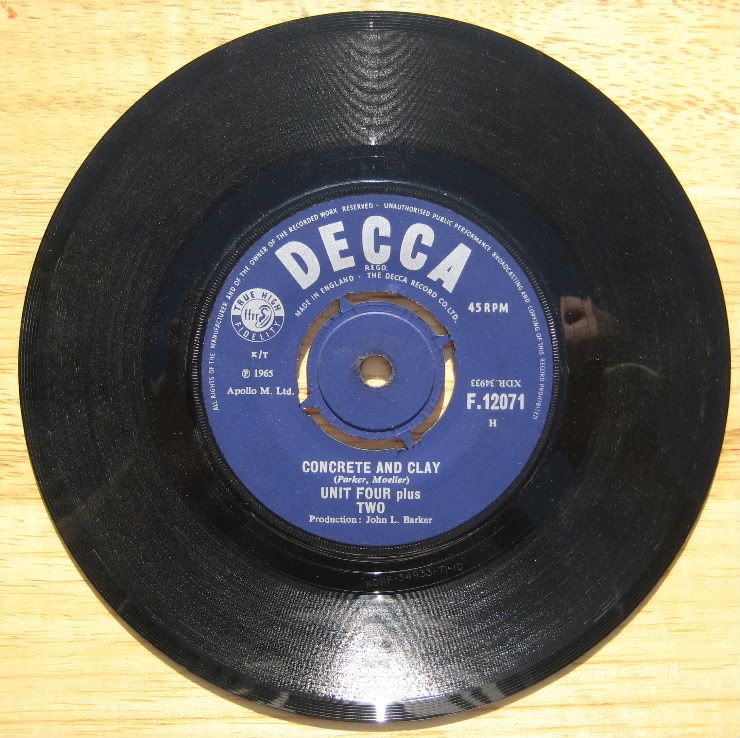
April 14: Unit 4+2, "Concrete And Clay"

Artist: Unit 4+2
Song: Concrete And Clay
Album: Concrete And Clay (single)
Year: 1965


CLICK HERE TO LISTEN (will open in new tab)


Throughout the course of music history, there is perhaps no more a long running and well known phenomena than that of the so-called "one hit wonder."  In nearly every aspect, success of this type is absolutely impossible to predict, and if one looks at the history of this idea, it is filled with some of the strangest and most diverse musical contributions one will find anywhere.  Though many consider the "one hit wonder" a new idea, as it is far more common in "the era of the single," the truth of the matter is, "one hit wonders" are as old as music itself, and some of the most unique songs in history come from the earliest uses of this term.  Case in point: the short-lived 1960's acoustic/electric group Unit 4+2.  Reaching their creative high-point at the height of the "British Invasion," few bands so perfectly exemplify the idea of "too much, too soon," and both the band and their biggest song remain largely hidden gems within the overall history of recorded music.  From their days as a simple acoustic duo, to their sudden rise to fame, the group played a rather "standard" fare of music until they found themselves as a sextet in the studio and ended up recording what is without question one of the most uniquely wonderful singles in music history.  Combining together a number of different genres and musical instruments, there is simply no other song that sounds quite like Unit 4+2's 1965 hit, "Concrete And Clay."

If there was ever a point in history where a "standard" sound had been solidified within pop music, it was the brief period following the "arrival" of The Beatles.  The fact of the matter is, anyone and everyone wanted to sound like them, and if one inspects record sales from those few months, the trend of similar music succeeding is quite clear.  Yet this is also the perfect "breeding ground" for the one-hit wonder, and "Concrete And Clay" perfectly fits the situation.  At its core, the song is more a bossa nova than it is anything resembling a rock song, as the swinging rhythm from drummers Hugh Halliday and Bob Henrit is one of the most infectious beats in history.  Punctuated by the granddaddy of all non-rock instruments, the triangle, "Concrete And Clay" is without question one of the most instantly recognizable songs in history.  The interplay of the acoustic guitars on the song reinforces this Latin feel, and the contrast of the drumming and guitars is unlike anything else in recorded history.  The overall tone of the song constantly shifts from an almost Elvis-era croon to something that almost resembles a "true" rock sound, and the fact that this is coming from a group that is almost completely acoustic in nature makes it even more inexplicable.  Regardless, the success of the song is not all that surprising, as the rhythm and melody are truly irresistible, and offered a fantastic contrast to the sound that a majority of other bands were making at the time.

Providing a fantastic contrast to the unorthodox musical arrangement, the vocal work throughout "Concrete And Clay" is more straightforward, and the leads and harmonies are nothing short of perfect.  Led by vocalist Brian Moules, the singing on the song brings forth the "classic" 1960's sound, and it is clear that Moules possessed one of the most purely beautiful voices in music history.  Again walking the line between crooning and a more aggressive singing style, there are moments when the group harmonies are almost reminiscent of the sound the Beach Boys would make famous, and it is perhaps due to this amazing musical texture that the song found success.  It is during the bridge section of "Concrete And Clay" that the Elvis comparison becomes more obvious, and yet it is also clear that the group is in no way attempting to "copy" The King, it is just the natural result of their wonderfully unique sound.  The other key aspect to the success of "Concrete And Clay" lies within the brilliantly crafted lyrics, and these words quickly make the case for the team of Tommy Moeller and Gregg Parker being one of the finest writing duos in history.  The lyrics are nothing short of beautiful, and it is one of the more fast-paced and oddly arranged love songs in history.  The chorus of "...the concrete and the clay beneath my feet begins to crumble, but love will never die...because we'll see the mountains tumble, before we say goodbye..." is without question one of the most touching lyrics ever penned, and all of "Concrete And Clay" is filled with similarly moving, original musings on the theme of true love.

While the list of "one hit wonders" throughout music history is massive, those songs that were able to top the record charts are comparatively small, and it places those elite tunes into a musical category all their own.  With "Concrete And Clay" falls into this list, it rises quickly to the top, as one must take into further account that Unit 4+2 achieved this unique accomplishment in a year in which more than half a dozen of the number one singles came from either The Beatles or The Rolling Stones.  The fact of the matter is, such an achievement puts Unit 4+2 into a class all their own, as one cannot deny the fact that every aspect of the song is wonderfully unique, and there has never been another recording that sounds even remotely like "Concrete And Clay."  Based around a heavy Latin influence, the acoustic guitar work brings with it a very "Spanish" sound and rhythm, and the mulitple percussionists further this mood, making the song swing in an era when songs "rocked" more than "swung."  Perhaps the success of "Concrete And Clay" is due to the fact that it defied so many of the trends of the time, yet remained impossible to ignore as every aspect of the song is unforgettable, and it is one of those songs that "gets stuck in your head," but in a good way.  Supported by some of the most original and truly heartfelt comparisons like "...you to me, are sweet as roses in the morning..." as well as a vocal track that is nothing short of stunning, there is simply no denying the fact that Unit 4+2's 1965 hit, "Concrete And Clay" is one of the most uniquely amazing songs ever recorded.

Tuesday, April 13, 2010

April 13: Al Green, "Tired Of Being Alone"

Artist: Al Green
Song: "Tired Of Being Alone"
Album: Gets Next To You
Year: 1971


CLICK HERE TO LISTEN (will open in new tab)


Perhaps the most difficult task in all of music is for an artist to create a song that, regardless of the era in which it is being played, does not sound dated.  While in the early years of recorded music, this was largely unavoidable due to the realities in recording technology, one can find examples of this unique talent as far back as the1950's.  These almost magical songs, that carry with them such amazing mood and tone that they resonate just as strong with each generation stand as the high water mark in terms of both recording as well as true musical talent, as the artists who recorded these classics remain the most highly respected in music history.  Standing today as one of the finest and most influential soul singers in history, there are few artists who were able to consistently find this timeless sound than the one and only Al Green.  From his moving gospel numbers to his unforgettable soul and R&B classics, one cannot mistake the voice or amazing musical arrangements of Al Green, and one would be hard pressed to find a more straightforward and unguarded singer anywhere in music history.  As the man who is largely responsible for "bridging the gap" between the Southern soul sound and the "Philadelphia soul" sound, few musicians can compare to the voice and impact of Al Green.  While he achieved his musical highpoint with Let's Stay Together, Al Green truly revolutionized the world of music with his 1971 classic, "Tired Of Being Alone."

While there is no question that on any song he sings, Al Green's amazing voice becomes the focus, one cannot overlook the superb music over which he sings, and on "Tired Of Being Alone," the music plays an even larger role.  Truth be told, Gets Next To You was the first collaboration between Green and producer/arranger Willie Mitchell, and it is on this album that the duo found the sound that would make them both famous.  On this album, Green seems to leave behind the gritter Southern sound, and thanks to the Hi Rhythm Section, "Tired Of Being Alone" truly sounds like nothing else that had been previously recorded.  Bringing a smoother, more sensual sound, the song sets a deep, soulful groove from the onset, and the punctuation from the horns plays a sensational contrast.  The Hi Rhythm Section, which were in essence the house band for Hi Records, was anchored by the Hodges brothers, and the bass of Leroy Hodges on "Tired Of Being Alone" is simply too good to go unnoted.  Though it may seem "standard" in modern times, the fact is, before this recording, such a "fat" bass sound had never really been recorded, and it is his sound that gives the song such a warm tone.  Similarly, the guitar from Mabon "Teenie" Hodges is also unlike anything else previously recorded, as the tone is so perfectly clean that it brings to mind the early work of Ike Turner.  Rounded out by legendary drummer Al Jackson Jr. and The Memphis Horns, if one is able to get past Green's extraordinary voice for a moment, one can clearly hear just how musically significant a song there is within "Tired Of Being Alone."

However, "getting past" Al Green's voice is far easier said than done, as he has without question one of the most truly beautiful voices in music history.  Amazingly unique, there is no other singer that sounds similar, and on nearly every song, he proves that every point on the vocal spectrum is well within his ability.  The fact that Al Green rarely sounds as if he is "pushing" to hit a note not only serves as a testament to his great ability, but it also gives his recordings a wonderfully honest and organic feel.  This tone is furthered by the fact that each of his songs is delivered with a frank, unguarded style that sets him far above his peers.  Truth be told, on many recordings, "Tired Of Being Alone" included, one is left to wonder just how much these lyrics hit home with Green, as the words are clearly coming from the heart, and he makes each work completely relatable by any listener.  The song is a plea for the woman he loves to return that love, but as one listens, it raises the question of whether or not Green "ran off" that love in the first place.  Perfectly capturing the emotion of the thoughts that run though a lonely mind late at night, "Tired Of Being Alone" is a lament like no other ever recorded.  Though it may seem like a simple sentiment, Green proves just how brilliant a performer he is, as he grabs the listeners heart with lines like, "...I'm cryin' tears, all through the years, I tell you like it is, honey, love me if you can..."  Each word and phrase is more heartbreaking than the one before, and Al Green conveys everything from regret to hope to the most pure and true love throughout the stunning vocals on "Tired Of Being Alone."

One can easily make the case that there are certain songs in history that are so timeless, so beyond description, that they will "never die" as the generations pass.  Sometimes due to a unique musical arrangement, sometimes due to a vocal that is truly "classic," these songs remain the greatest in history, and yet because there are so few, it is clear that making a song of this caliber is perhaps the hardest thing one can do in music.  Though he had already gained a bit of notoriety with a handful of singles, it was Al Green's 1971 classic, "Tired Of Being Alone" that truly catapulted him into the spotlight and almost instantly cemented his name as one of the greatest soul singers in history.  Bringing a more relaxed, smoother sound than any of his peers, Green largely "rewrote the books" on how soul music could sound, and his singing paved the way for countless artists that followed his formula.  Yet even though many tried, none could ever replicate Green's sound, and this is largely due to the fact that none of them had the luxury of the sensational musicians playing behind Green on songs like "Tired Of Being Alone."  Perhaps only rivaled by the legendary Funk Brothers, The Hi Rhythm Section are without question one of the greatest bands in history, and the distinctive musical approach and tone which is displayed on "Tired Of Being Alone" truly revolutionized music, though their contribution is often lost being the mesmerizing vocals of Al Green.  In short, the fact that it is still as relevant and "fresh" today as it was nearly forty years ago proves the true power and musical mastery that is contained within Al Green's legendary 1971 classic, "Tired Of Being Alone."

Monday, April 12, 2010

April 12: Daily Guru, "Gurucast #15"

CLICK HERE TO LISTEN (will open in new tab)


(Left Click (PC) or Command-Click (Mac) to save it to your desktop...it's about 75MB)

One hour of amazing music and SOME commentary from "The Guru" himself.

TRACKLIST:

1. Thin Lizzy, "The Rocker" The Man & His Music, Volume 1
2. Eddie Cochran, "Summertime Blues"  Summertime Blues
3. The Lurkers, "Ain't Got A Clue"  Fulham Fallout
4. The Upsetters, "Knock Three Times"  Trojan Upsetter Box Set, Disc 1
5. Wirepony, "Some Lightning" Right Hook of Love
6. Al Green, "Let's Stay Together"  Let's Stay Together
7. Tom Petty, "Big Weekend"  Highway Companion
8. The Clash, "Garageland"  The Clash (UK)
9. Joe Lally, "Tonight At Ten"  Nothing Is Underrated
10. Art Tatum, "Tenderly"  20th Century Piano Genius
11. Jay-Z, "Heart Of The City (Ain't No Love)" The Blueprint
12. The Ruts, "In A Rut"  Grin And Bear It
13. Telefon Tel Aviv, "I Lied"  Map Of What Is Effortless
14. Johnny Hobo And The Freight Trains, "Untitled"  Johnny Hobo And The Freight Trains
15. The Blasters, "Marie, Marie"  American Music
16. Michael Jackson, "Smooth Criminal"  Bad
17. The Ramones, "Life's A Gas"  Adios Amigos!

Sunday, April 11, 2010

April 11: The Ruts, "West One (Shine On Me)"

Artist: The Ruts
Song: "West One (Shine On Me)"
Album: Grin And Bear It
Year: 1980


CLICK HERE TO LISTEN (Full Version) (will open in new tab)


CLICK HERE TO LISTEN (7" Version) (will open in new tab)


Though the overall list is quite long, there are a handful of bands from music history that stand far above the rest when it comes to the question of "how was this not the biggest band in the world?"  With each band having their own special circumstances for being in this category, there are also a number of groups for whom this question has no answer.  In many cases, bands that fit this description were making music during one of the periods of great change within music, yet for one reason or another, in retrospect, they stand out so far from their peers, that it simply does not make sense that they remain comparatively unknown.  In the overall picture of music history, there is perhaps no band that better fits this scenario than one of the truly amazing and sonically brilliant groups of the late 1970's punk explosion: The Ruts.  Taking the attitude of punk and infusing it with a heavy dub feel, as well as bringing a pop sensibility like no other band of the genre, the group only released a pair of records before lead singer Malcolm Owen met a tragic fate, yet every song on these two albums is absolutely fantastic.  Responsible for one of the all-time punk classics, "Staring At The Rude Boys," The Ruts took on every aspect of society in their music, and after hearing just one song, anyone can realize that this group was far beyond any of their peers.  While each song in their catalog is truly amazing, no song better portrays The Ruts' ability to walk the line between punk, dub, and pop than what would be their final single: the absolutely superb, "West One (Shine On Me)."

In reality, there are actually two rather distinct versions of "West One (Shine On Me)," as one of the biggest differences between The Ruts and most other punk bands was the fact that their songs were musically superior and were rarely the "standard" two-minute punk style.  The full version of the song runs nearly six minutes, placing a spectacular musical breakdown about two-thirds of the way through the song, and clearly, a song of this length is rarely "radio friendly."  Pulling out this breakdown, as well as other portions of the music, the 7" version of "West One (Shine On Me)" clocks in and just under three minutes, yet still manages to convey all of the power, emotion, and musical brilliance of the song.  From the moment the song begins, it is clear that The Ruts are also far beyond their peers in the fact that they are always moving as a single musical unit, and the tone and sound they create is rarely anything short of moving.  "West One (Shine On Me)" is no different, and the uniquely-toned guitar from the late Paul Fox is easily one of the most distinctive aspects of the bands' music, and on this song, it also brings an overwhelming sense of urgency.  Working in just as powerful a manner, John "Segs" Jennings winds his bass around the guitar and drums and his progressions have clearly influenced countless players in the years that followed.  Truth be told, drummer Dave Ruffy rarely sounded as fantastic as he does here, and the amazing pace, combined with his unique fills catapult him high atop the list of punk drummers.  The solos, particularly those from Fox, are another way in which the group is like none of their peers, and these breakdowns and solos stand among the finest ever of any musical genre.

Much like the music of his bandmates, the voice of Malcolm Owen is like nothing else in music history, and it stands as one of the most perfect combinations of music and vocals.  It is almost impossible to understand without experiencing firsthand, but Owen's voice truly "just fits" with the music over which he sings, and the way he approaches the vocal is also nothing short of musical perfection.  Finding an ideal balance between grit and clear singing, Malcolm Owen also conveys all the emotion one can take on every one of The Ruts' songs, and his work on "West One (Shine On Me)" is no different.  It is within his singing that one can understand just how intense the live performances of The Ruts must have been, as each word demands the utmost attention, and the tension builds and builds before exploding at each chorus, making the song far beyond "just a punk song."  Bringing images of everything from a cold, dark London night to a bar packed full of patrons and bright lights, Owen conveys amazing moods, and when the entire band joins in for harmonies, The Ruts prove to truly be a band like no other in any genre in history.  This overall mood that was far beyond anything else at the time, combined with the unmistakable voice of Owen was able to power "West One (Shine On Me)" onto the U.K. singles chart, and the song remains one of the highlights of the bands' extraordinary catalog.

Perhaps one of the reasons that The Ruts remain comparatively forgotten in music history is simply because they did not quite fit properly into any musical genre.  While the attitude behind their music was clearly that of punk rock, the music itself was far more rock and roll and every song has an undeniable pop sensibility.  Furthermore, the group was leaps and bounds beyond the "three chord" approach, as their songs were far lengthier and more musically complex than nearly anything else that even resembled punk.  Each of the three musicians in the band was unquestionably talented, and the fact that on every song, they are each so musically creative is the final piece that makes The Ruts the most "unpunk" punk band in history.  Bringing this amazing sound together, and adding in the uniquely fantastic voice of Malcolm Owen, more than three decades after their first album was released, the songs of The Ruts are still just as powerful and refreshing.  Truth be told, there has rarely been a band since that brings as much emotion and musical power as The Ruts, and even less are able to do so with as original and consistent a sound.  From the extraordinary tone and solos of Paul Fox to the playing of what is unquestionably one of the greatest rhythm sections in music history, few bands from any genre can compare to the awesome power of The Ruts, and everything that makes this band so phenomenal is captured on their final single, 1980's magnificent "West One (Shine On Me)."

Saturday, April 10, 2010

April 10: Peter Gabriel, "Big Time"

Artist: Peter Gabriel
Song: "Big Time"
Album: So
Year: 1986


CLICK HERE TO LISTEN (will open in new tab)


If there is one term that gets tossed around by music critics far more than it should it is the term "genius," and it seems that whenever an artist does something that is even the slightest bit different than the norm, this is the title they are given.  For those music fans who have some restraint when using such a word, there are only a handful of musicians in history who are worthy of such a title, and it is these elite musicians who have had such an impact on the world of music, that genres as we know them would simply not exist without their presence.  While names like Coltrane, Zappa, and Wilson are certainly deserving of such a title, there are a number of artists, that while nothing near "underground," are often overlooked as musicians of the same caliber.  In this latter group of musicians, there is one man, that even after he left his main group, proved to be even more talented than anyone had assumed, and he remains one of the most innovative and important musicians in history.  From his years in Genesis to his stunning solo work, there has never been an artist whose even remotely resembles the sonic brilliance of the one and only Peter Gabriel.  Whether it is his timeless love songs or his mind-blowing pop singles, more than thirty years after his first solo records, he continues to push the boundaries on music and create some of the most uniquely amazing songs anywhere on the planet.  When it comes to chart success, one must go directly to Gabriel's 1986 record, So, as it was this album that spawned many of his most memorable songs, among them the sonic masterpiece, "Big Time."

Truth be told, "Big Time" often gets lost in the Gabriel catalog, as it happened to be released as a single between two of his biggest hits: "Sledgehammer" and the ballad, "In Your Eyes."  While both of those songs are certainly fantastic in their own right, one can make the case that it is "Big Time" that is the most musically adventurous of the three.  While the deep grooving bassline is certainly akin to that of "Sledgehammer," on this song, it is a bit heavier and can perhaps be said to be more aggressive.  In fact, the bass playing on "Big Time" remains one of the most innovative moments in music history, as the unique tone was achieved by bassist Tony Levin and drummer Jerry Marotta both playing the same bass simultaneously.  Using one of Levin's fretless basses, Levin himself only did the fingers for the notes while Marotta hit the actually strings with drumsticks.  It is this factor that gives the sound such a percussive feel, and it is this recording that would inspire Levin to create Funk Fingers, which are small sticks that can be worn on the fingers, enabling him to play the part live in concert.  Since Marotta was engaged with bass duties, the drums on "Big Time" are played by none other than former Police and Oysterhead percussionist, Stewart Copeland.  Having played alongside everyone from Roy Orbison to Robert Plant, the guitar on "Big Time" is handled by David Rhodes, and the slightly distorted, almost ska sound he gives remains one of his most unique recordings.  The final touch to this amazing wall of sound is the keyboards, played by Gabriel himself, and the overall mood and sonic beauty of "Big Time" is truly like nothing else in music history.

As has been true throughout his entire career, Peter Gabriel possesses one of the most unique and instantly recognizable voices in the history of recorded music.  Able to easily convey any emotion, as well as work anywhere on the vocal scale, Gabriel's singing is in a class all its own, and his work on "Big Time" furthers that idea.  Not only does he sing across the musical scale on "Big Time," but Gabriel also uses a handful of different vocal approaches, from traditional singing to a sound that one can make a case is more like rap than anything else.  Perhaps most easily compared to the vocal style of David Byrne, Gabriel's sound is more melodic, but the final lyrics of the song strike the balance between more "formal" singing and Byrne's legendary rap-singing style.  This is yet another way in which Peter Gabriel showed that he was able to make music in any style as well as combine them together for an even more fantastic overall sound.  Furthering this idea that Gabriel was able to take things had had been done before and make them sound like nothing else, the lyrical theme of the song, though nothing new, never sounded as brilliant as it does on "Big Time."  Revolving around the story of one mans' quest for fame, Gabriel uses simple ideas intertwined with superb allusions to craft one of the most memorable songs in history.  Perfectly summing up not only the song, but the story of nearly anyone who has ever tried to "make it big," Gabriel songs, "...the place where I come from is a small town, they think so small, they use small words. But not me, I'm smarter than that, I worked it out. I've been stretching my mouth, to let those big words come right out."  As he weaves his tale of this shot at success, the song brilliant builds to the final, iconic final verse, and the overall sound of the song is like nothing else that Gabriel or anyone else had ever created.

Along with the extraordinary music and vocals, one cannot overlook the fact that Peter Gabriel used a newer medium with "Big Time" to prove that across all disciplines, he was truly an artistic genius.  As EmpTV had by this point taken a foothold in the music industry, Gabriel used "Big Time" to unleash one of the most memorable and truly amazing videos in history.  Utilizing everything from claymation to stop-motion to simple puppetry, the video for "Big Time" is nothing short of stunning and remains one of the finest visual-musical accomplishments ever, and one that countless musicians since have borrowed from for their own music videos.  Quite literally everything about "Big Time" is perfect, from the music to the singing to the visual interpretation, and in an era that contained a massive amount of copycat or otherwise musically unadventurous performances, it was artists like Peter Gabriel that ensured that all genres of music would continue to progress.  Using unorthodox arrangements, techniques, and instruments alongside his lifelong quest to blend together genres in new an exciting ways, Gabriel found the ideal balance between musical creativity and pop sensibility on nearly every song of his landmark 1986 record, So.  Yielding a majority of the biggest commercial hits of his career, the album is also slightly less melancholy than his previous work, which also may have played into the records' overall success.  Regardless of the reasoning, one cannot deny the absolute genius of the record, as well as Peter Gabriel himself, and one can find everything that makes him such a fantastic artist within his unforgettable 1986 single, "Big Time."